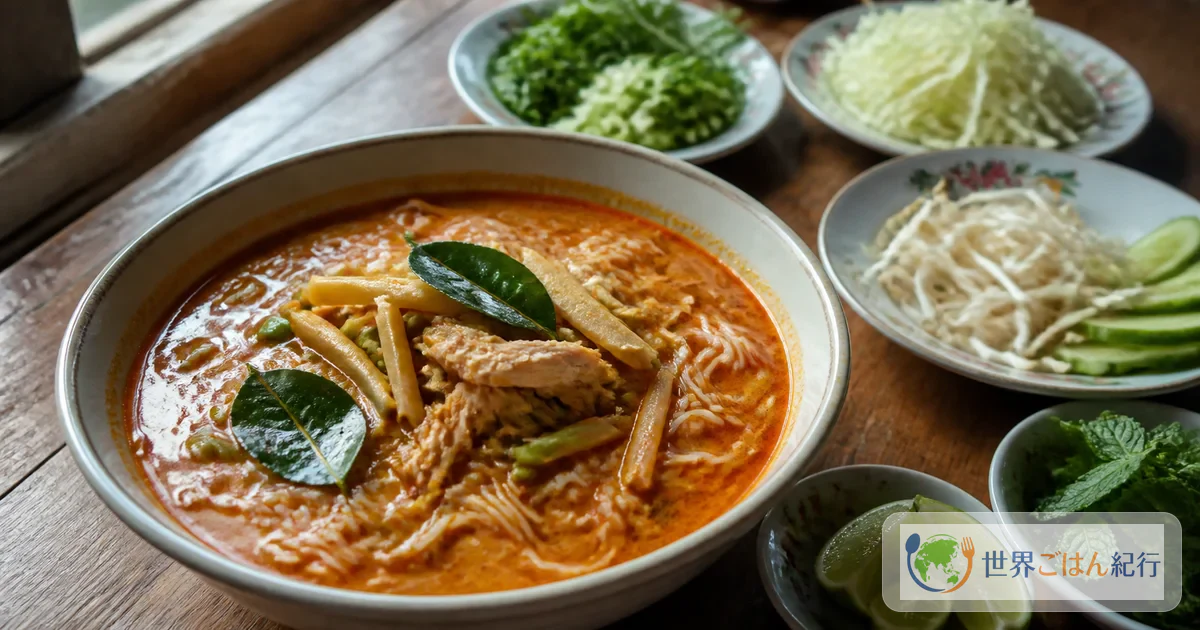
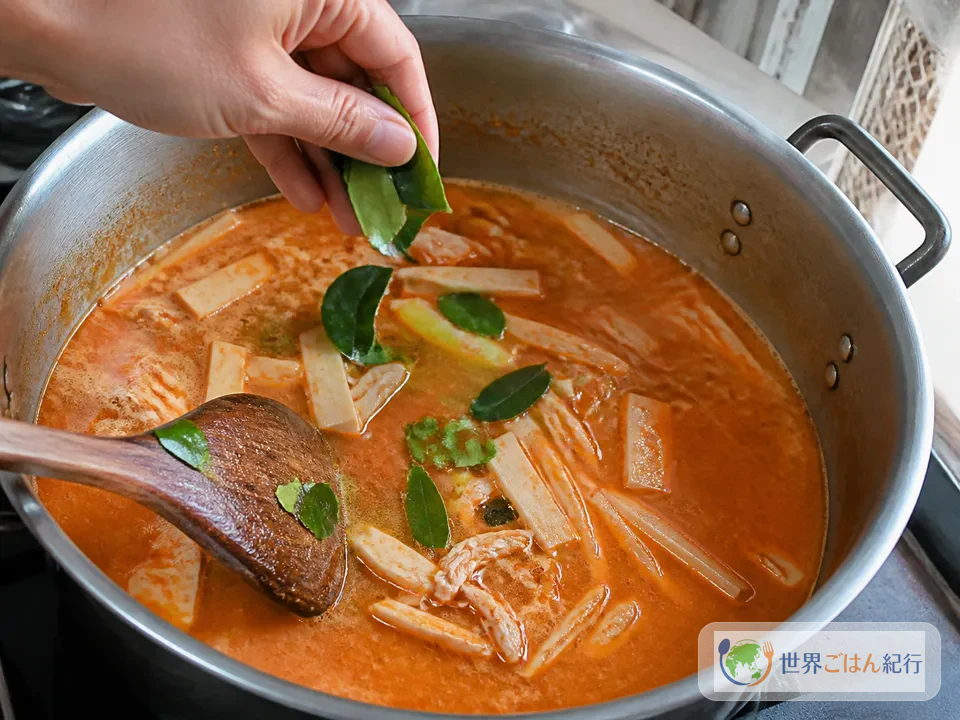
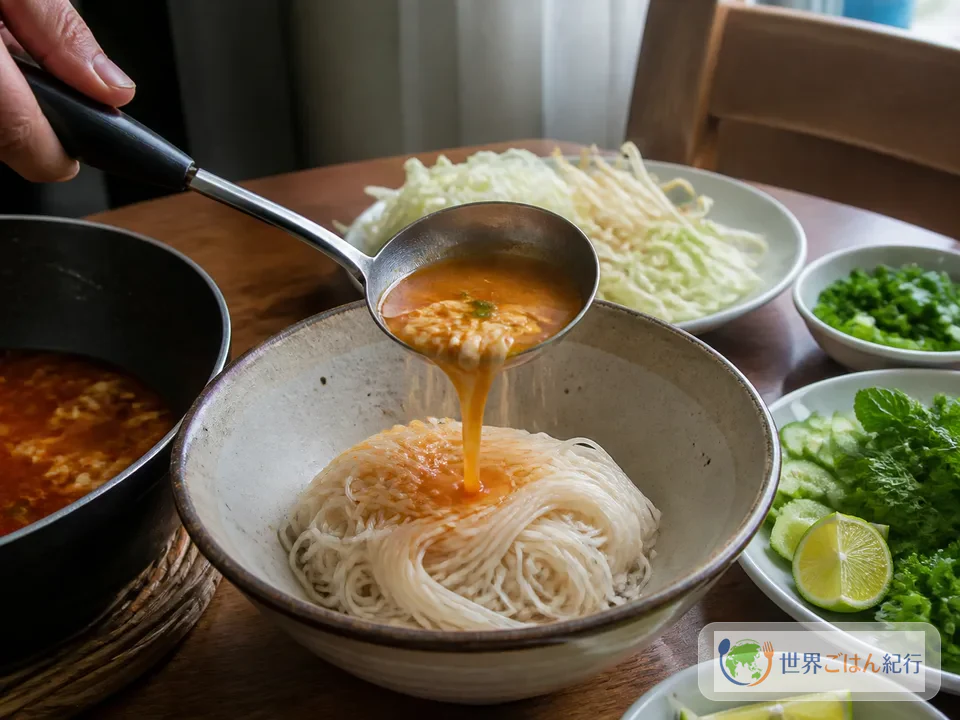
A green scent rises from the board where lemongrass has been bruised, and red powder is left in the mortar where dried chiles were crushed. Coconut milk shifts slowly in the pot, while beside the bowl sit shredded cabbage, bean sprouts, mint and lime, each on its own. This is khao poon (ເຂົ້າປຸ້ນ), one of Laos's signature dishes: a broth of chicken, fish or pork, built on an aromatic paste and fish sauce and poured over thin rice noodles. The red coconut-milk version is rich, but the noodles and vegetables never simmer in the pot, so you control how heavy each mouthful feels.
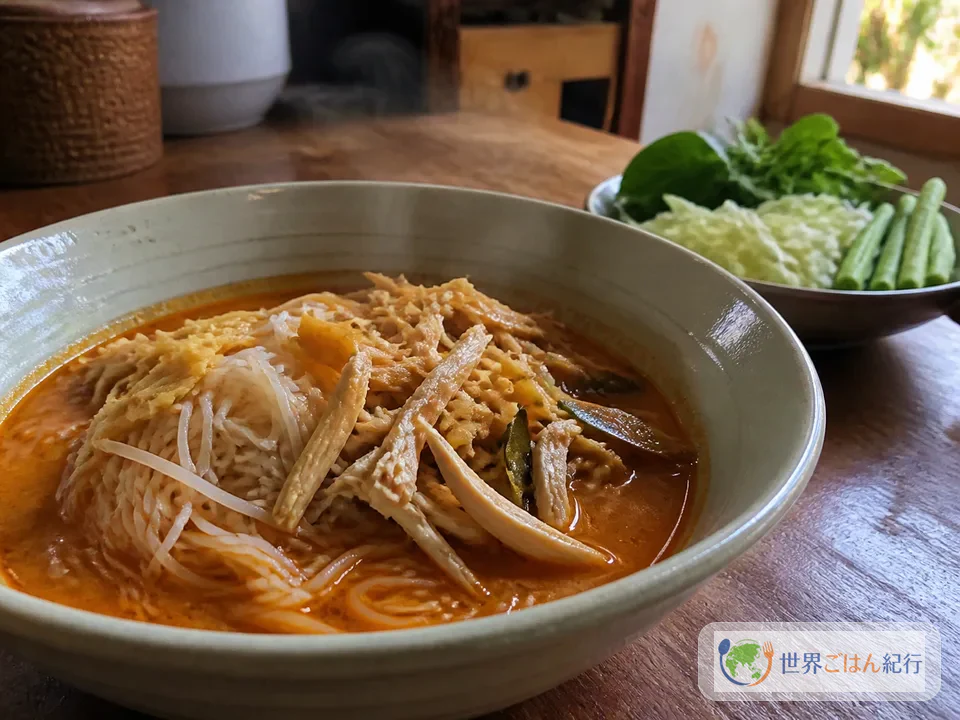
Khao poon at the Lao table
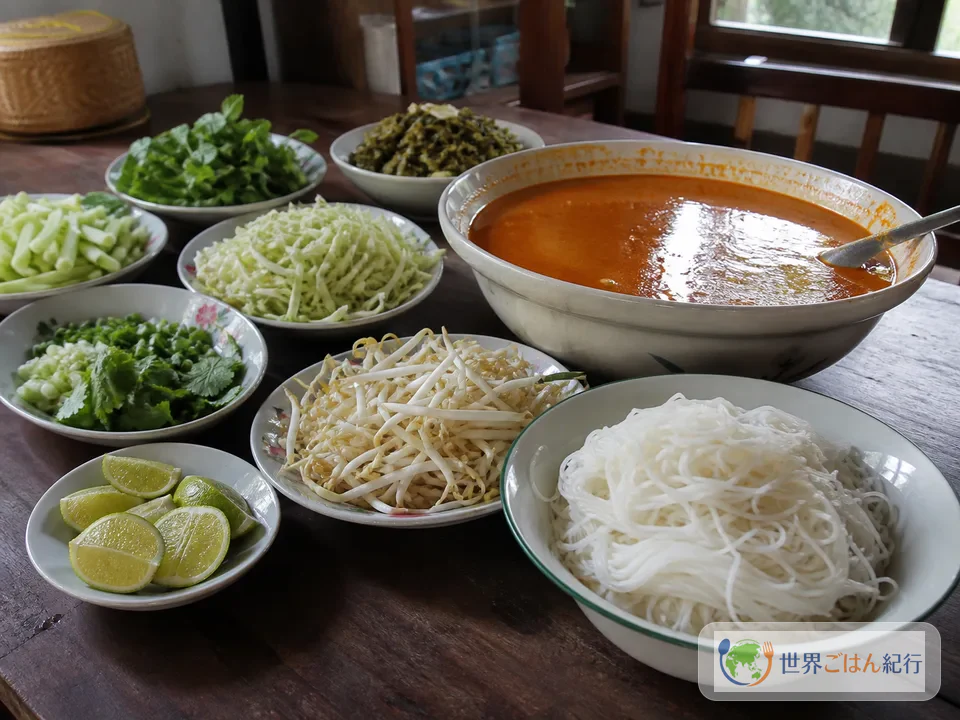
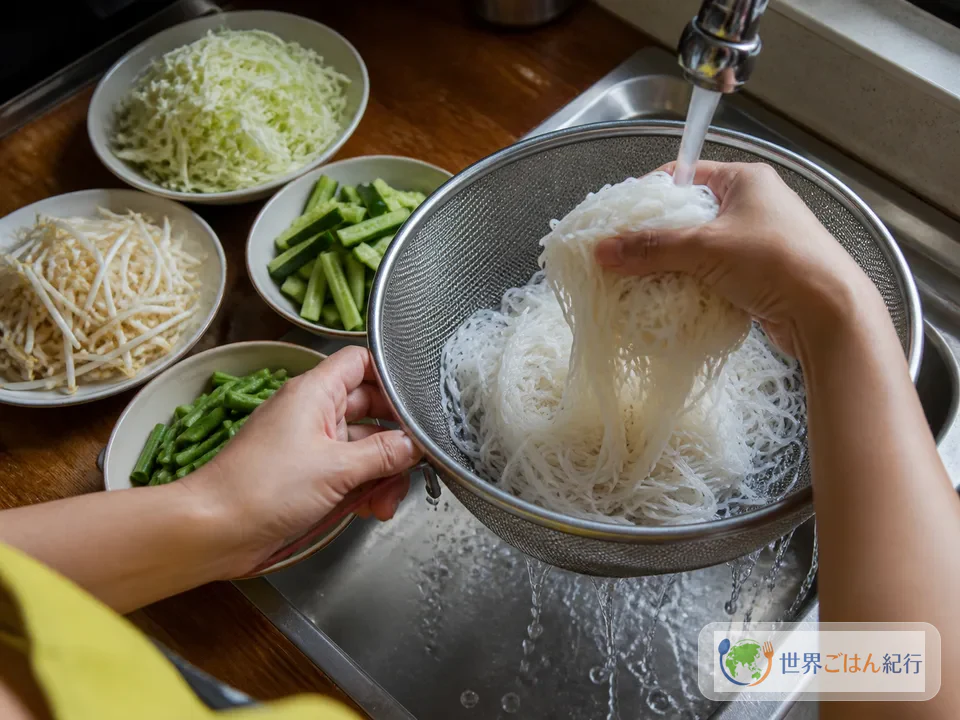
The traditional broth is made with fish, pork bones or chicken carcass, lemongrass, garlic, onion, galangal, and padaek or fish sauce. It goes over fresh khao poon noodles, dried noodles or rice noodles. Cabbage, bamboo shoots, bean sprouts, mint, long beans and lime stay out of the pot and go on the table for each person to add. The hot broth doesn't finish the flavor by itself; the green vegetables and herbs go on at the end.
In Laos, khao poon is a dish for family celebrations and Buddhist temple events. It is at its best when one person crushes aromatics, another handles the noodles and another cuts vegetables, all in the same kitchen. Rice in Laos is tied to festivals and religious ceremonies as well as daily meals, handed down over generations as a foundation of life and ritual. Here the thin rice noodles are the center of the table, soaking up the heat of the broth, the saltiness of the fish sauce and the moisture of the vegetables.
Northern, coconut and meatless versions
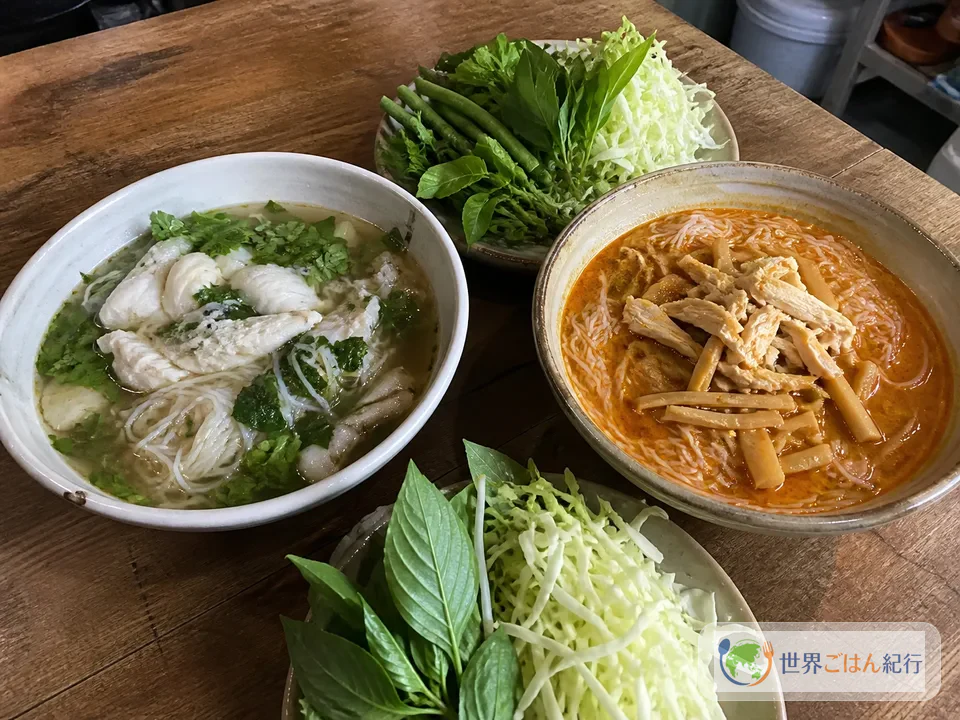
Khao poon is known as "Lao curry noodles," yet the traditional northern version contains no coconut milk at all. It is a broth rich in ingredients: fish and pork bones or chicken carcass, flaked fish, pork, and seasoning from padaek or fish sauce. In the chicken version, chicken and an aromatic paste become a red broth with coconut milk, fish sauce and makrut lime leaves. That version is close to Thailand's khanom jeen nam ya, but khao poon comes with Laos's fermented seasonings, its herbs, and the habit of serving vegetables separately.
There is a meatless version too, made with yellow split peas, mushrooms, taro and pumpkin, and a paste of coconut milk and chile stirred into the broth. Raw cabbage, long beans, morning glory, banana blossom and bean sprouts come alongside like condiments.
| How it appears | How the broth is built | How it reaches the table | Judgment for home cooks |
|---|---|---|---|
| Traditional northern style | Fish, pork bones or chicken carcass, herbs, padaek or fish sauce; no coconut | Rice noodles with many vegetables on the side | For days you want a lighter broth. Needs time to flake the fish |
| Chicken and coconut version | Chicken, aromatic paste, coconut milk, fish sauce, makrut lime leaves | Red broth with rice noodles, vegetables and mint | Ingredients are easy to gather; good for a first attempt |
| Meatless home version | Beans, mushrooms, root vegetables, coconut milk, chile | More vegetables and herbs alongside | Rebuild the seasoning without fish sauce |
Put strong fermented aroma at the center, or bring forward the roundness of chicken stock and coconut, and the same dish tastes very different. Decide how you'll build the broth before you shop, and you won't end up with seasonings you don't need.
Ingredients (serves 4)
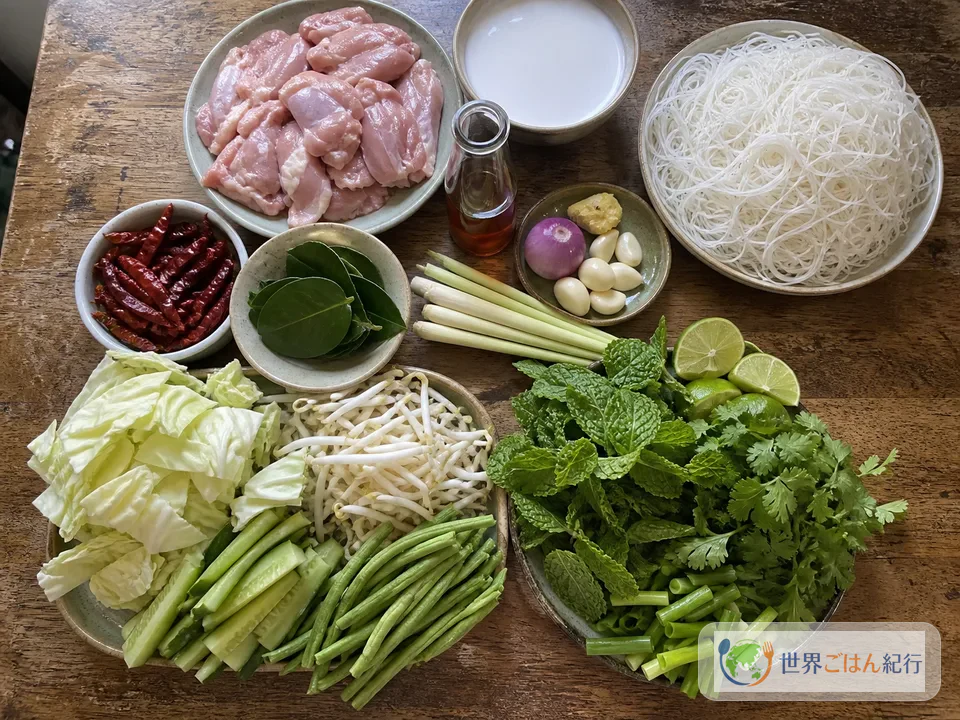
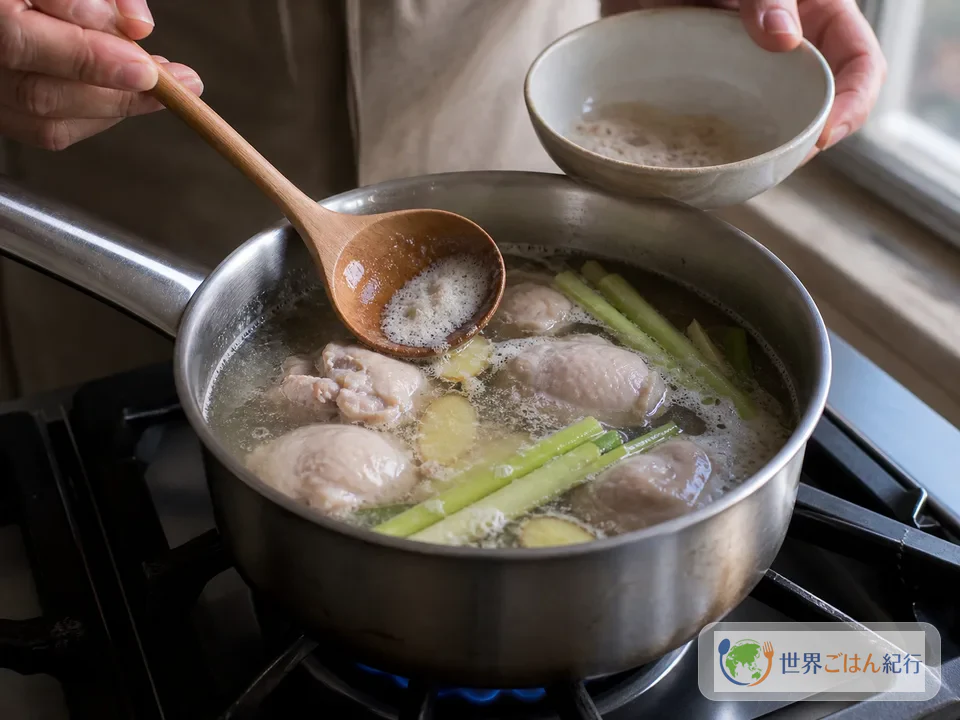
The broth is made a little strong so that it is just right once noodles and vegetables go into the bowl. Boneless chicken thigh is easy to shred after simmering; if you use breast, take it out of the pot as soon as it is cooked through.
Use whichever chicken and rice noodles you can buy nearby. Makrut lime leaves, lemongrass and fish sauce are easiest to use up if you cook Southeast Asian food regularly. For frozen items, choose ones where you can take out only what you need rather than using all at once.
Choosing khao poon ingredients
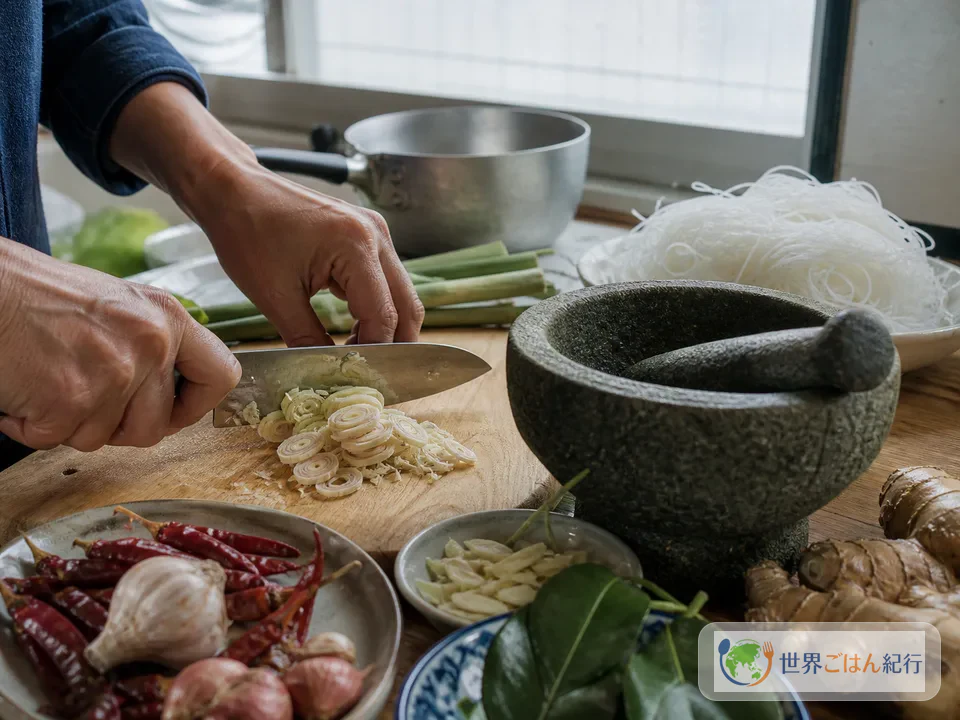
Chicken and the aromatic paste
This recipe uses chicken thigh instead of the traditional Lao fish or pork bone broth, because it's easy to handle in any home kitchen. It keeps the roundness of coconut milk and the fermented depth of fish sauce, in the style of chicken khao poon nam gai. Chicken thigh, cabbage, bean sprouts and cucumber are all in ordinary supermarkets, and coconut milk and dried rice noodles sit on the import shelves.
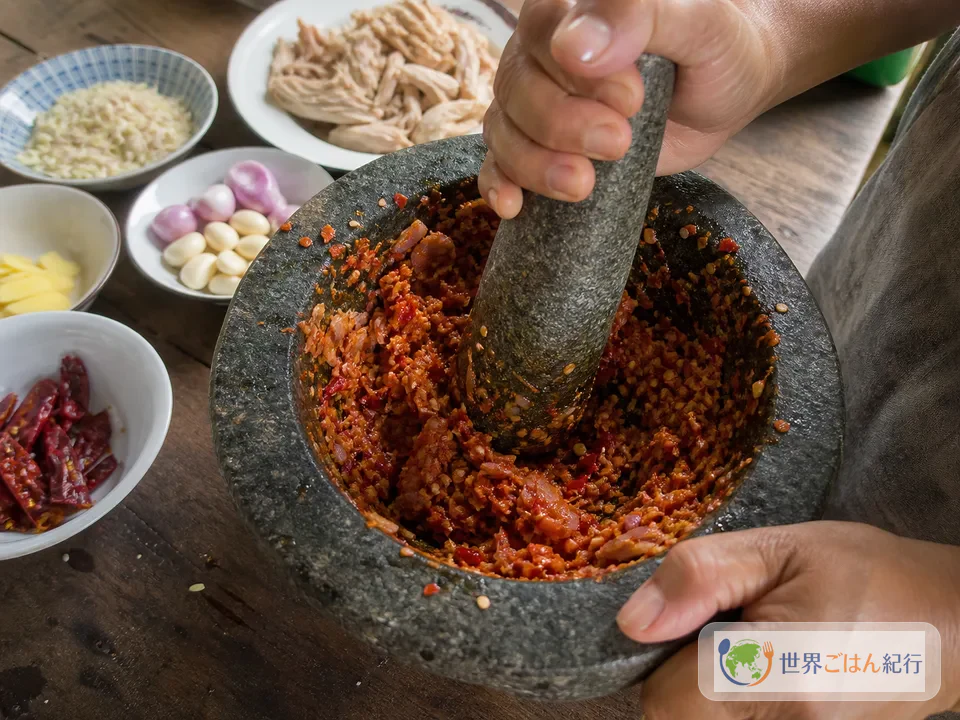
What really shapes the flavor is how you make the aromatics into a paste. Crushed chiles, garlic, onion, ginger and lemongrass spread their fragrance through the broth far better than chopped ones. Turn the soft base of the lemongrass into paste and put the rest in the stock pot.
A mortar is optional (see the FAQ for the knife method). If you often make Lao or Thai pastes, salsas or spice mixes, though, a heavy granite mortar stays put on the counter and makes it easier to crush dried chiles and onion separately. No room to store one? Skip it.
Galangal and ginger
Galangal and ginger are both rhizomes, but galangal smells closer to dried citrus and white pepper. If you find it frozen, replace 10 g of the 20 g ginger with 10 g galangal to move the aroma in that direction. The amounts work with ginger alone, too: keep the order of chicken stock, fish sauce, lemongrass and makrut lime leaves, and the dish stays close to its name.
Fish sauce, padaek and substitutes
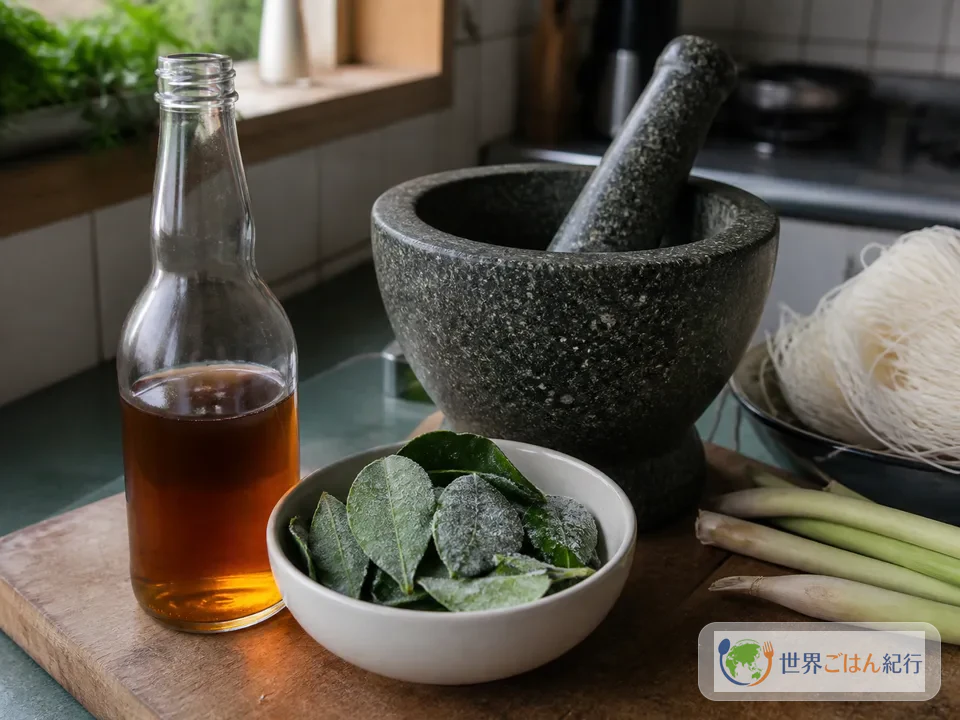
Fish sauce and padaek behave differently in the pot. In northeastern Thailand, the fermented fish known as pla ra, and in some regions as pla dek, is made by fermenting freshwater fish for a long time with salt and rice bran, and it has a strong aroma and saltiness. Padaek comes from a similar fermentation culture, but its strength and solids vary from product to product. For a first attempt, use fish sauce: it's liquid and easy to measure, so mistakes are easier to correct. Try padaek when you want more aroma.
If you'll use fish sauce in khao poon, stir-fries and glass noodle salads, a larger bottle makes sense. For a one-off, light soy sauce and salt will do. Soy sauce adds saltiness without the aroma of fermented fish, so treat it as a substitute for when you need to avoid fish, and make up the depth with mushrooms or roasted onion. If you need to avoid seafood, check the type of fish and any additives on the label.
Makrut lime leaves
Frozen makrut lime leaves let you take out only what you need. Leaf size and count vary, so check that the pack is frozen and how many it holds. Whatever is left after the 3 leaves used here can go into tom kha gai or green curry; if you'll cook this only once, a little lemon zest saves a trip. Added at the start, the leaves make the aroma too rounded, so put them in near the end once the broth has settled. Remove the hard central rib and tear large leaves to a size diners can set aside.
Method
Measure all the ingredients and thinly slice only the 3 inches (8 cm) base of the lemongrass for the aromatic paste. Wash the knife and board used for chicken with detergent before cutting vegetables. While the broth simmers, prepare the noodles and table vegetables so the noodles don't wait too long at serving.
Fixing khao poon broth and noodles
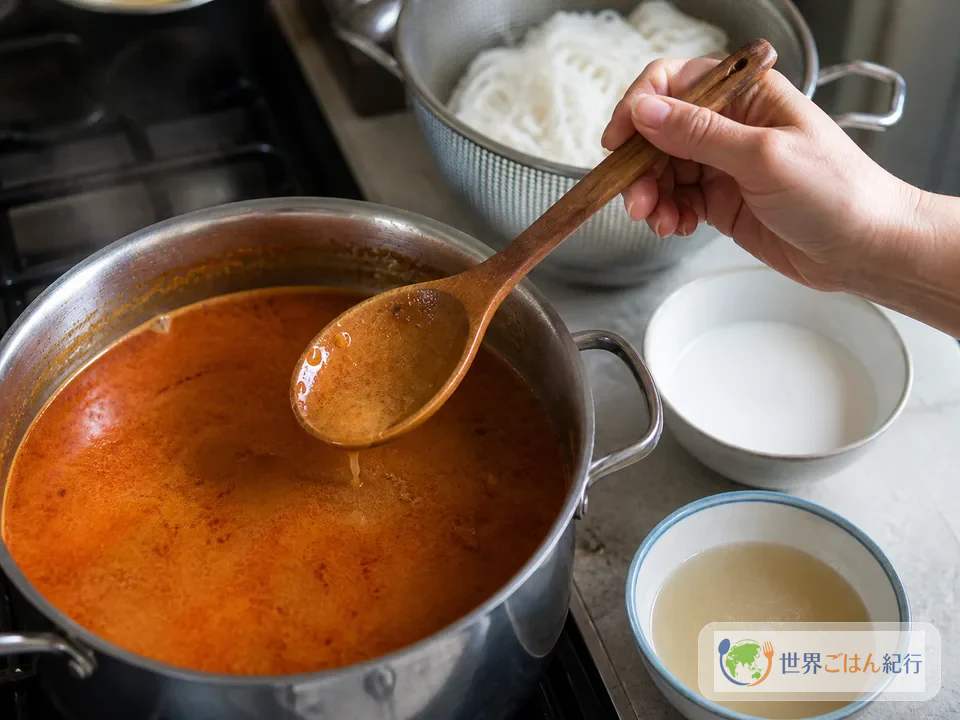
The key is to finish the broth first, then boil the noodles, and add the vegetables at the table. Noodles simmered in the broth absorb liquid, taste saltier and lose their snap. Hot broth, springy noodles and cool vegetables meeting in one bowl let you move the heat and the fish-sauce aroma at your own pace.
Boil dried rice noodles in a separate pot rather than rehydrating them in the broth. If the package says 5 minutes, taste at 4 and a half, and when the hard core has just disappeared, drain into cold water. Fresh noodles in Laos soften along with the broth, but dried ones boiled until fully soft break in the bowl under hot broth. Stop them slightly firm and start eating right after pouring.
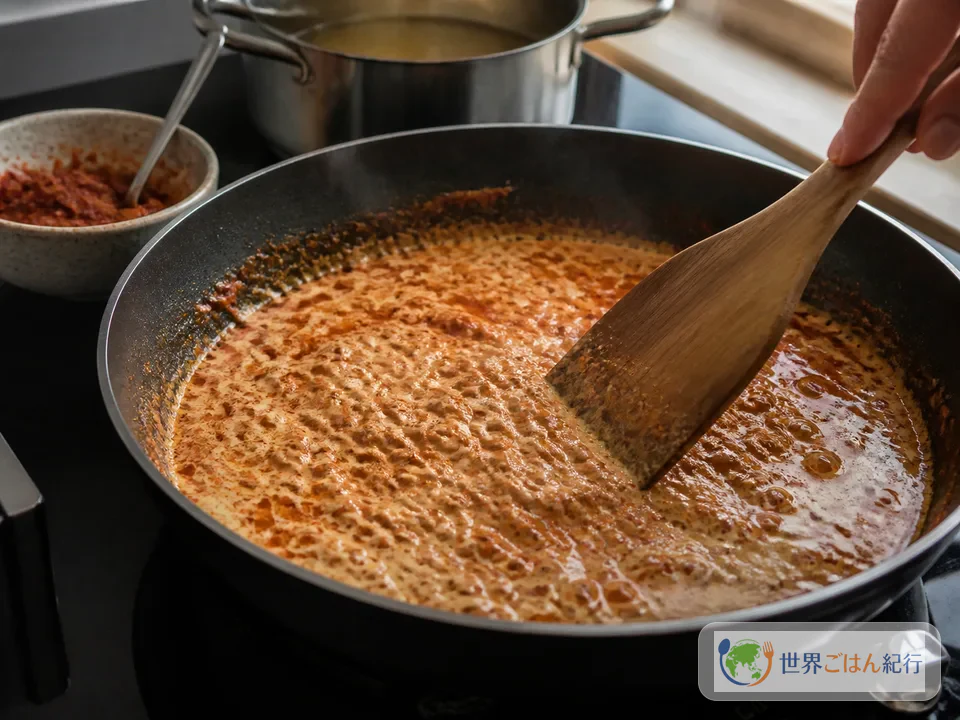
With fish sauce, coconut milk and chile in the same pot, it's tempting to correct a strong taste with sugar alone. Sugar rounds off saltiness, but it can't fix a lack of liquid or burnt aromatics. Look at the pot first and separate what can be restored from what must be remade.
| Condition | What to check | How to fix |
|---|---|---|
| Too salty | The fish sauce saltiness comes first when you drink only the broth | Add 3.5 tbsp (50 ml) at a time of unsalted chicken stock or hot water, and absorb with a little coconut milk and vegetables. Do not add more fish sauce |
| Broth is thin | It runs off the spoon at once and the aromatics don't linger on the tongue | Remove the lid and reduce over medium-low heat, 3 minutes at a time. Add stock back if it reduces too far |
| Aromatics taste raw | The green smell of onion remains | Return to the frying pan and fry over medium-low heat for 2–3 minutes. If burnt, remake only the paste |
| Coconut milk separated | White solids stick to the bottom and there is mostly oil | Take off the heat and stir in stock 2 tbsp at a time. Reheat on low and do not boil |
| Too hot | The sting of chile lingers | Set a little broth aside and thin it with coconut milk and stock. Add more noodles and cabbage rather than hiding it with sugar |
| Noodles are soft | The noodles keep swelling after draining | Take them out of the broth and rinse lightly in water. If they don't recover, boil fresh noodles for a shorter time |
| Center of the chicken is red | It hasn't reached 165°F (74°C) or red juice runs when cut | Return it to the broth and heat gently until cooked through. If already plated, put only the chicken back in the pot |
Once dried rice noodles have gone into the broth, it's hard to pick them back out. If they're still firm, add a little stock, warm over low heat, plate and eat right away. Noodles that have soaked up all the liquid are better replaced with a fresh batch than rescued by adjusting the broth.
To add fish sauce, scoop a little broth into a bowl, mix in 1 tsp and taste before touching the whole pot. Decide how much goes back into the pot, then adjust; that way each diner can still choose their own strength at the table.
Serving and storing khao poon
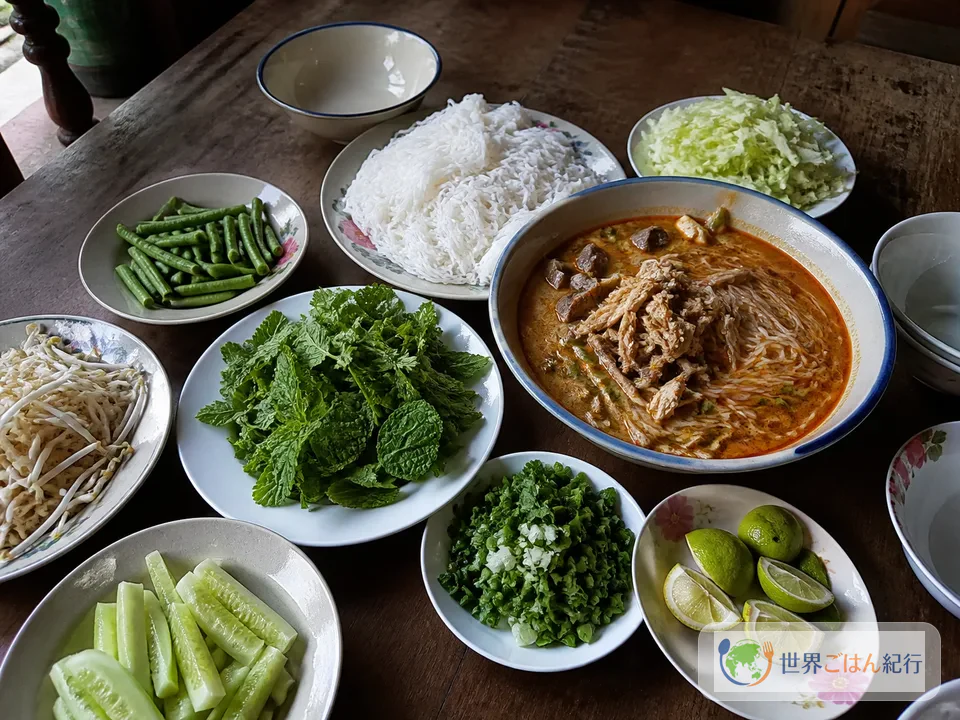
Put noodles in a bowl, pour in the hot broth, add raw vegetables and herbs, then squeeze lime over the top. Set the vegetables on a separate plate so each diner takes what they like. Assemble each mouthful from noodles and toppings instead of making the broth too strong on its own; seasoning is then easier to adjust.
With a plate of vegetables on the side, the same broth tastes different in every bowl. More cabbage thins the heat, and mint makes the fish-sauce aroma feel lighter. Lime adds sourness and also cuts the aftertaste of chile.
You can also shift the pot itself, toward a Lao-style broth or toward an easy weeknight dinner.
| Direction to change | What to change | How the flavor moves |
|---|---|---|
| Closer to the light northern broth | Reduce coconut milk to ¾ cup (200 ml) and increase the stock by ¾ cup (200 ml) | Fish sauce and herbs come forward, and the broth becomes lighter |
| Stronger fermented aroma | Replace part of the fish sauce with padaek labeled for cooking | Aroma and saltiness increase. Taste a little at a time |
| Meatless | Replace chicken with mushrooms, beans, pumpkin and so on; omit fish sauce | Build the outline from mushroom and bean umami, herbs and lime |
| Dividing heat within the family | Reduce chiles and set out dry-toasted chiles for the bowl | Children and people who dislike heat can adjust it themselves |
When using a fermented fish seasoning like padaek, check the product's heating instructions and ingredients, and warm it thoroughly in the pot. Avoid substituting a home-fermented raw fish product in the same amount. If you have a shellfish or fish allergy, check not only fish sauce but also padaek, fish-based stock and each product's labeling.
Storing khao poon
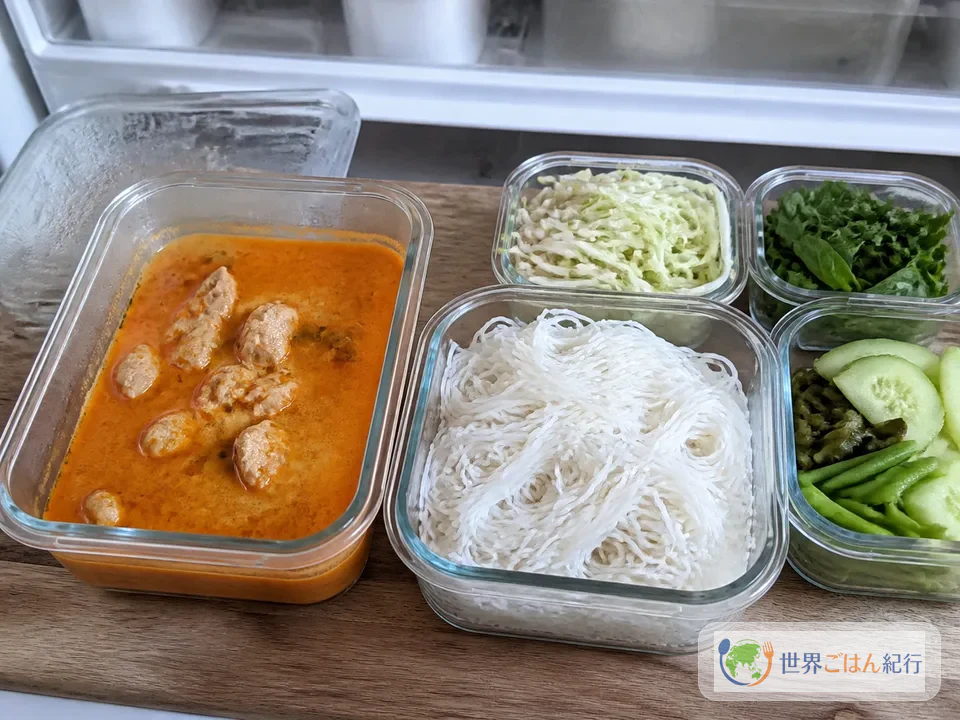
Move leftover broth to a shallow container once it has cooled slightly and refrigerate it apart from the noodles; eat it within about 3 days. Keep the vegetables and herbs separate as well, and cut them on the day you eat. Noodles left soaking in the broth absorb liquid and break easily.
To reheat, warm only the broth over medium-low heat until it is hot all the way through. To freeze, seal only the broth, thaw it in the refrigerator, then warm it. Coconut milk tends to separate when reheated, so don't let it boil, and mix in a little stock or hot water to restore the strength. If the look or smell seems off, don't eat it, however few days it has been stored.
Lao dishes to cook alongside
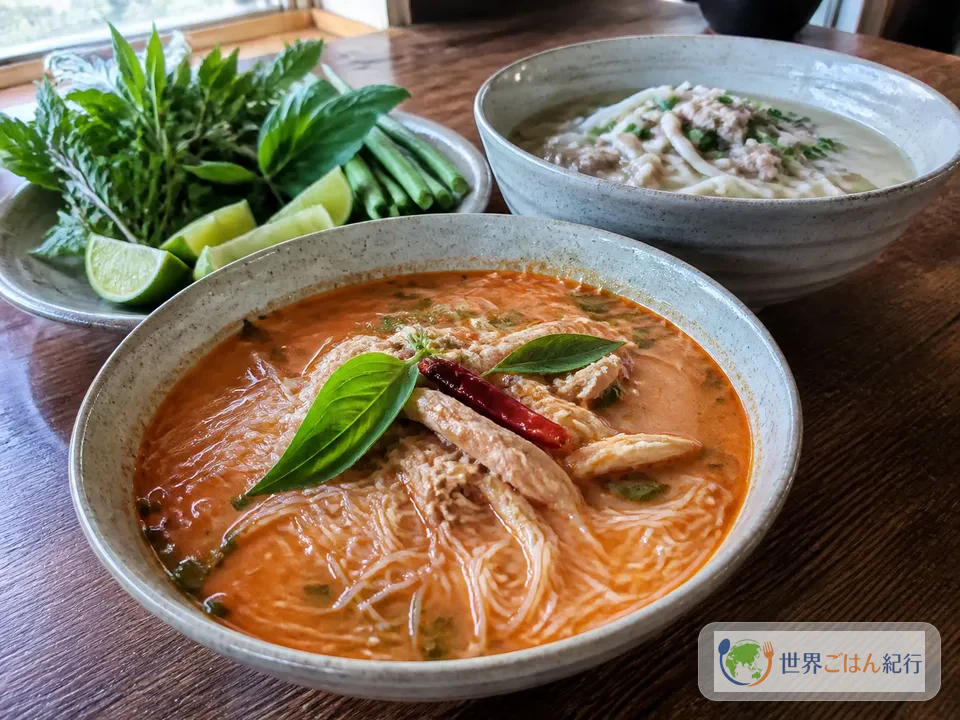
If you like the way herbs and rice noodles come together in khao poon, try Khao Piak Sen, a hand-cut rice-based noodle that thickens its own broth. Laab brings minced meat and herbs together with lime and is served with raw vegetables, no broth at all. For a Thai comparison, look at how chiles, fermented seasonings and vegetables are arranged in Khanom Jeen Nam Ya, eaten with a fish broth.
Frequently asked questions
Q. What do I do with fresh khao poon noodles?
Handle fresh noodles according to the package or the seller's guidance, and cook them for less time than dried ones. Khao poon noodles are thin and round, and are cooked separately from the broth. Fresh rice noodles vary a lot by product, so after blanching, taste one and stop when there is no core and they don't break.
Q. Can I make this without a mortar?
Yes. Finely chop the chiles, garlic, onion, ginger and lemongrass with a knife and press them with the flat of the blade. The pieces stay larger than with a mortar, so extend the frying time by 1–2 minutes and check that the raw onion smell has gone.
Q. How far ahead can I make it?
Make the broth the day before and prepare the noodles and vegetables on the day you eat. As the broth cools, the coconut fat sets and the surface turns white, but gentle warming brings it back.