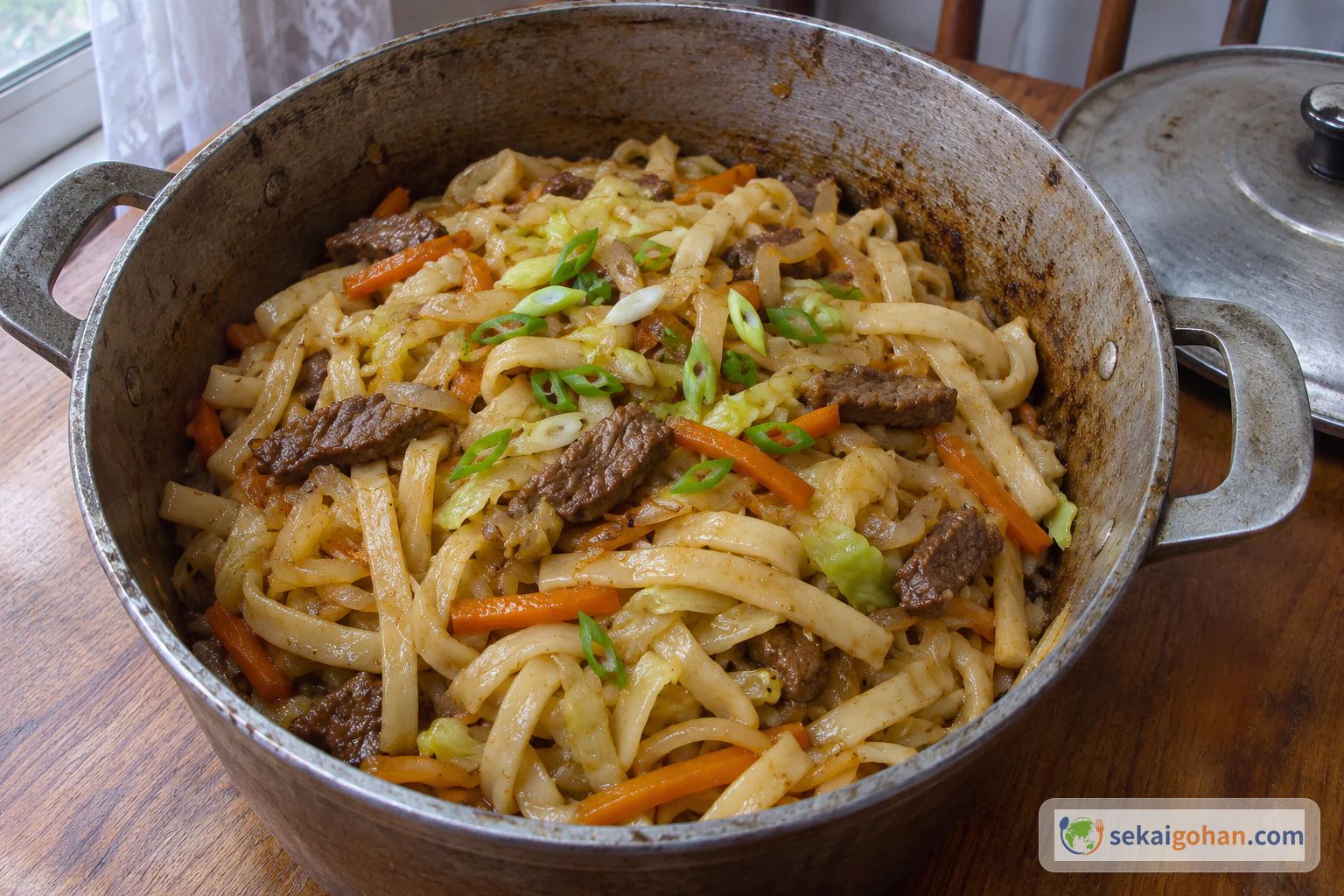
Stir soy sauce, sugar, garlic and ginger together in the evening kitchen and a sweet smell rises, a little like yakitori glaze. Add parboiled bone-in chicken and its fat melts into the sauce, and by the end the clear glass noodles have turned brown. This is Andong jjimdak, a Korean feast braise from Andong in North Gyeongsang Province. A dark soy sauce, sweet and savory rather than chili-red, soaks into the chicken, potatoes and noodles, and all of it is headed for a bowl of white rice.
Andong jjimdak: origin and how it is eaten

Jjim appears in the names of steamed and braised dishes, and dak means chicken. Andong jjimdak (안동찜닭) brings together bone-in chicken, potatoes, carrots, onion, green chili peppers and Korean glass noodles called dangmyeon (당면), all simmered in a sweet-savory soy-based sauce.
The dish has roots as an old celebration dish of Andong. It also spread in the 1980s along the chicken street of Andong's old market, where chicken restaurants competed with fried chicken shops. Today it arrives as chicken, vegetables and noodles heaped on a big platter and shared among several people.
Among Korean dishes it has its own place. kimchi jjigae is a red, sour stew, bulgogi is sweet-savory grilled beef, and japchae has its ingredients cooked separately and then tossed. Andong jjimdak is a big-platter main, meant to be eaten with rice.
In Korean it is written 안동찜닭. In English you will see "Andong jjimdak," "Andong jjim dak" and "jjimdak." Use "Andong jjimdak."
Ingredients (serves 4)

This serves 4 as a big-platter main. For 2 servings, halve everything and use a deep skillet or shallow pot about 9.5 inches (24 cm) across. You can make it with bone-in chicken alone, but at home a mix of drumsticks or wingettes and boneless thighs balances cooking time and ease of eating.
This dish contains chicken, soy sauce and oyster sauce (which may contain wheat), soy and sesame. Dried shiitake, Korean glass noodles and seasonings are made on different lines depending on the product, so anyone with a food allergy should check the ingredient labels. When using bone-in chicken, cook it all the way through so that no red juices remain before serving.
Choosing ingredients and substitutes for Andong jjimdak

The three decisions in a home kitchen are the cut of chicken, the kind of noodle and how concentrated the soy sauce gets. Chicken, potatoes, carrots and onions come from any ordinary supermarket. Swap in the wrong direction, though, and the dish slides toward Japanese chikuzenni, yakitori-glazed chicken or noodle-studded nikujaga. What holds it together is the chicken fat, the sweet-savory soy sauce, the gloss of the dangmyeon and the aroma of green chilies.
Chicken
Bone-in chicken pieces come closest. A mix of drumsticks or wingettes and boneless thighs also works; thigh alone makes the sauce easy, but the bone aroma is weaker, and breast alone is best avoided. Color is a poor guide to whether bone-in chicken is cooked through, so with large drumettes or cut-up pieces, check the thickest part with an instant-read thermometer.
Korean dangmyeon
Dangmyeon is the star that soaks up the sauce; without it, the dish is closer to a braised chicken and potato dish with noodles. Look for Korean sweet potato starch noodles, which are thick and chewy and hold together after absorbing the sauce. If a Korean grocery is nearby, check its dangmyeon first, since thickness and whether it comes pre-cut change how it handles. A bag labeled 당면 or 자른 당면 (cut dangmyeon) is what you want.
Otherwise, try the dried noodle shelf of an Asian grocery. Thick glass noodles, cooked briefly, are the closest stand-in. Mung bean glass noodles are thin and tend to break up in the braise, and shirataki or rice vermicelli won't do the job.
Soy sauce and rice syrup
The sauce is built on Korean soy sauce, sugar, rice syrup (mulyeot), garlic, ginger and green chilies, cooked over fairly strong heat while the liquid reduces and seasons the dish. Soy sauce here is the base that holds the chicken fat and the noodles together, not a dye. Regular dark soy sauce alone turns salty before it turns dark, and the color comes up fast, so adjust by how far you reduce the sauce rather than by adding more soy, sugar or syrup.
A slightly lighter color is fine as long as the chicken tastes savory and sweet, the chilies smell green and the noodles glisten. Stop when the sauce tastes slightly sweet from the pot alone and the saltiness is right when eaten with rice. A Korean platter is well coated in sauce, but imitate that with ordinary dark soy sauce and the salt gets ahead of everything else.
Green chilies
The green chili is not only for heat. It brings a green aroma and a light bitterness into the sweet soy sauce, and Korean green chilies are optional. A mix of shishito peppers, Anaheim-type peppers and a little green bell pepper keeps the green aroma while staying easy to handle at home. Slice shishitos on the diagonal, seeds and all, and add them early to bring out the aroma. Bell pepper goes in thin strips for only the last 2 minutes so it doesn't turn grassy. Chili flakes alone push heat ahead of aroma.
For a milder version, swap the green chilies for shishito peppers and add a touch more black pepper. For children, leave out the green chilies and serve chopped green chili or gochugaru only on the adults' plates. Keeping the whole pot mild also helps when you reheat it the next day.
| Hard-to-find ingredient | Close substitute | Substitute to avoid |
|---|---|---|
| Korean soy sauce | ½ cup (90 ml) dark soy sauce with extra liquid | Making it dark with tamari alone |
| Rice syrup | Honey, or a little extra brown sugar | Adding lots more sugar |
| Korean dangmyeon | Thick glass noodles, cooked briefly | Shirataki, rice vermicelli |
| Green chili | Shishito, Anaheim-type peppers, a little bell pepper | Chili flakes alone |
| Bone-in chicken | A mix of drumettes and boneless thighs | Chicken breast alone |
Sesame oil and pots
Korean sesame oil goes in at the finish, and its aroma rounds off the heavy sweet-savory sauce. It also goes into japchae and bibimbap, so it's easy to use up if you keep cooking Korean food. For 4 servings, a deep skillet is easiest to stir. For 2 servings brought piping hot to the table, a small pot that can go on direct heat keeps the dish from cooling.
Method
Parboil the chicken first to remove fat and scum before braising it in the sauce. Do not make the sauce too strong at the start. Aim for a sauce that has reduced a little just before you add the noodles. If the noodles go in early, they soak up too much sauce on the bottom of the pot and clump.
Add the Korean noodles last and cook them briefly so they absorb the sauce as they go. If they go in early, they absorb too much sauce, clump and scorch on the bottom of the pot.
Andong jjimdak troubleshooting: salty sauce, pale color, clumped noodles

| Problem | Cause | Fix |
|---|---|---|
| Too salty | Too much soy sauce, or reduced too far | ½ cup (100 ml) water, 1 tsp sugar and more potato, then 5 minutes over low heat |
| Color too pale | Not reduced enough, or noodles added too early | Push the noodles to the edge and reduce 2 minutes over medium heat |
| Noodles clump | Added too early, or too little liquid on the bottom | Add 3 tbsp water and loosen them over low heat for 2 minutes |
| Chicken is tough | Cooked too long over high heat, or too much breast meat | Cover, rest 5 minutes over low heat and spoon sauce over |
| Potatoes fall apart | Cut too small at first, or overcooked | Next time use 1 inches (3 cm) pieces and stop at half-cooked before the noodles |
The most common mistake is adding more soy sauce to make the dish look black. The darkness comes from the amount of sauce and how far you reduce it, so if the color is pale, take off the lid and reduce over medium heat 1 minute at a time before reaching for the bottle. Taste the sauce on its own, then again with a bite of rice.
Clumped noodles need patience rather than chopsticks. Add a little water, warm them over low heat, then lift them apart with tongs. Dangmyeon tighten suddenly as they cool, so keep loosening them gently in the pot until just before serving, and eat soon after they hit the plate.
Serving and storing Andong jjimdak
What to serve with it
White rice, kimchi, lightly salted cucumber and soybean sprout namul go well. The sauce and noodles left at the bottom of the platter will carry the rice on their own. If you'd like a soup anyway, a light seaweed or radish soup stays out of the way of the sweet-savory sauce better than doenjang jjigae, with its miso-like aroma. Setting japchae beside the platter doubles up on noodles, so on that day favor vegetable sides.
Storage and reheating

To store, separate the chicken and vegetables, the noodles and the sauce as much as you can. Stored together, the noodles keep absorbing the sauce and break into short pieces by the next day. Keep it in the refrigerator for about 2 days. The chicken and vegetables alone can be frozen, but the noodles lose their texture, so freezing them is not recommended.
To reheat, put the chicken and vegetables in a small pot with 3 tbsp sauce and 2 tbsp water. Warm over medium-low heat for about 4 minutes, and when it bubbles, return the noodles and heat them for just 1 minute. In a microwave, keep the noodles separate and heat the chicken and vegetables at 600 W for 2 minutes, stir, then 1 minute more. Loosen the noodles with boiling water and return them to the sauce at the end so they're less likely to break.
Leftovers make a good small rice bowl the next day, spooned warm over rice. If there isn't enough sauce, warm 1 tsp soy sauce, 2 tbsp water and 1/2 tsp sugar in a small pot for 30 seconds and add it. Finish with just a few drops of sesame oil after reheating; added at the start, its aroma fades.
Bone-in chicken is hard to judge by looks, so check that the thickest part is cooked through before eating. Reheat stored leftovers until they are steaming hot all the way through.
FAQ
Can I make it with chicken thighs only?
Yes. Cut 2 lb (900 g) boneless thighs into 1.5 inches (4 cm) cubes and stop the parboil at 30 seconds. Shorten the braise to 8 minutes in step 3 and 10 minutes in step 4. The sauce is lighter than with bone-in chicken, but it's easier to eat and works for lunch boxes. To make up for the missing bone savor, be sure to use the shiitake soaking liquid.
Can I use ordinary glass noodles if I don't have Korean ones?
You can, but the texture will not be the same. With ordinary mung bean glass noodles, reduce to 2.75 oz (80 g), skip the soaking and cook only 3 minutes in step 5. Longer cooking breaks them into small pieces that clump on the bottom. Thick glass noodles, if you can find them, come closer to dangmyeon.
Do I add gochujang?
Basic Andong jjimdak gets its heat from green chilies, black pepper and, if you like, a little dried chili. Gochujang adds sweetness and a fermented flavor, moving the dish toward a different sweet-spicy chicken braise. If you add it, stay within 1 tsp so the soy sauce flavor still leads.
Can I make it in a pressure cooker?
Yes, but keep the noodles and potatoes out of it. Put in the parboiled chicken, the sauce and the liquid, and stop at 5 minutes at pressure plus 5 minutes natural release. Then move everything to a regular pot, simmer the vegetables for 10 minutes and add the noodles last. Pressure-cook it all together from the start and the potatoes fall apart while the noodles break into short pieces.