Ratatouille: A Provençal Vegetable Stew Where Every Vegetable Keeps Its Shape

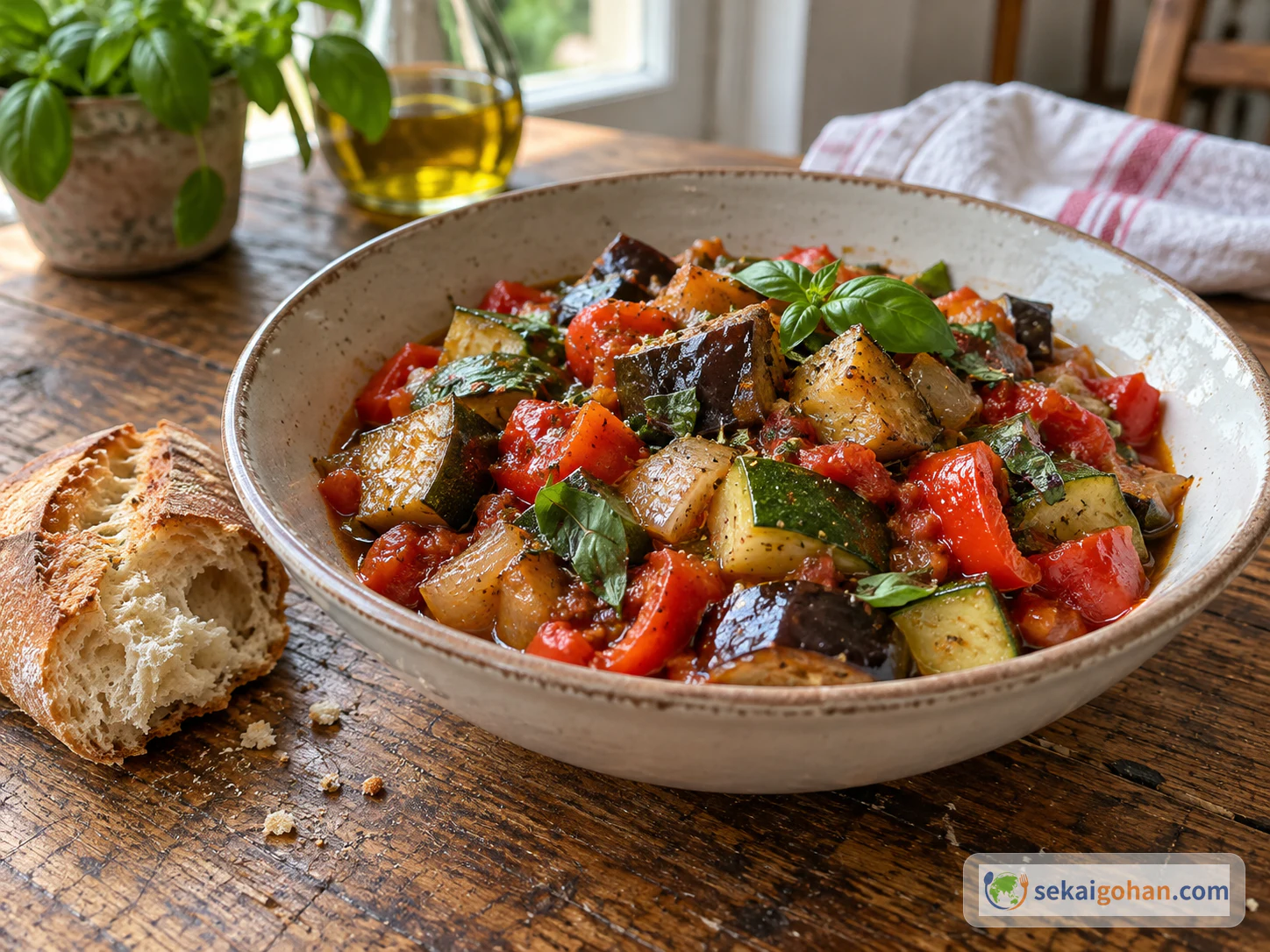
Chunky ratatouille served on a ceramic plate with a piece of baguette alongside
Serves
6 servings
Cuisine
French

How to make ratatouille, the vegetable stew of Provence and Nice, from the James Beard recipe for 6 servings: cutting eggplant, zucchini, pepper and tomato, cooking garlic and onion without browning, adding the tomatoes last, and judging the finish by texture rather than the clock. Also covers substitutions, the separate-pan method, and how it differs from the thinly sliced confit byaldi.

Cooking flow

Cooking steps

STEP11 / 7

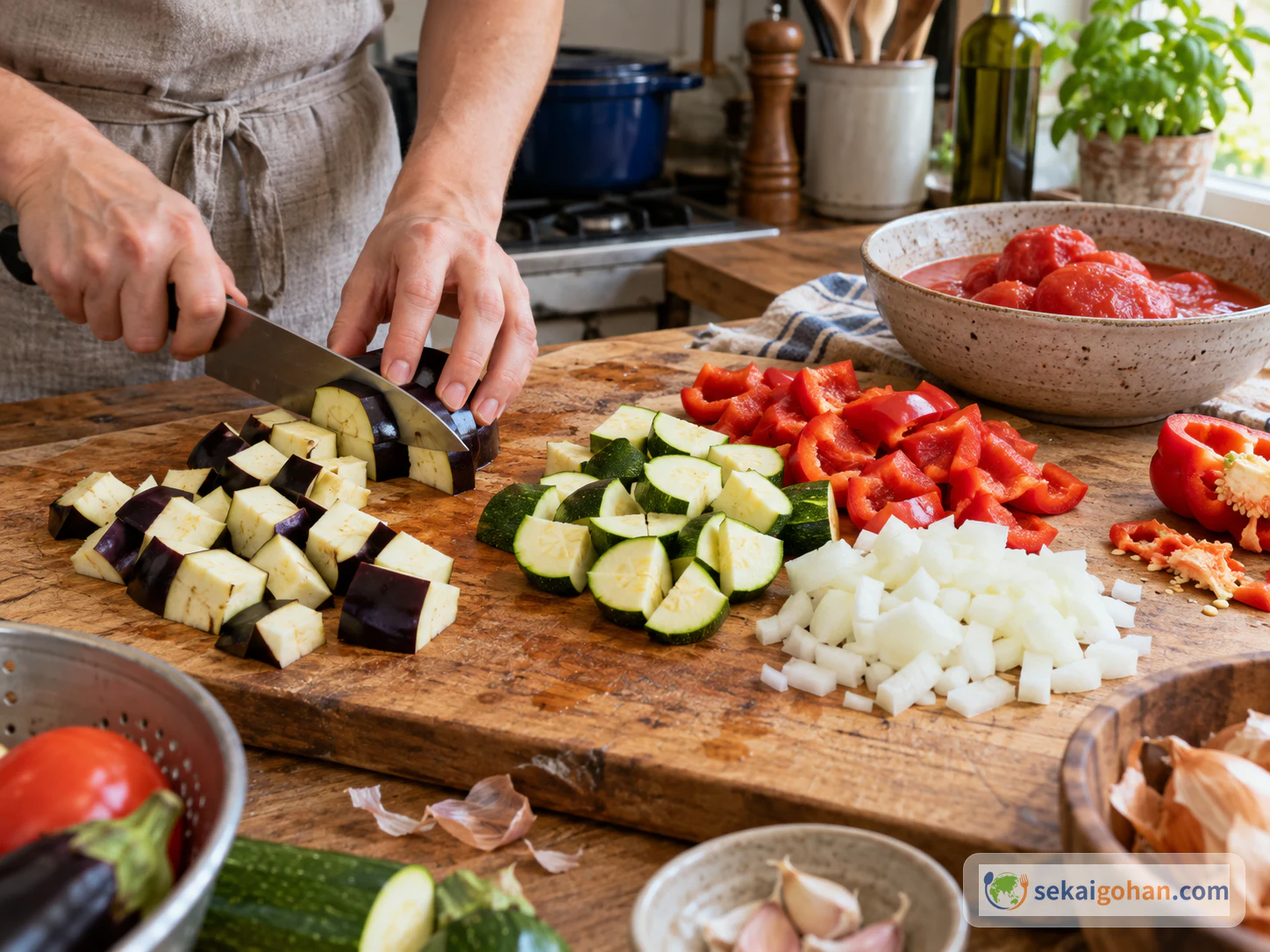
Cut the vegetables coarsely

Hands coarsely cutting unpeeled eggplant, with zucchini and pepper prepared nearby
Cut coarsely so that each vegetable keeps a different texture in the finished stew

Chop the onion. Chop the red bell pepper coarsely. Dice the eggplant coarsely without peeling it. Slice the zucchini into rounds, then cut each round into quarters. Measure each vegetable by volume after cutting.

For the tomatoes, score the skin, dip them briefly in boiling water, then move them to cold water and slip off the skins. Remove the seeds and chop the flesh. If you are using canned plum tomatoes, chop them coarsely instead.

STEP22 / 7

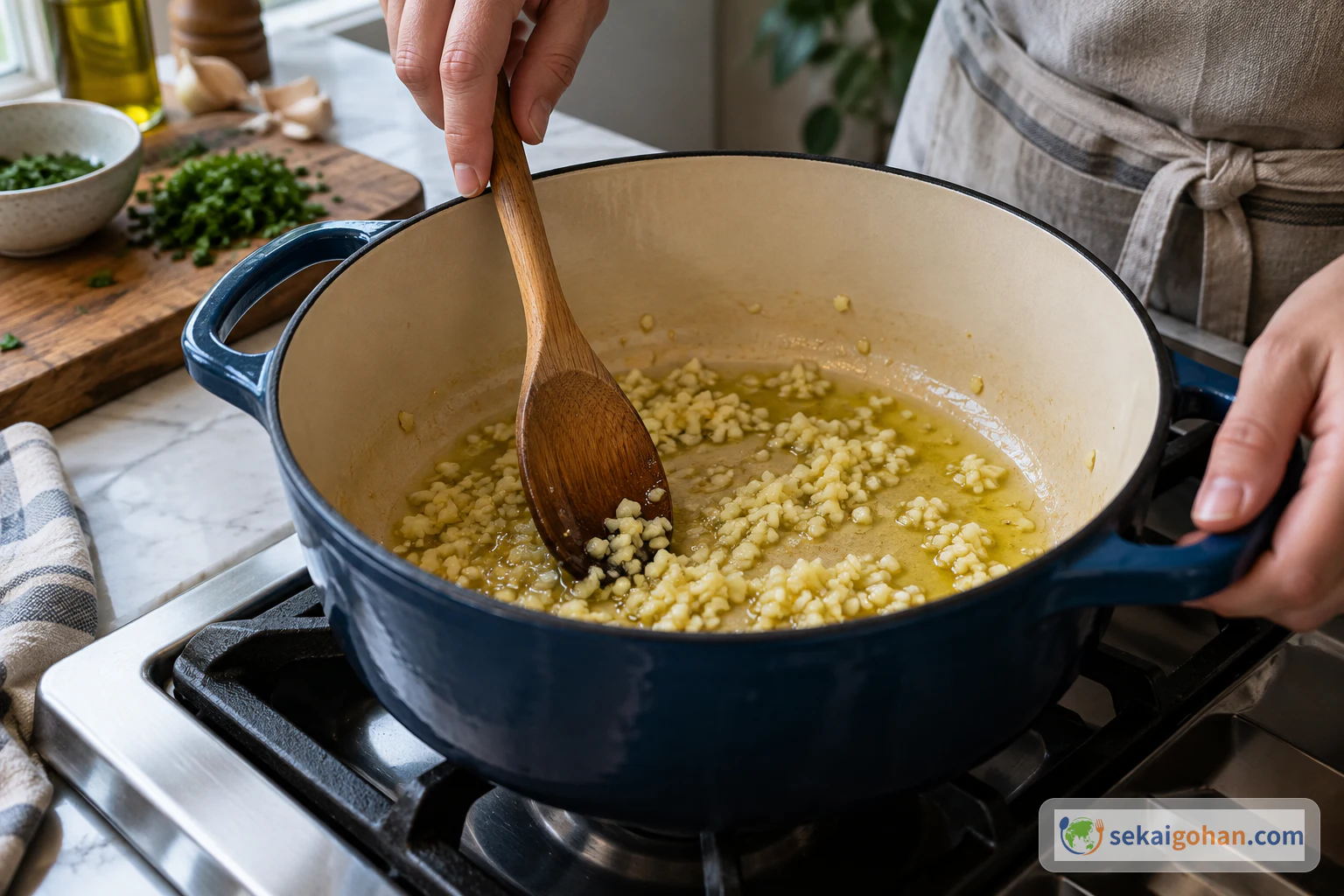
Warm the garlic in the olive oil without browning it

Chopped garlic warming gently in olive oil in a pot, still pale
Keep the garlic pale; its aroma should move into the oil, not burn

Pour all 1/2 cup olive oil into a large, heavy pot and set it over low heat. Add the garlic and cook it very gently. Don't let it brown. Before the garlic starts to take on color, push it to the edge of the pot.

STEP33 / 7

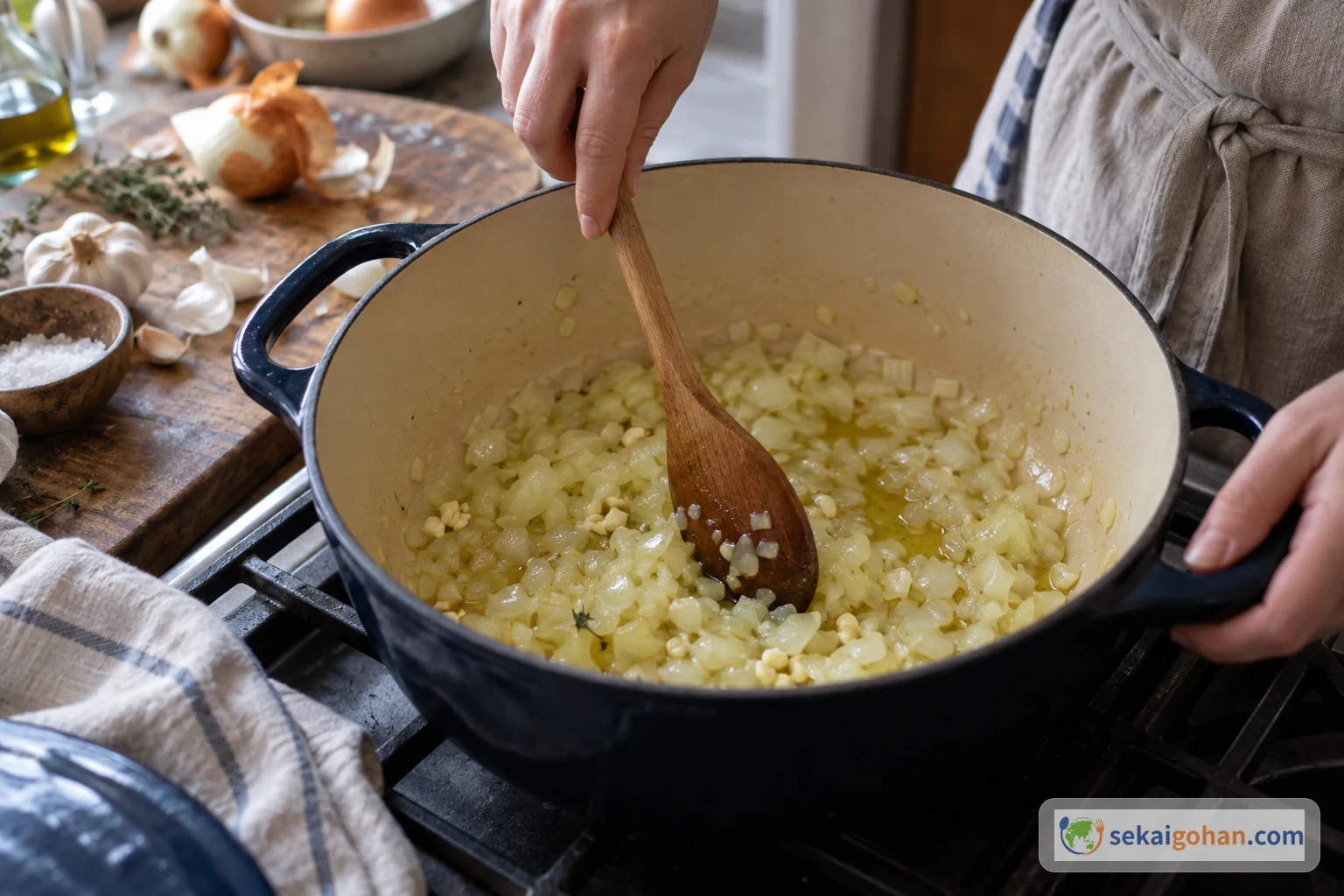
Soften the onion, then combine it with the garlic

Chopped onion cooking slowly in a pot until soft
Cook the onion until soft and translucent, without browning

Add the onion and cook it slowly until it is translucent and soft. Don't let it scorch; you want its sweetness. Then stir it together with the garlic.

STEP44 / 7

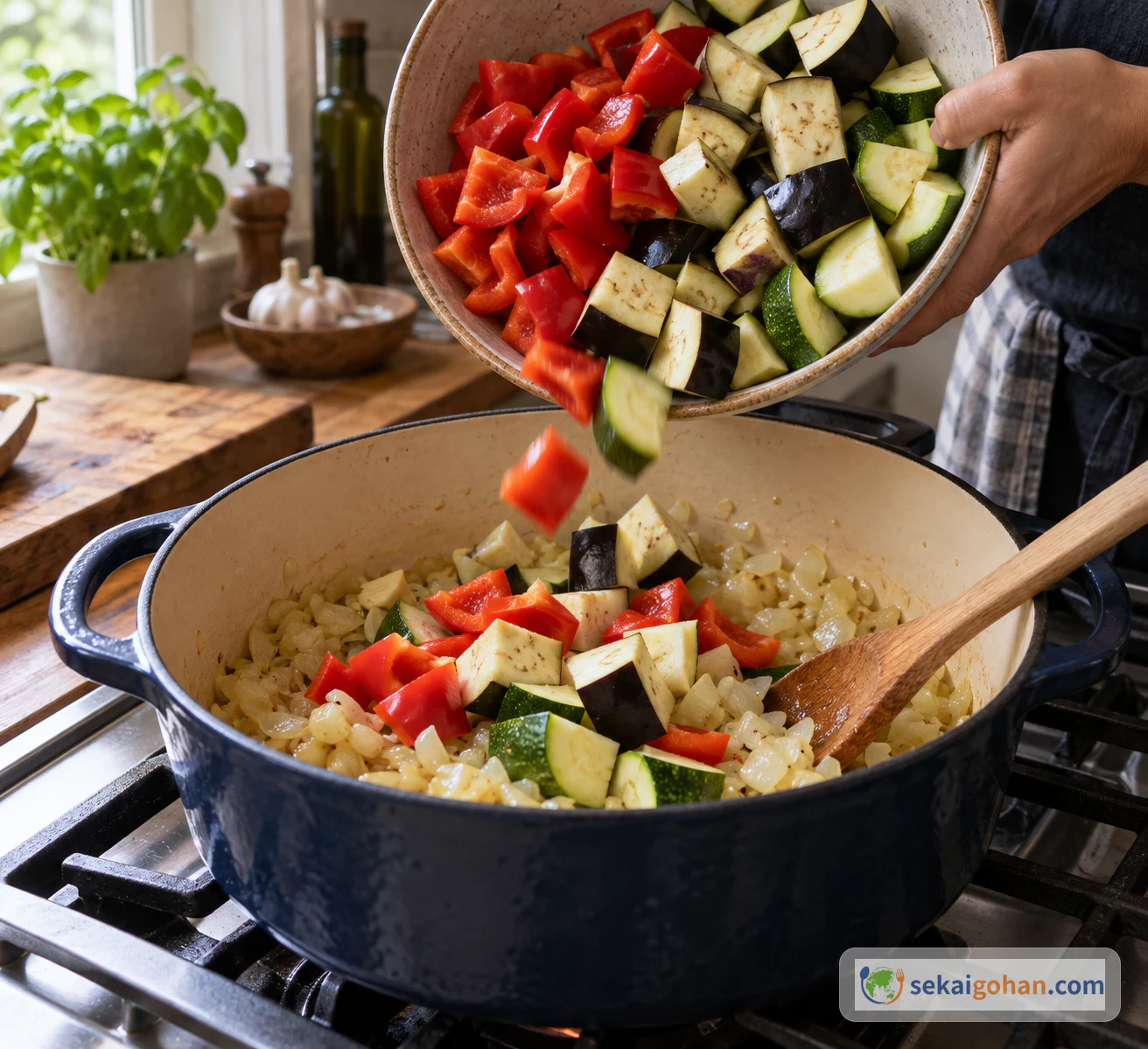
Add the pepper, eggplant and zucchini

Red bell pepper, unpeeled eggplant and zucchini being added to the pot with the onion
Add the remaining vegetables to the softened onion and garlic and coat them with oil

Add the red bell pepper, eggplant and zucchini to the pot. Stir with a wooden spoon and shake the pot lightly so the oil coats everything.

STEP55 / 7

Season and cook briskly for about 10 minutes

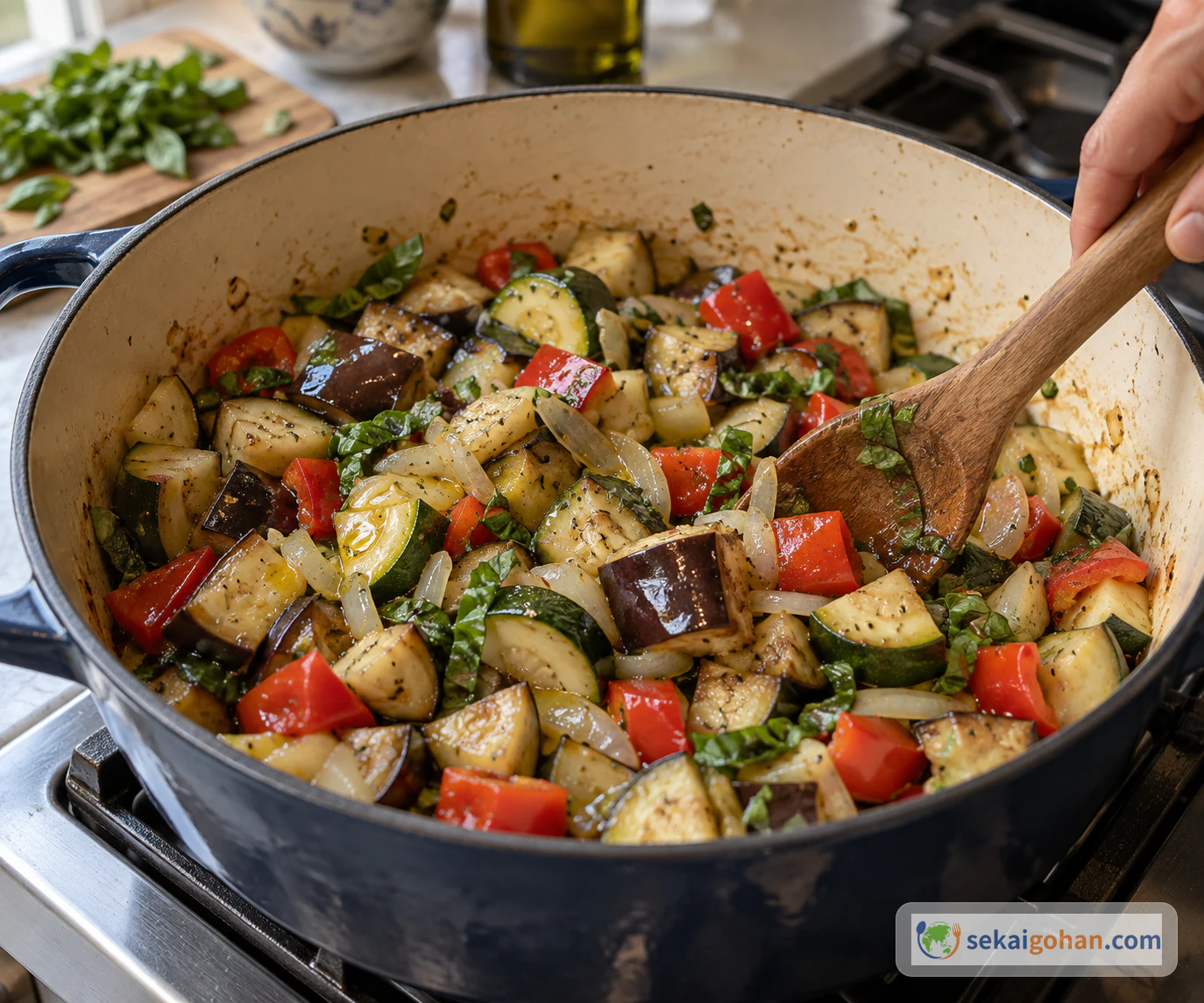
Vegetables being stirred with a wooden spatula over medium-high heat
Stir almost constantly; the basil goes in here with the other seasonings

Add the salt, black pepper and basil (and the cayenne or Tabasco, if you are using it). Cook over brisk heat, meaning medium-high, for about 10 minutes, stirring almost constantly so nothing scorches.

If vegetables start sticking to the bottom of the pot, lower the heat. Don't add water at this stage; adding liquid belongs to the finish, after the tomatoes.

STEP66 / 7

Add the tomatoes and cook to the consistency you like

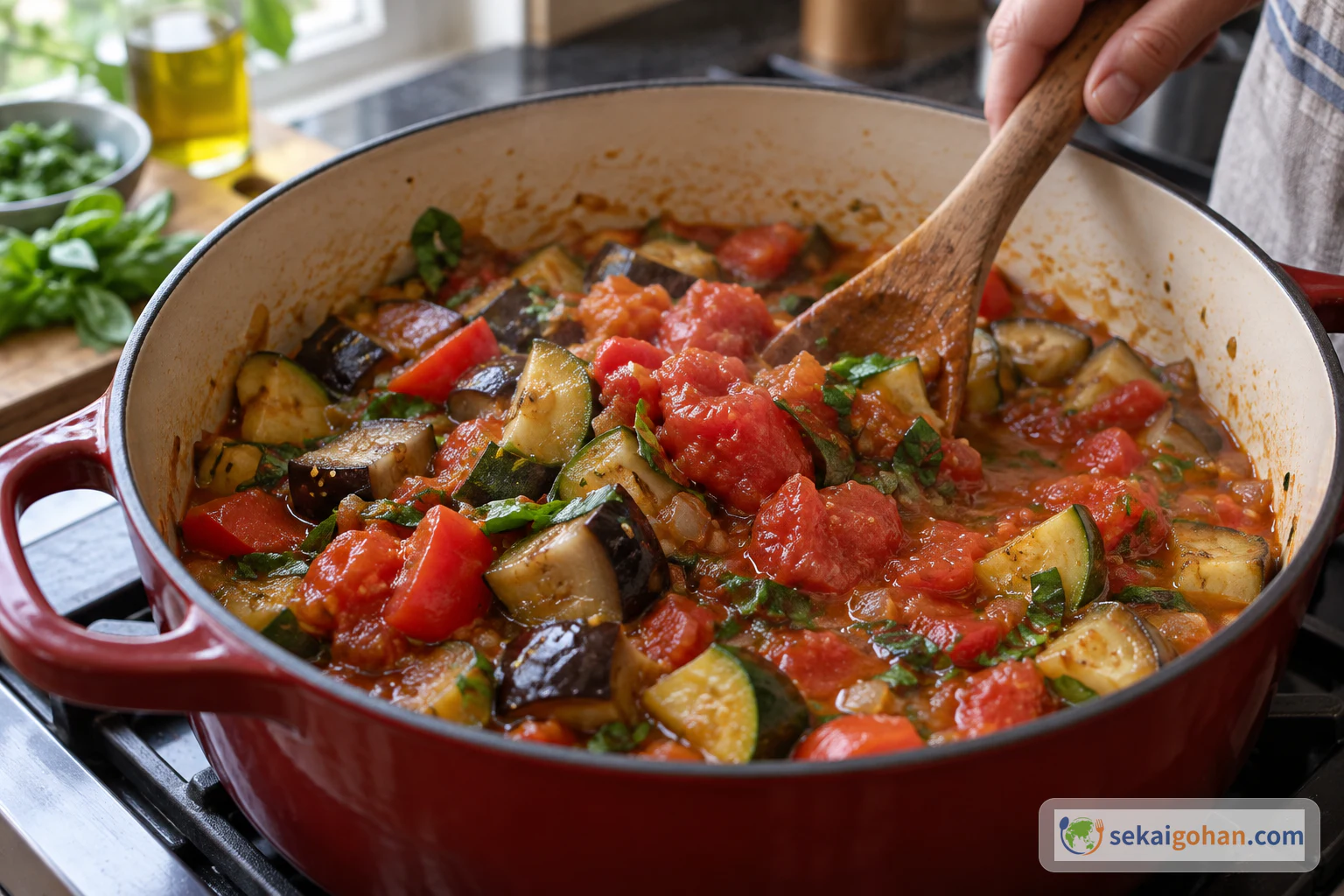
Chopped tomatoes folded into the vegetables with basil already in the pot, reducing while the vegetables keep their shape
After the tomatoes go in, watch the liquid and the vegetable edges rather than the clock

Add the tomatoes and stir them in. Cook until the vegetables come together, to the consistency you like.

Look for vegetables that still hold their shape, liquid that no longer spreads thinly across the bottom of the pot, and a stew that holds together at the thickness you like.

If the stew becomes too dry, add a little tomato juice, water or broth. Add water only if you need it.

STEP77 / 7

Taste and adjust

STEP 7

Taste and adjust with salt and pepper. Some cooks prefer ratatouille thick and soft; others prefer it with some bite left. Both are a matter of preference.

0 / 0
Ingredients

Ingredients

1 / 1

Ingredients

Ingredient Amount Role
Olive oil 1/2 cup All of it goes into the pot at the start, for cooking and for the aroma of the whole dish. Any type
Garlic 5 cloves Finely chopped. Warmed gently so its aroma moves into the oil
Onion, chopped 1 1/2 cups Measured after chopping. The sweet base of the stew
Red bell pepper, coarsely chopped 1 1/2 cups Green or red; this version uses red only, not both
Eggplant (aubergine), unpeeled and coarsely diced 1 1/2 cups Keep the skin on. Coarse dice for texture
Zucchini (courgette), sliced and quartered 1 1/2 cups Cut into rounds, then each round into quarters
Salt 1 tbsp Added with the other seasonings before the tomatoes
Black pepper, freshly ground 1 tsp Added with the seasonings
Fresh basil 3 tbsp Added with the seasonings, before the tomatoes
Tomatoes, peeled, seeded and chopped 1 1/2 cups Added last, after the other vegetables have cooked for about 10 minutes
Cayenne pepper or Tabasco A dash (optional) Heat. Omitted in this version
Water A little, only if needed Optional finishing adjustment if the stew becomes too dry after the tomatoes
Boiling water and cold water As needed Separate working water for peeling and cooling the tomatoes, not added to the stew
Baguette As needed (optional) Served alongside; not part of the stew
Egg As needed (optional) Cooked separately and thoroughly, served alongside; not part of the stew
0 / 0

Gather eggplant, zucchini, peppers and tomatoes in one pot, and it is tempting to cook them all to the same softness. Ratatouille asks for something different. The vegetables are cut coarsely and added in order, so each one keeps its shape while they all share one sauce. The result is a rustic, chunky summer stew from Provence, fragrant with olive oil, garlic and basil.

Ratatouille in Provence and Nice

Ratatouille is a vegetable stew from Provence in southern France, especially Nice, and it is tied to the region's vegetable gardens. It is built from garden vegetables that are easy to come by, such as eggplant, zucchini and tomatoes, seasoned with garlic. The dish belongs to the season when southern French summer vegetables ripen, so let that season guide you when you shop.

The Name and Its History

The name is linked to the Occitan word ratatolha. Its earliest known occurrence is in an 1831 military journal, and a 1903 cookbook from Nice also refers to it. Ratatouille as we know it is more recent, and less bound by rules, than the popular story of a centuries-old dish suggests.

Ratatouille, Confit Byaldi and Related Dishes
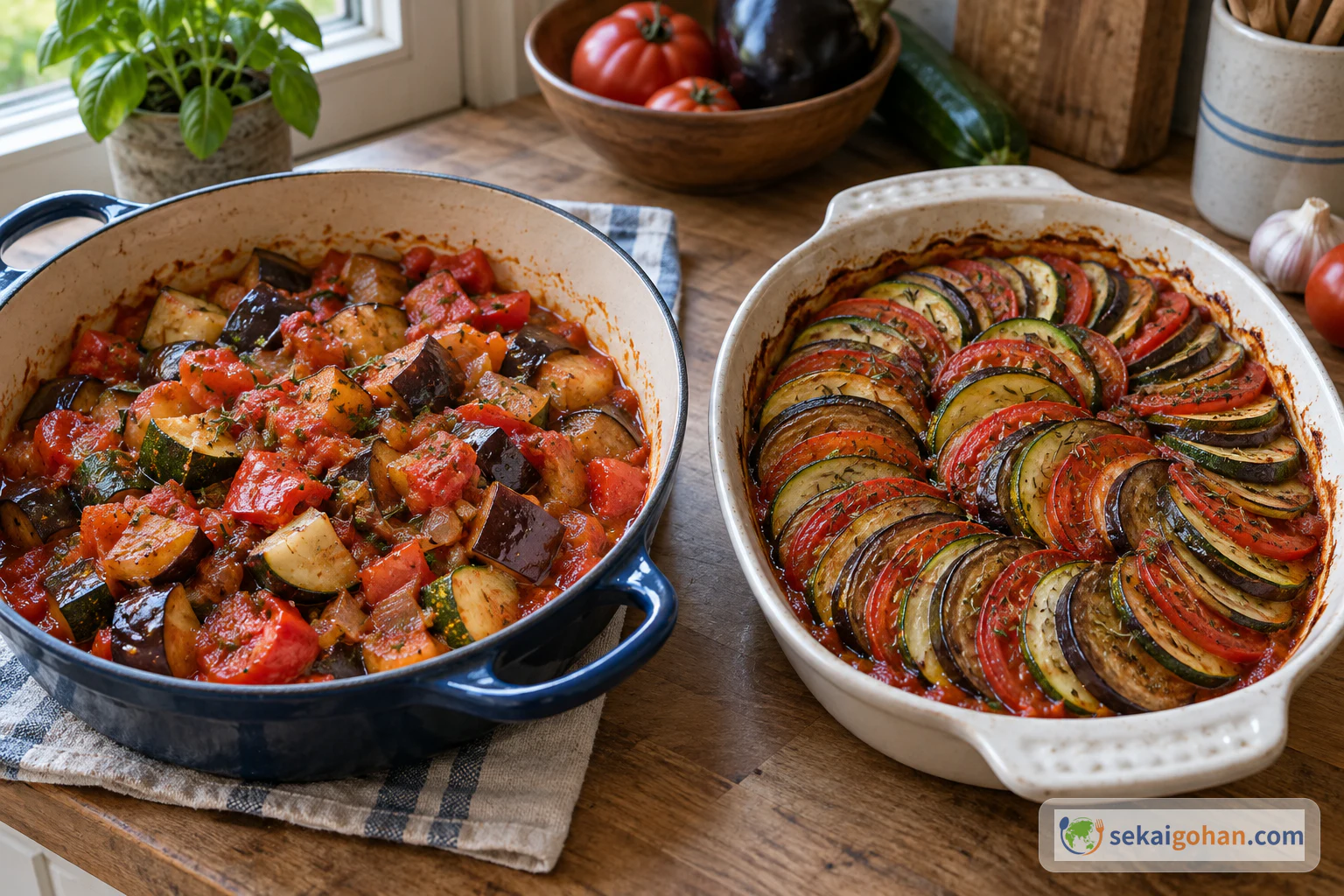
Chunky ratatouille stew beside a dish of thinly sliced vegetables arranged in overlapping circles
On the left, a coarse-cut ratatouille stew; on the right, a layered dish of thin slices in the confit byaldi style

Many people hear "ratatouille" and picture thin rounds of zucchini, eggplant and tomato arranged in overlapping circles, the version known from film. That layered dish is confit byaldi, a variation. This recipe is the classic coarse-cut stew, where the vegetables go into the pot in order and cook together.

Across southern Europe you'll find related but separate dishes, such as Spanish pisto and Italian caponata. For another southern French classic, try bouillabaisse, or explore more of the country's cooking under France.

Ingredients for 6 Servings: Matching the Vegetables by Volume
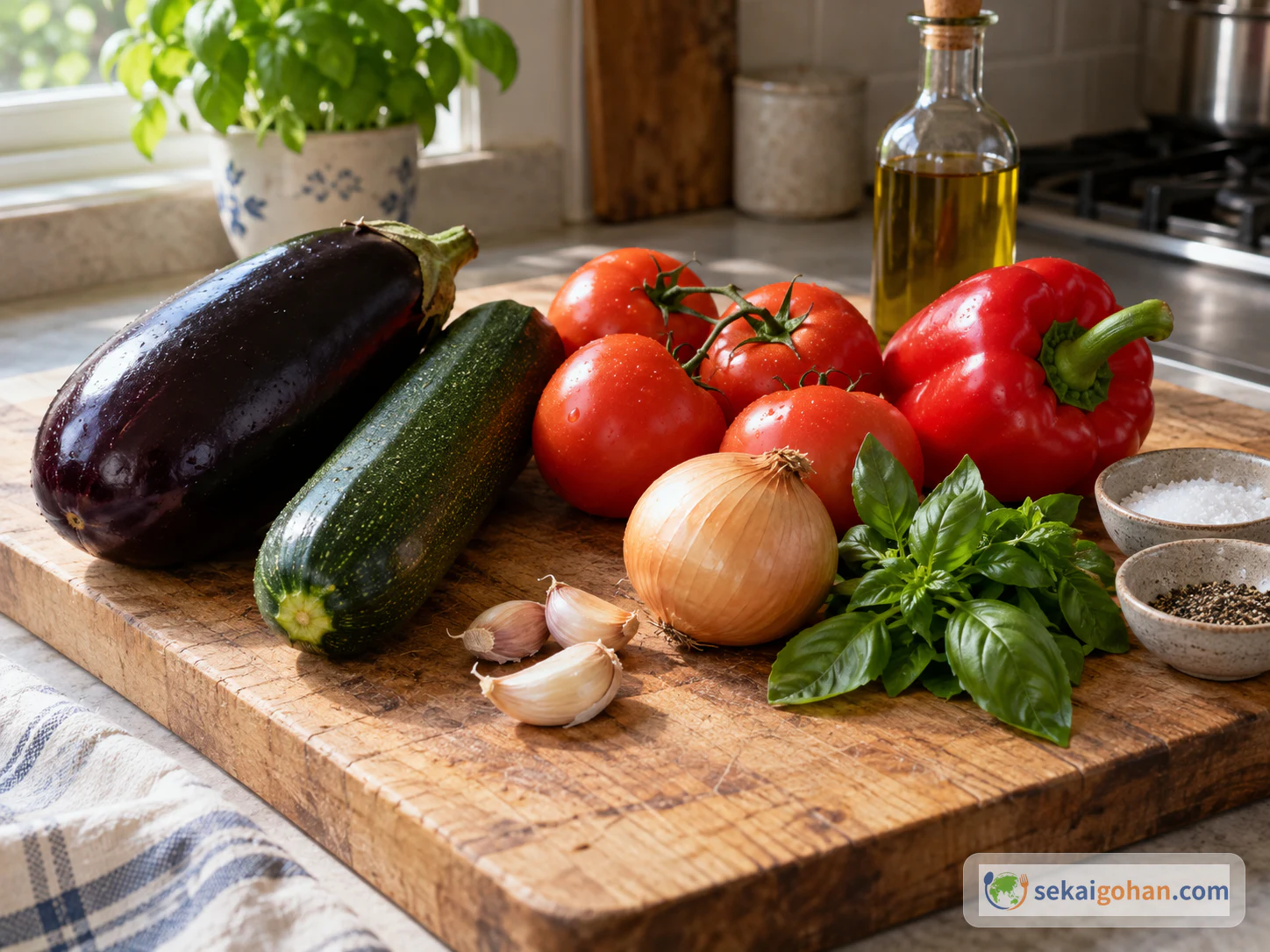
Eggplant, zucchini, tomatoes, red bell peppers, onion, garlic, fresh basil and olive oil, with small bowls of salt and black pepper
The vegetables are measured by volume after cutting, so cut first, then measure

Most vegetables are measured in cups after chopping or dicing. Measure by volume, not weight. With a 240 ml measuring cup, 1 1/2 cups of cut vegetable is 360 ml, and 1/2 cup of olive oil is 120 ml.

This recipe uses red bell pepper, fresh basil and fresh tomatoes, peeled, seeded and chopped. Skip the optional cayenne or Tabasco.

Equipment

  • A large, heavy pot (a lid is not used in this recipe)
  • A wooden spoon or wooden spatula
  • Measuring cups (240 ml cup) and measuring spoons
  • A knife and cutting board
  • A saucepan of boiling water and a bowl of cold water for peeling the tomatoes

Choosing Ingredients for Ratatouille

Peppers. Green or red peppers both work. Green ones keep the stew less sweet, while red ones add sweetness and color. Measure 1 1/2 cups in total, not 1 1/2 cups of each.

Tomatoes. Fresh tomatoes need peeling and seeding, and very juicy ones will take longer to cook down. When time matters more, use the same amount of canned Italian plum tomatoes, coarsely chopped. Look for plum tomatoes on the label, since diced canned tomatoes are a different product, and because salt and liquid vary between brands, taste before you salt.

Basil. If you can't find fresh basil, use 2 tsp dried basil. The aroma will be different, so use one or the other rather than both.

Eggplant. Other varieties, such as long slender eggplants, work if you match the volume. Watch them as they cook, because some soften faster than others.

Salt. A tablespoon of fine salt holds more than a tablespoon of coarse salt, so taste before adding more. If you want a less salty stew, start with less.

Allergy check

Check the labels of bottled and canned products such as Tabasco and canned tomatoes, as ingredients and cross-contact vary by product. The optional baguette contains wheat, and the optional egg accompaniment contains egg; check the bread label for any other allergens. Cook the eggs thoroughly.

Method: Garlic and Onion Gently, the Other Vegetables Briskly, Tomatoes Last

How to judge the end

Cook the vegetables for about 10 minutes before the tomatoes. After the tomatoes go in, decide by looking at the vegetables and the liquid in the pot.

Fixing Common Ratatouille Problems

What this pot should keep

Garlic that never browns, onion that turns soft and sweet, vegetables cut coarsely enough to keep their outlines, and tomatoes added only at the end. Judge the finish by the texture you want, not by a fixed time.

Condition Likely cause What to do
Eggplant and zucchini turn watery Too many vegetables crowded into a pot that is hard to stir Use a large pot so you can stir easily. Cook off liquid after the tomatoes to adjust the thickness
The garlic tastes bitter The garlic browned Next time, keep the heat low and push the garlic aside before it colors
The eggplant soaks up the oil Eggplant absorbs oil readily Stick to the 1/2 cup oil in total; watch the heat and the bottom of the pot instead
Vegetables stick during the 10-minute stage Heat too high, not enough stirring Lower the heat and keep stirring. Don't add water at this stage
Too dry after the tomatoes The liquid has cooked off Add a little water, tomato juice or broth at the finish
Too salty with canned tomatoes Salt in the canned product Check the label next time, and add the salt more cautiously

Serving Ratatouille and Variations

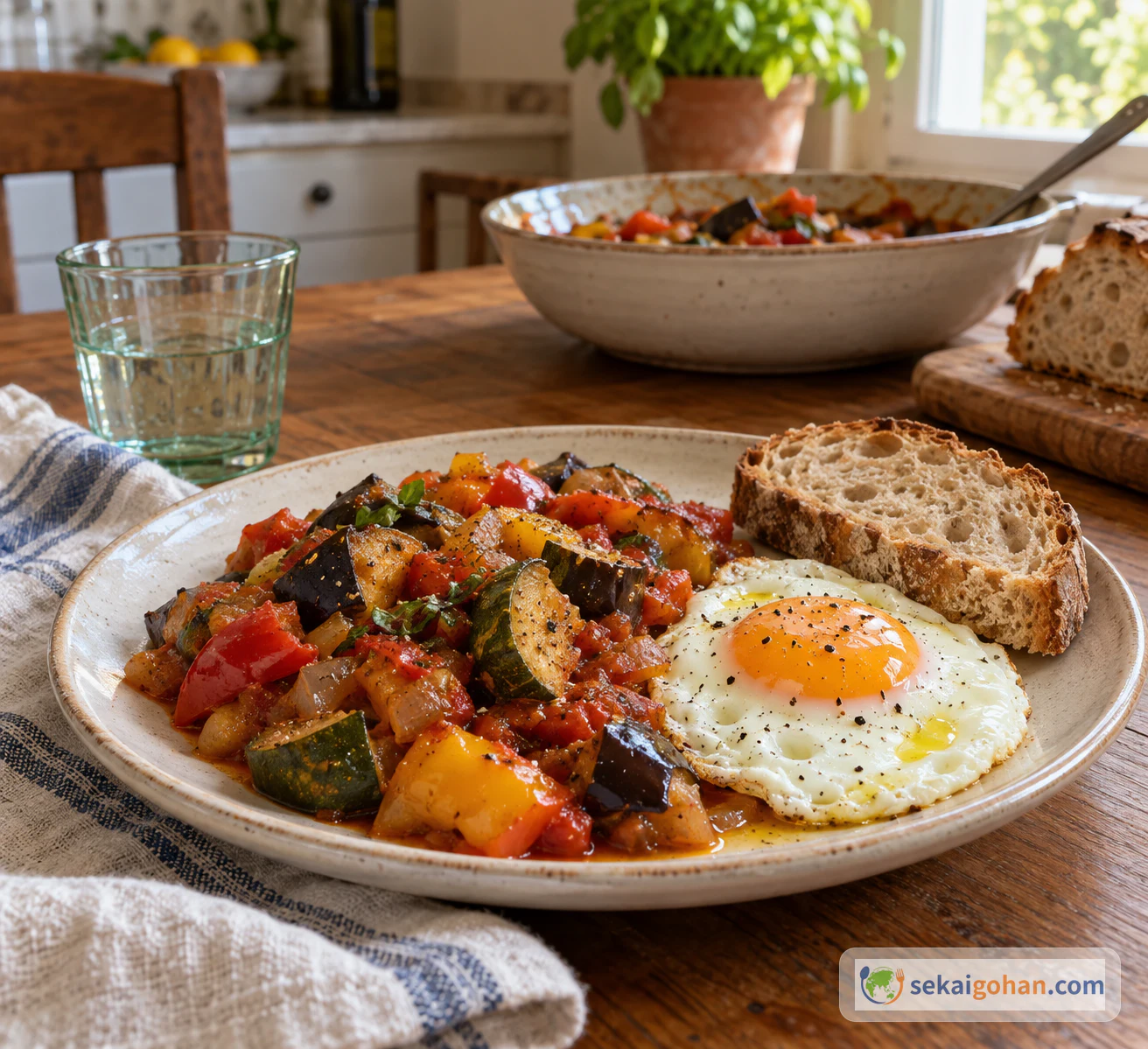
A warm serving of ratatouille with an egg dish and bread on a home table
Bread and egg are optional accompaniments served on the side

Ratatouille works as an accompaniment, an appetizer or a meal, and it is good hot, warm or cold. It goes well with eggs, which should be cooked separately and thoroughly, and with bread. Bread topped with cheese alongside it can make a main dish.

There are other ways to make it, too. Some Niçoise cooks cook each vegetable in its own pan, then finish them together, uncovered, to avoid excess liquid. Each vegetable gets its own texture, at the cost of more pans and more work. Cutting the vegetables smaller shortens the cooking and gives a different finish from the coarse cut here. A pinch of cayenne or a dash of Tabasco is optional, if you like a little heat.

Frequently Asked Questions

Can I make it ahead?

Yes. Cool leftovers promptly and refrigerate them. Reheat until steaming hot all the way through.

Is this the same as the dish in the film?

No. The thinly sliced, layered dish is confit byaldi, a variation. This recipe is the coarse-cut stew.

Sources

  • James Beard Foundation, "Ratatouille" (recipe attributed to James Beard). The recipe used in this article: yield of 6 servings, ingredients and amounts, the gentle garlic sauté and softened onion, adding the other vegetables and cooking briskly for about 10 minutes before the tomatoes, cooking to the desired consistency, the range of texture preferences, and serving as an accompaniment, appetizer or meal. https://archive.jamesbeard.org/recipes/ratatouille
  • Ville de Nice, service de restauration scolaire, "Les spécialités du menu Nice Label." The City of Nice school catering service's description of ratatouille in a Provençal context, its account linking the word to Occitan ratatolha, and the garden vegetables seasoned with garlic. https://cantines.nice.fr/actualite/nice-label
  • Rebecca Seal, "Deconstructing ratatouille," National Geographic Traveller (UK). Reported history (an 1831 military journal and a 1903 Nice cookbook reference), the separate-cooking method of Niçoise cook Sophie Agrofoglio, serving hot, warm or cold and with eggs, confit byaldi as a variation, and ratatouille's resemblance to other southern European vegetable dishes. https://www.nationalgeographic.com/travel/article/deconstructing-ratatouille