Casado: Costa Rica's Everyday Lunch Plate of Rice, Beans, Chicken and Sweet Plantains

A Costa Rican casado plate of white rice, black beans, grilled chicken, fried plantains and cabbage salad
Prep
35 min
Cook
50 min
Total
1 hr 25 min
Serves
4 servings
Level
Intermediate
Cuisine
Costa Rican

Casado is a Costa Rican lunch plate of rice, black beans, citrus-garlic chicken, sweet fried plantains and cabbage salad. Includes timing and substitutions.

Cooking flow

Cooking steps

STEP11 / 7

Cook the rice and start the beans

25 min

Cooking white rice while warming black beans in a small pot
Cook the rice slightly firm, and bring out the aroma of the black beans with onion and garlic

Rinse 2 rice-cooker cups (300 g) of rice. In a rice cooker, use 2 tbsp less water than the 2-cup line, add 1/4 tsp salt and run the normal cycle. In a pot, combine 300 g rice and 360 ml water, bring to a boil over medium heat, then cook over low heat for 12 minutes, turn off the heat and steam for 10 minutes. It is ready when steam rises, the grains are plump and upright, and firm enough not to turn mushy under the bean juices.

STEP22 / 7

Season the chicken with citrus and garlic

15 min

Seasoning chicken with lime, garlic and oregano
Even out the thickness before seasoning the chicken. Internal temperature matters more than browning

Open out the thick parts of the 1.25 lb (600 g) chicken thighs and even them to about 1 inches (2.5 cm) thick. In a bowl, combine the chicken, 2 tbsp lime juice, 3 tbsp orange juice, the grated garlic, 1 tsp oregano, 1/2 tsp cumin, 1 tsp salt, 1/3 tsp black pepper and 1 tbsp oil, and rub it in. It is enough when the surface is glossy and the garlic and herbs form a thin coating over all of the meat. Rest in the refrigerator for 10 minutes.

STEP33 / 7

Simmer the beans to a spoonable thickness

12 min

Simmering black beans in a small pot with onion, garlic and cumin
Do not reduce the beans too far; leave enough liquid to seep a little into the rice

Heat 1 tbsp oil in a small pot over medium heat and cook the onion for 3 minutes. When the edges turn translucent, add the garlic and cook 30 seconds over medium-low heat. Add the black beans, ½ cup (120 ml) water or bean-can liquid, 1/4 tsp cumin, 1/2 tsp oregano and 1/3 tsp salt, and simmer gently over low heat for 8 minutes. Mash about a tenth of the beans lightly with a wooden spoon until the liquid no longer runs thin and clings to the rice.

STEP44 / 7

Cook the chicken over medium heat to the center

16 min

Browning the chicken in a skillet
Build color over medium heat, then finish to the center over medium-low

Heat a skillet over medium heat for 2 minutes, then lay the chicken in, skin side or best-looking side down. Leave it untouched for the first 4 minutes to build color. Flip, drop to medium-low, cover and cook 6 to 7 minutes. Insert a thermometer into the thick part; at 74°C (165°F), turn off the heat and rest on a cutting board for 5 minutes. It is done when, sliced 1 cm (3/8 in) thick, the juices run clear and there is no raw pink in the center.

STEP55 / 7

Pan-fry the plantains

8 min

Pan-frying ripe plantains in shallow oil
Do not scorch the plantains over high heat; use medium heat to bring out sweetness and color

Peel the plantains and cut on the diagonal into 1.5 cm (1/2 in) slices. Heat 3 tbsp oil in a skillet over medium heat to about 170°C (340°F); a wooden chopstick put in the oil should release fine bubbles quietly. Lay the plantains in without overlapping and fry 2 minutes, flip, and fry 2 minutes more. Remove when the edges are deep golden and the center gives slightly when pressed. If you are using bananas, stop at 1 1/2 minutes per side and take them out before they fall apart.

STEP66 / 7

Prepare the salad and eggs

8 min

Tossing the cabbage and tomato salad while frying eggs alongside
Use the salad's acidity to lighten the plate, and set the whites over medium-low heat

Cut the 9 oz (250 g) cabbage into 0.125 inch (3 mm) strips and the 10.5 oz (300 g) tomatoes into 0.5 inches (1.5 cm) dice. In a bowl, toss the cabbage, tomatoes, 1 tbsp lime juice, 1 tbsp rice vinegar and 1/2 tsp salt, and let sit 5 minutes. It is ready when the salt and acid are evenly distributed and no large pool of watery dressing is left at the bottom of the bowl. In a separate skillet, heat 2 tsp oil over medium-low and cook the 4 eggs for 3 to 4 minutes. Stop when the edges of the whites have just set and the yolks are still soft on top, so they mingle with the rice and beans.

STEP77 / 7

Plate it all

5 min

Plating rice, black beans, chicken, plantains, salad and fried eggs on one plate
Do not mix everything on the plate; combine rice, beans, meat, sweet plantain and tart salad a little at a time

On a large plate, place the rice, beans, chicken sliced 0.5 inches (1 cm) thick, plantains, salad and eggs each in its own spot. Warm the tortillas in a dry skillet over medium heat, 20 seconds per side, until soft with a little color returned, and tuck them at the edge of the plate. In a small bowl, mix 2 tbsp Worcestershire sauce, 1 tbsp rice vinegar, 1 tsp soy sauce, 1 tsp sugar and a pinch of cumin until the sugar dissolves and the color is even, and spoon a little over the plate as a Lizano-style tart sauce. Do not mix the rice and beans fully; arranging the plate so each bite can be a different combination is the casado way to eat.

0 / 0
Ingredients

Ingredients

1 / 3

Rice and beans

Ingredient Amount Substitutes & notes
Rice 2 rice-cooker cups (300 g) Japanese-style short-grain rice. Cook it slightly firm (a rice-cooker cup is 180 ml)
Water 2 tbsp less than the 2-cup line on the rice cooker 360 ml if cooking in a pot
Salt 1/4 tsp For the rice
Canned black beans 2 cans, 480 g drained Unsweetened. Unsweetened canned red kidney beans also work
Onion 1/2 (100 g) 7 mm (1/4 in) dice
Garlic 2 cloves (10 g) Minced
Neutral oil 1 tbsp For the beans
Ground cumin 1/4 tsp Do not overdo it
Dried oregano 1/2 tsp Regular oregano is fine
Water or liquid from the bean cans 120 ml Adjust for saltiness
Salt 1/3 tsp For the beans; adjust for the salt in the canned beans
2 / 3

Chicken and Lizano-style sauce

Ingredient Amount Substitutes & notes
Chicken thighs 1.25 lb (600 g) Divide into 4 pieces; open out thick parts to about 1 inches (2.5 cm)
Lime juice 2 tbsp Lemon juice also works
Orange juice 3 tbsp Sweet juice is fine
Garlic 2 cloves (10 g) Grated
Dried oregano 1 tsp For the chicken
Ground cumin 1/2 tsp For the chicken
Salt 1 tsp For the chicken
Black pepper 1/3 tsp Coarsely ground
Neutral oil 1 tbsp For the chicken
Worcestershire sauce 2 tbsp For the Lizano-style sauce
Rice vinegar 1 tbsp For the Lizano-style sauce
Soy sauce 1 tsp For the Lizano-style sauce
Sugar 1 tsp For the Lizano-style sauce
Ground cumin a pinch (about 0.2 g) For the Lizano-style sauce
3 / 3

Plantains, salad and finishing

Ingredient Amount Substitutes & notes
Ripe plantains 2 (about 1 lb (500 g)) 3 if using firm bananas
Neutral oil 3 tbsp For the plantains
Cabbage 9 oz (250 g) Sliced into 0.125 inch (3 mm) strips
Tomatoes 2 (10.5 oz (300 g)) 0.5 inches (1.5 cm) dice
Lime juice 1 tbsp For the salad
Rice vinegar 1 tbsp For the salad
Salt 1/2 tsp For the salad
Eggs 4 For fried eggs
Neutral oil 2 tsp For the eggs
Flour or corn tortillas 4 About 6 inches (15 cm) across
0 / 0

Order lunch at a Costa Rican diner and a little of everyday life lands on the plate: white rice, beans, grilled meat, sweet plantain and a tart salad. This isn't a banquet. It's the plate that carries you through the afternoon, whether you're working or traveling. The name, casado, means "married," because all those separate dishes come together as one lunch. Making it at home is less about unusual seasonings and more about getting the order of things right, and once you have that down, any ordinary pot will do.

What Casado Is and Where It's Eaten

Casado plates on a soda table, with rice, beans, chicken, plantain and salad on a single plate
Casado is a soda lunch that brings rice, beans, a main, sweet plantain and a tart salad together on one plate

Casado is the set-meal plate served at sodas, the casual neighborhood eateries of Costa Rica. The usual lineup is white rice, black beans, a main of beef, fish or chicken, fried sweet plantain and a salad of cabbage and tomato, often with a fried egg and tortillas alongside. Each part has a job, and that is what you want to keep when you cook it at home.

Element What you commonly see in Costa Rica The principle to keep at home
Rice White rice, often served separately rather than as gallo pinto Cook slightly firm so it can take the bean juices
Beans Black or red beans Canned black beans, or unsweetened canned red kidney beans
Main Chicken, beef, pork or fish Start with chicken thighs for dependable cooking
Sweetness Ripe plantain If you cannot find plantain, briefly fry firm bananas
Acidity Cabbage, tomato, lime, vinegar Make a separate salad to cut the heavy rice and beans
Side bite Tortilla, fried egg, picadillo Add a fried egg and store-bought tortillas for the soda feel

The real work is in the sequence. You cook the rice, keep the beans from getting watery, grill the chicken, fry the plantains until sweet without scorching them, and let the salad's acidity lighten everything.

Casado has plenty of relatives in Central American home cooking. Honduras's baleadas lean toward breakfast, with beans wrapped in a flour tortilla, while Nicaragua's vaho is a weekend dish of meat and root vegetables steamed in a big pot. Casado sits between them as the everyday midday plate. Venezuela's pabellón criollo and Brazil's feijoada are rice and beans too, but the flavor carries a very different weight.

Ingredients (serves 4)

The two items people stumble over when shopping are black beans and plantains. For the beans, use salted canned (cooked) beans, not sweetened ones. Plantains can sometimes be found at international grocers; if not, use bananas that still have some firmness and fry them without adding sugar. Overripe bananas fall apart and read as dessert.

Rice, beans, chicken, plantains, cabbage, tomato, limes, eggs and seasonings laid out in a kitchen
The ingredients are separate, but if you cover the roles of rice, beans, main, sweetness and acidity, you get a casado plate
A shopping photo of canned beans, cumin, a thermometer, limes and plantains
Black beans, cumin, a thermometer and plantains are easy to get wrong at the store. Choose salted canned beans, not sweet simmered ones

If you cannot find canned black beans, use unsweetened canned red kidney beans. Black beans taste more Costa Rican, but red beans still play the role of a small dish of beans that supports the rice and meat.

Cumin is not the star, but a small amount ties the base of the beans and chicken together. Substituting curry powder pushes the aroma in a different direction, so keep a small jar of ground cumin on hand.

Chicken thighs can brown on the outside while the thick part is still hard to judge. Do not rely on color. Cook to an internal temperature of 74°C (165°F), and the rest of the plate will come together with confidence.

Choosing Ingredients and Substitutes for Casado

You won't always find the exact Costa Rican ingredients at the grocery store, and that's fine. As long as you keep the roles of rice and beans, a main, something sweet and something tart, ordinary supermarket ingredients get you close to a soda plate. Salsa Lizano, the classic local sauce, is the hardest to track down. A mix of Worcestershire sauce, vinegar, soy sauce, sugar and cumin stands in for it. Use it sparingly, just a little over the chicken and beans, to pull the plate together.

Hard-to-find item Ideal Substitute What changes
Black beans Salted canned black beans Canned red kidney beans Color and aroma are a bit lighter
Plantain Ripe, with black spots Firm bananas Sweeter and more fragile; do not slice thin
Salsa Lizano Costa Rican salsa Lizano Worcestershire, vinegar, soy sauce, sugar, cumin Gets close on acidity, but the vegetable aroma of the local sauce is weaker
Tortilla Corn tortillas Flour tortillas Less aroma, but still scoops up rice and beans
Main Chicken, beef, pork or fish Chicken thighs Cooks reliably the first time and teaches you the plate's sequence

Once you've found a source for plantains, they open the door to mofongo and vaho as well.

Method: Landing the Rice, Beans, Meat and Sweet Plantain at the Same Time

Casado is not a one-pot dish. You make the rice, beans, meat, something sweet and something sour separately, then place them on one plate at the end. Start the rice first, season the chicken, warm the beans, then cook the meat and plantains, and nothing on the plate cools off.

Common Casado Mistakes and Fixes

A watery bean and pale plantain compared with a thick bean and well-browned plantain
Watery beans make the rice sink, and plantains with weak browning do not show their sweetness

The beans are watery and the rice turns soggy

If you add all the liquid from the can, the beans run across the plate and into the rice. Start with ½ cup (120 ml) and mash a few beans at the end to thicken. You're aiming for a small dish of beans that cling to the rice, not a soup.

The plantains scorch or fall apart

Oil that's too hot scorches the outside before the inside is done, and oil that's too cool soaks in and makes the plantains heavy. Hold it at about 170°C (340°F), where fine bubbles rise quietly at medium heat. Bananas are softer than plantains, so cut them thicker and move them as little as possible.

The chicken tastes disconnected from the plate

The main holds together better with the rest of the plate when it isn't strongly seasoned on its own. Salt, garlic, citrus and a little cumin are enough. Barbecue sauce or sweet teriyaki pulls it away from the plain character of the beans and plantains.

Everything gets mixed on the plate

Mixing isn't wrong, but if you stir it all together from the start, you lose the feeling of separate dishes sharing one plate. Try a bit of beans on the rice, a bit of tart salad with the chicken, and plantain in between. Eating it that way is half the fun.

Storing and Reheating Casado

Rice, beans, chicken, plantains, salad and lime in separate storage containers
Do not store casado as one plate; separate the rice, beans, meat, plantains and salad for easier eating the next day

Store the rice, beans, chicken, plantains and salad in separate containers. If you refrigerate them already plated, the salad's moisture seeps into the rice and softens the plantain surface. The rice, beans and chicken keep in the refrigerator for 2 days, and the plantains keep until the next day. Eat the salad the same day.

To reheat, microwave the rice at 600 W for 1 minute 30 seconds to 2 minutes, warm the beans in a small pot over low heat for 5 minutes, and heat the chicken covered in a skillet over low heat for 4 minutes. A 3-minute turn in the toaster oven brings back the plantains' surface. Serve the salad cold, with a little lime squeezed over just before eating.

Leftovers also make a light next-day lunch: set a little rice, beans and chicken on a tortilla and roll it up. Keep the plantains and salad on the side, since wrapping them in would make everything soggy.

FAQ

Q1. Does casado always use black beans?

Black beans fit best, but red beans work too. What matters more is using salted canned or cooked beans rather than sweet simmered ones, which turn the plate toward a New Year's dish instead of a staple meal.

Q2. Can I make it without meat?

Yes. Replace the chicken with 10.5 oz (300 g) of grilled fried tofu (atsuage, thick deep-fried tofu), add 2 more fried eggs and use 1 extra can of beans. Keep the beans slightly salty and the salad slightly tart, and the rice goes down easily even without meat.

Q3. What can I use if I cannot get plantains?

Cut firm bananas thick and cook them briefly. Fully ripe bananas are too soft and fall apart, so choose ones with just a few spots on the peel. Thinly fried sweet potato adds sweetness too, though the aroma is different.

Q4. What is the difference between casado and gallo pinto?

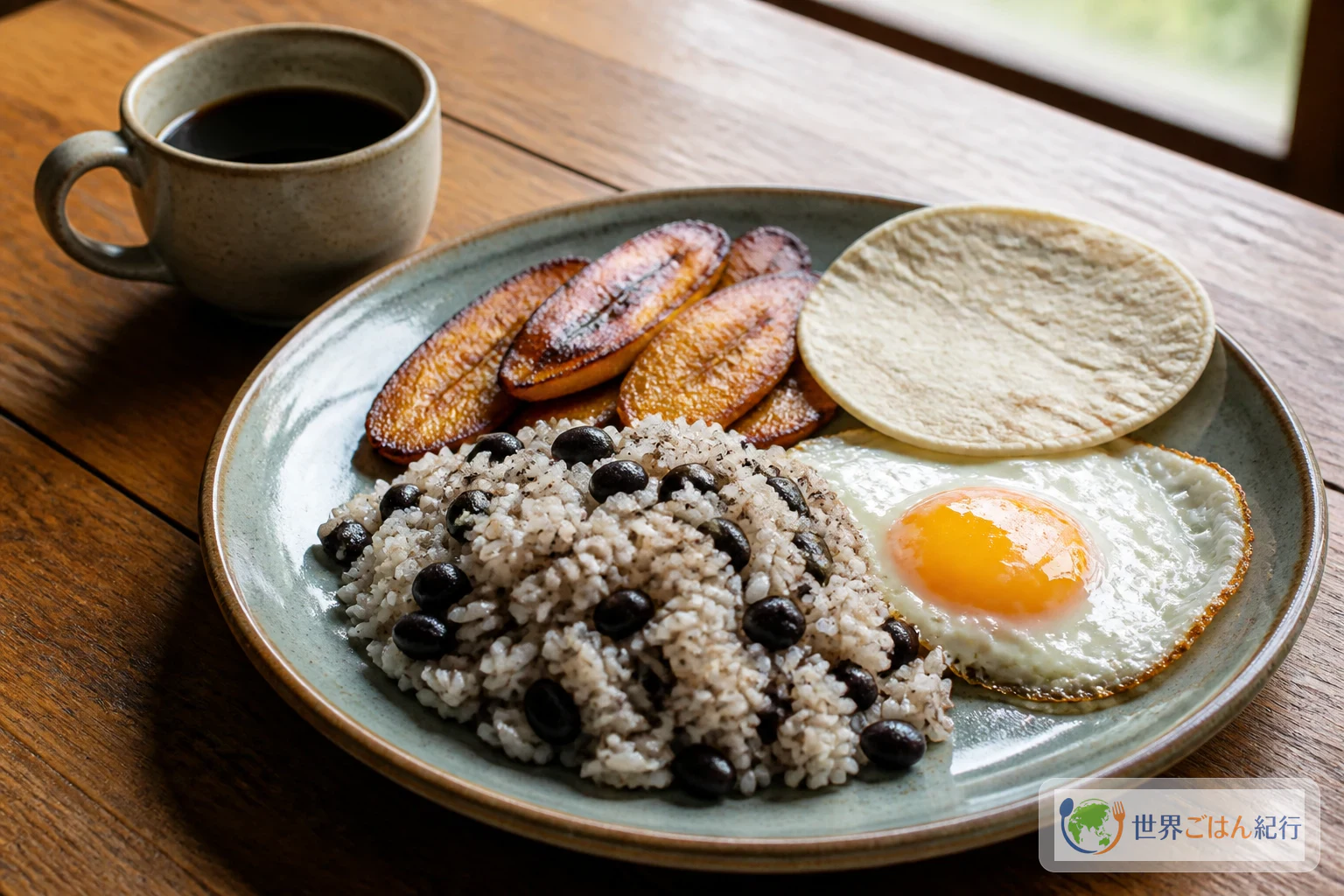
Gallo pinto is a breakfast-leaning dish of rice and beans stir-fried together. Casado is a lunch or dinner plate that sets several dishes, including rice and beans, side by side. Both have rice and beans, but the makeup of the meal is different.
Sources