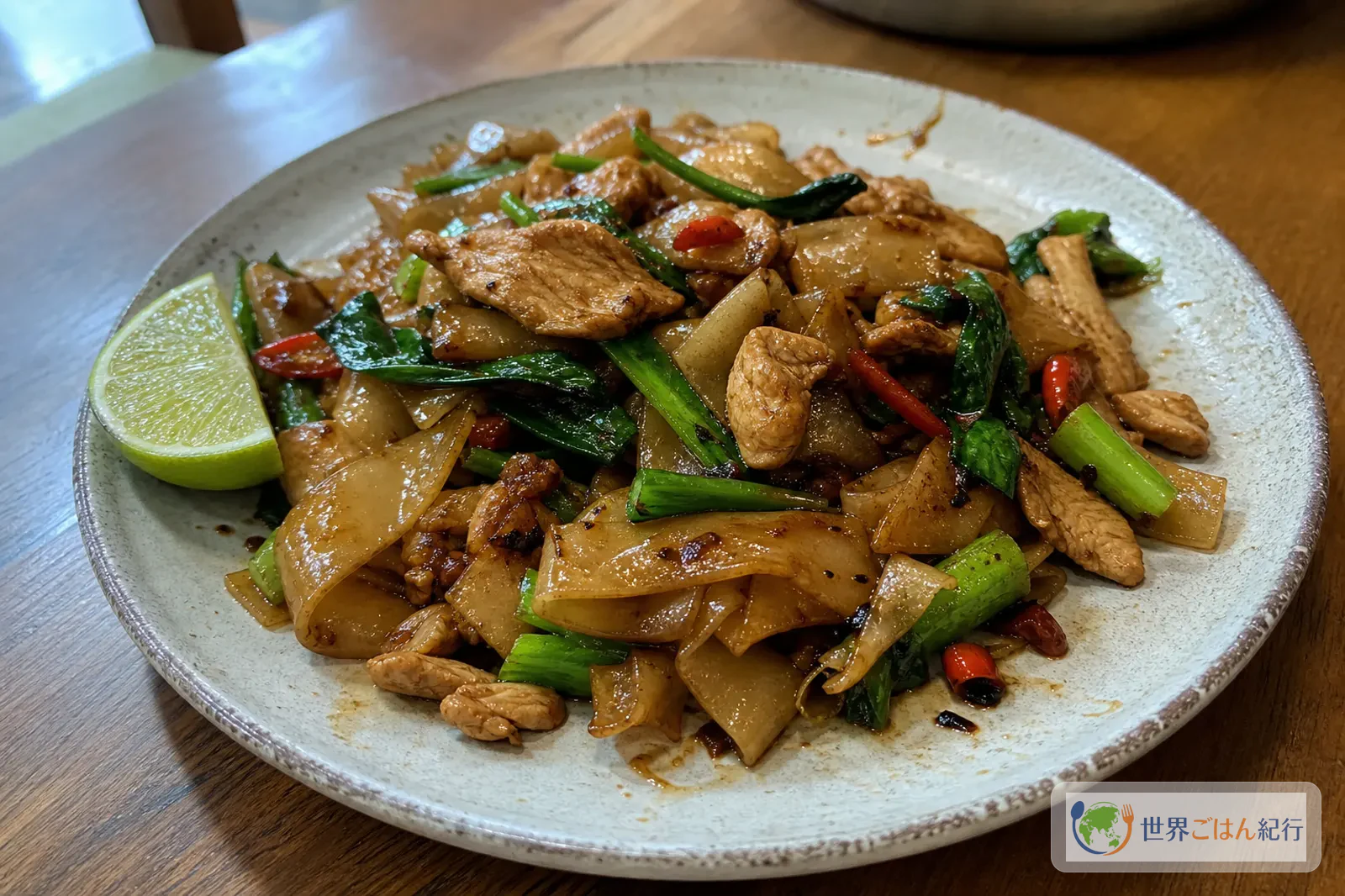
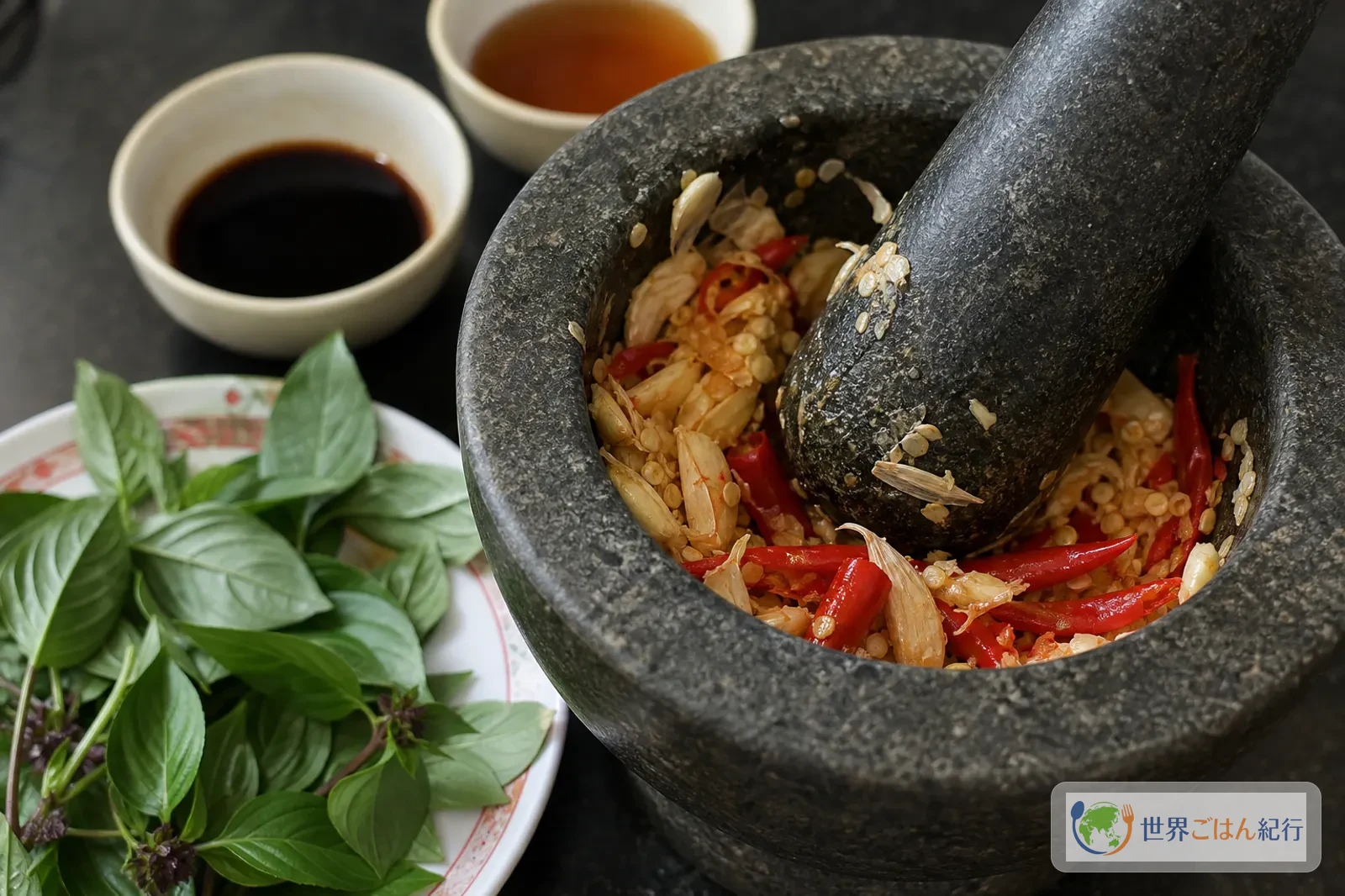
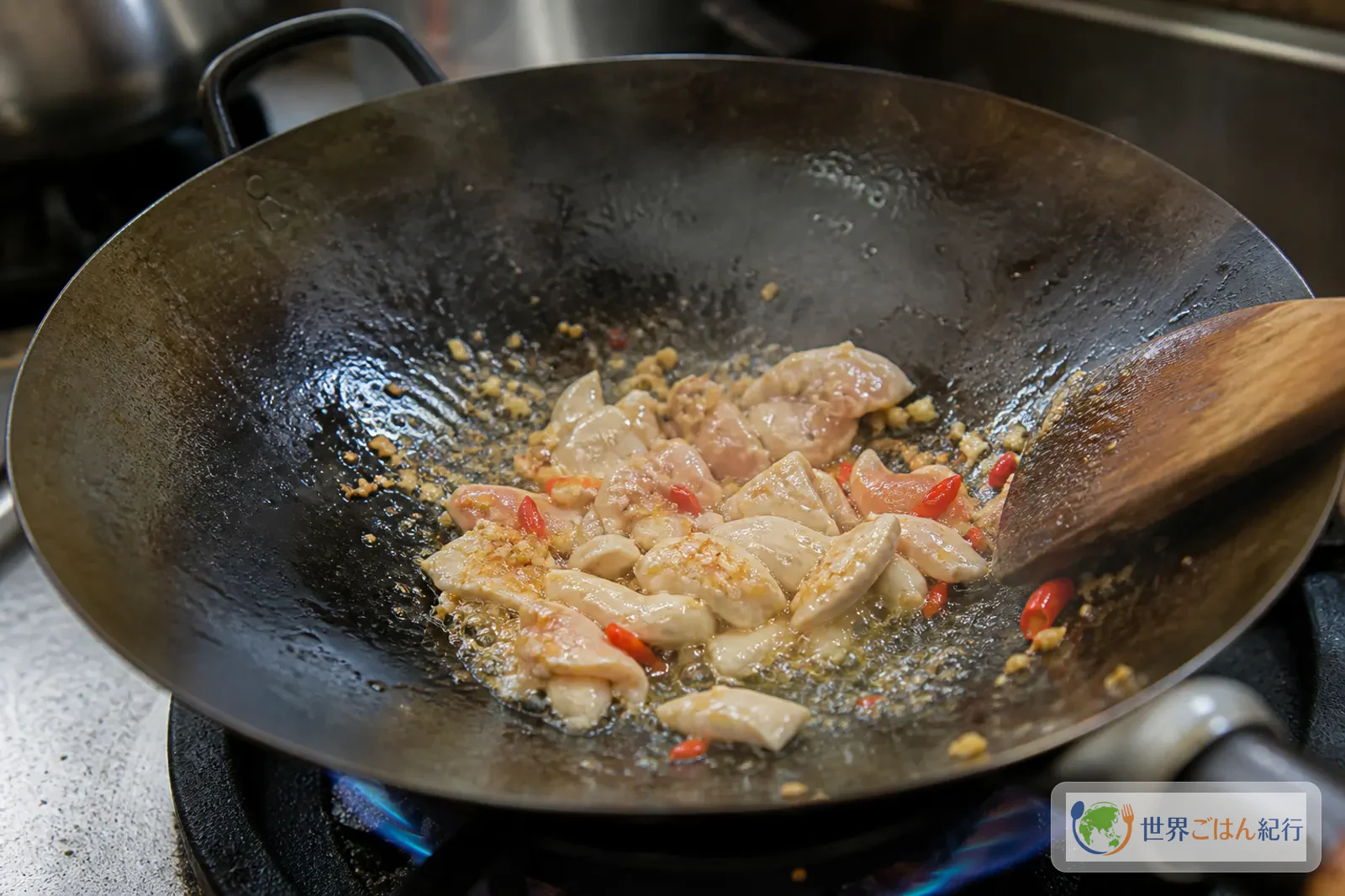
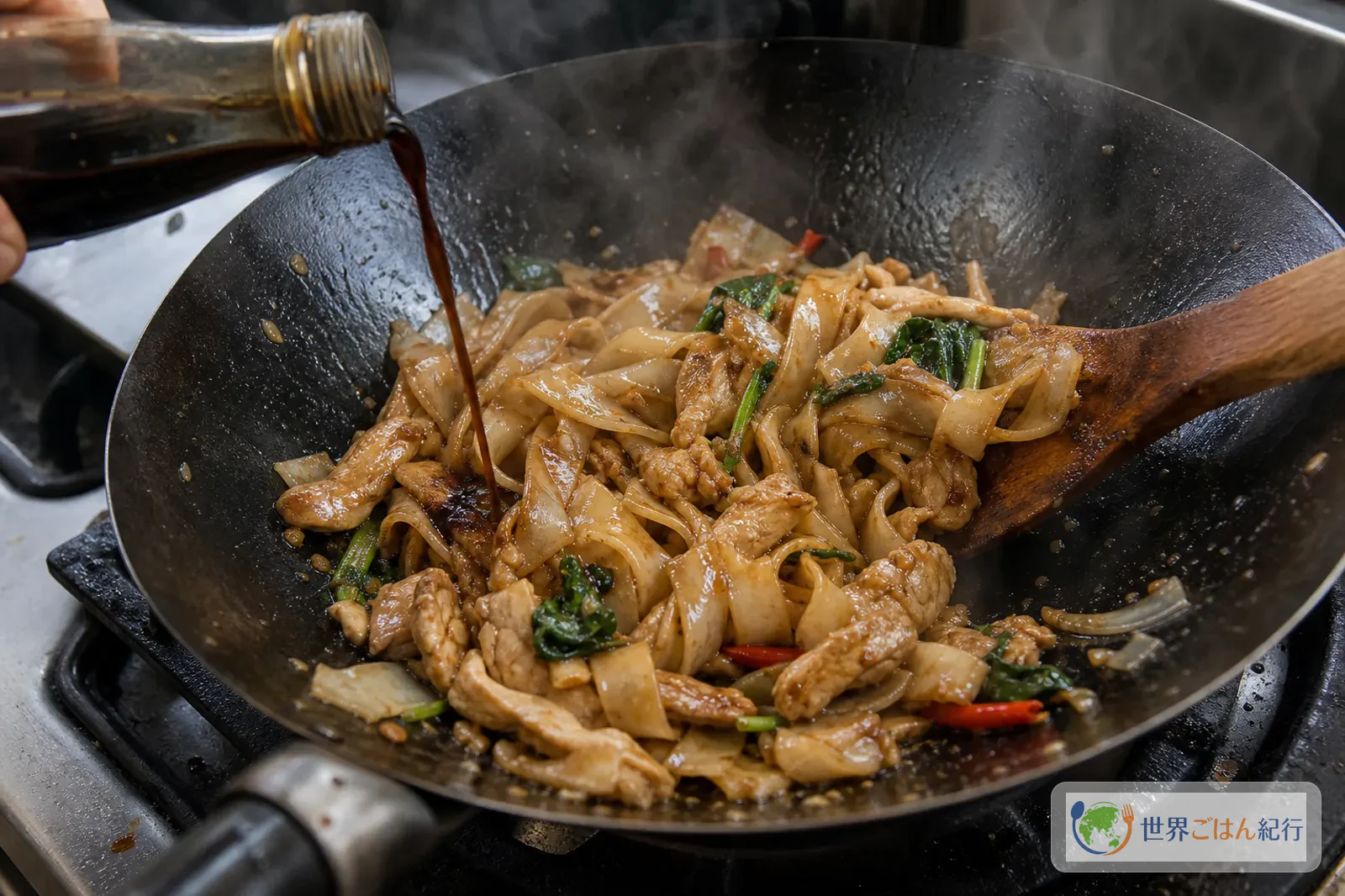
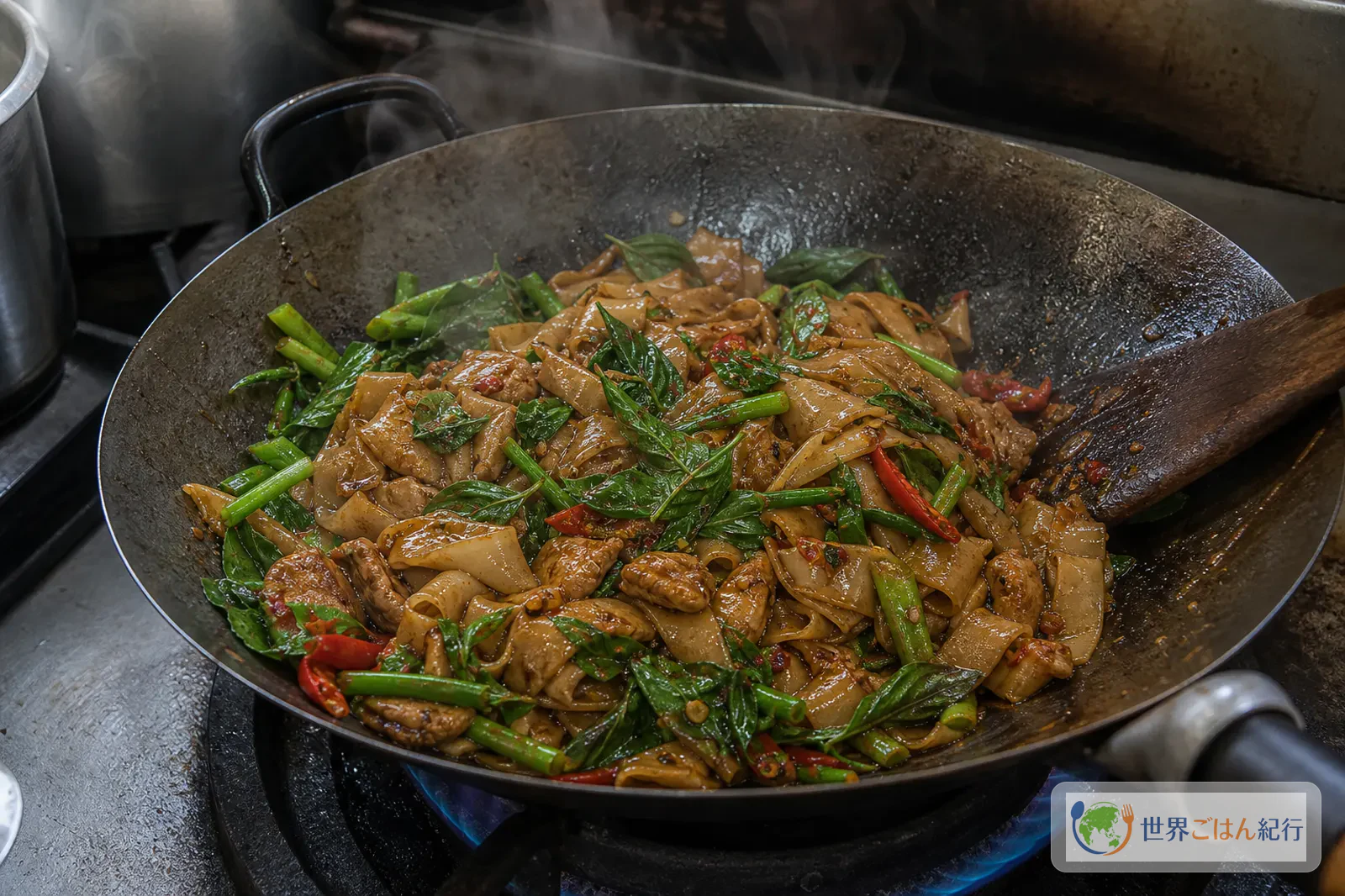
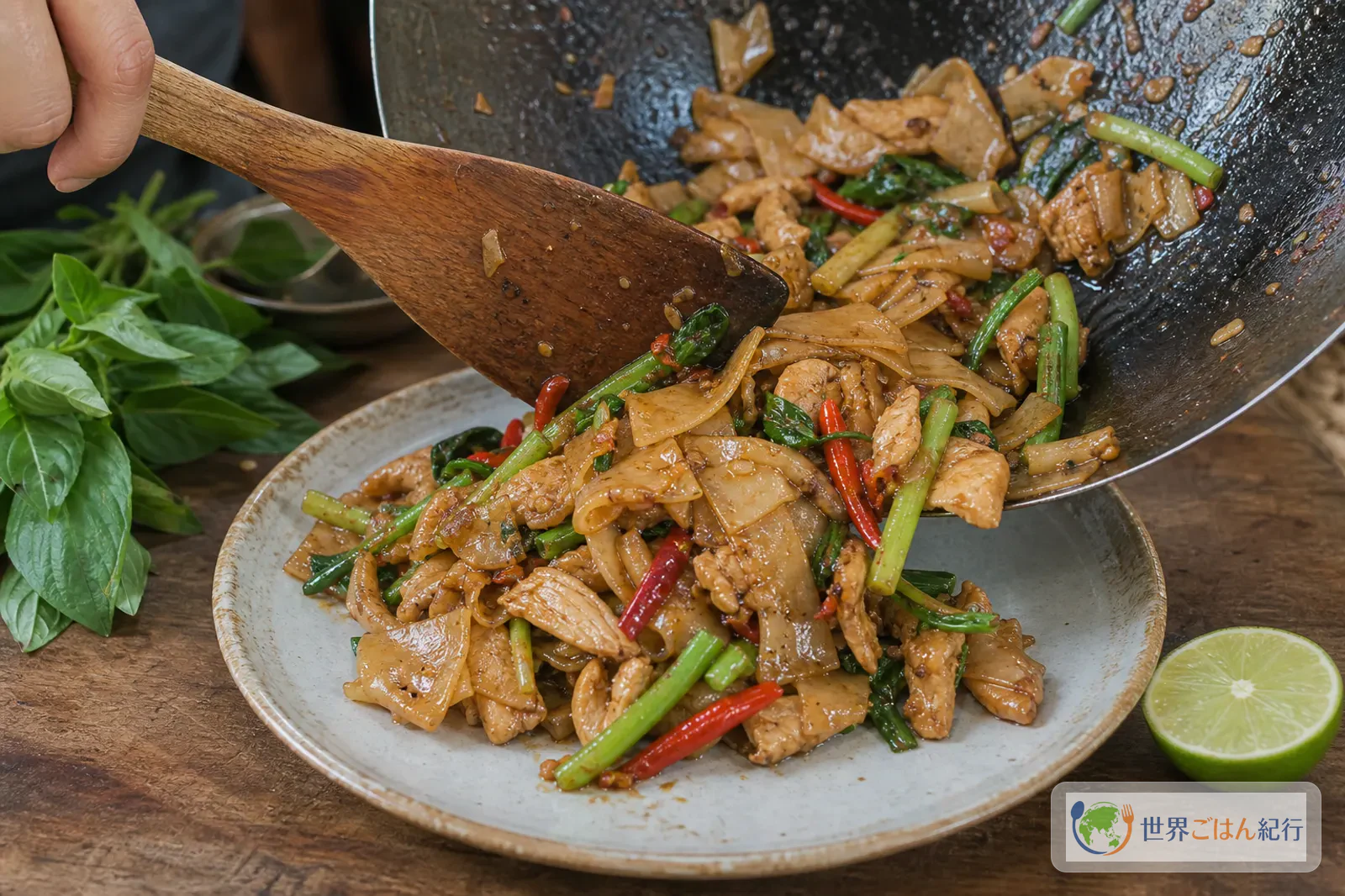
The moment crushed garlic and chile hit an oiled wok, the air in the kitchen changes. Add wide rice noodles, circle dark soy sauce around the wall of the pan, and a sweet char, the saltiness of fish sauce and, at the very end, the green scent of basil all rise together. Pad kee mao (ผัดขี้เมา, also written phat khi mao), known in English as drunken noodles, is a Thai street noodle built on chile, garlic, basil and dark soy sauce. It comes together in a few fast minutes over high heat, and that momentum is what ends up on the plate.
About pad kee mao
Despite the English name, no alcohol goes into the dish. There are several stories behind it: the flavor is so strong you crave it after drinking, even a drunk person can make it by instinct, or it's so hot it sobers you up. Pick whichever you like best.
Pad kee mao is where Chinese-origin wok culture and Thailand's chile-and-herb cooking overlap. Stir-frying flat rice noodles over high heat is much like Malaysia's char kway teow, but where char kway teow leans toward sweet soy sauce and the seafood aroma of the Straits region, pad kee mao pushes forward with garlic, chile and holy basil. Indonesia's mie goreng, finished with sweet soy sauce, is another close cousin. Even within the same rice culture, the sauce, the width of the noodle and the use of heat change the dish completely.
Compared with a sweet-and-sour noodle like pad thai, pad kee mao is all about heat and char. If you love the basil stir-fry in gapao rice, you'll find that same aroma here, in noodle form.
Ingredients (serves 2)
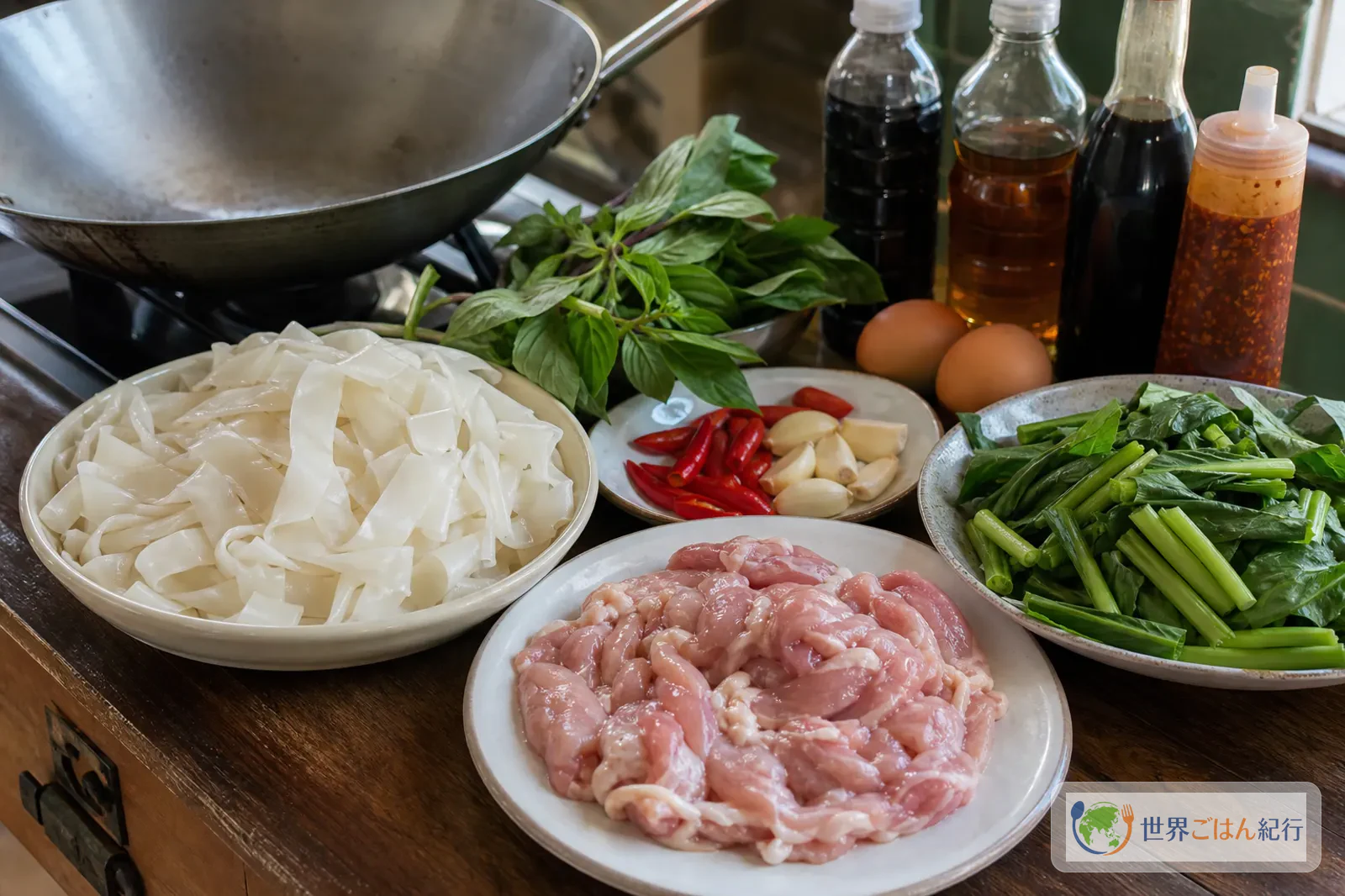
This recipe uses egg, chicken, fish sauce, soy, soy sauce containing wheat, and oyster sauce, which contains oysters. Cook the chicken until it is white and opaque through the center and the juices run clear. Rice noodles dry out easily if left long at room temperature, so after soaking, drain them and stir-fry the same day.
Ingredients that cause hesitation when shopping
What is worth tracking down for pad kee mao is not ordinary chicken or greens. It is wide rice noodles, dark soy sauce and a wok that lets you spread the noodles. Fish sauce is now in most supermarkets, but rice noodles and dark soy sauce differ a lot from store to store, and if these are weak it easily drifts toward "spicy soy-sauce stir-fried noodles."
Choosing noodles, sauces and basil for pad kee mao
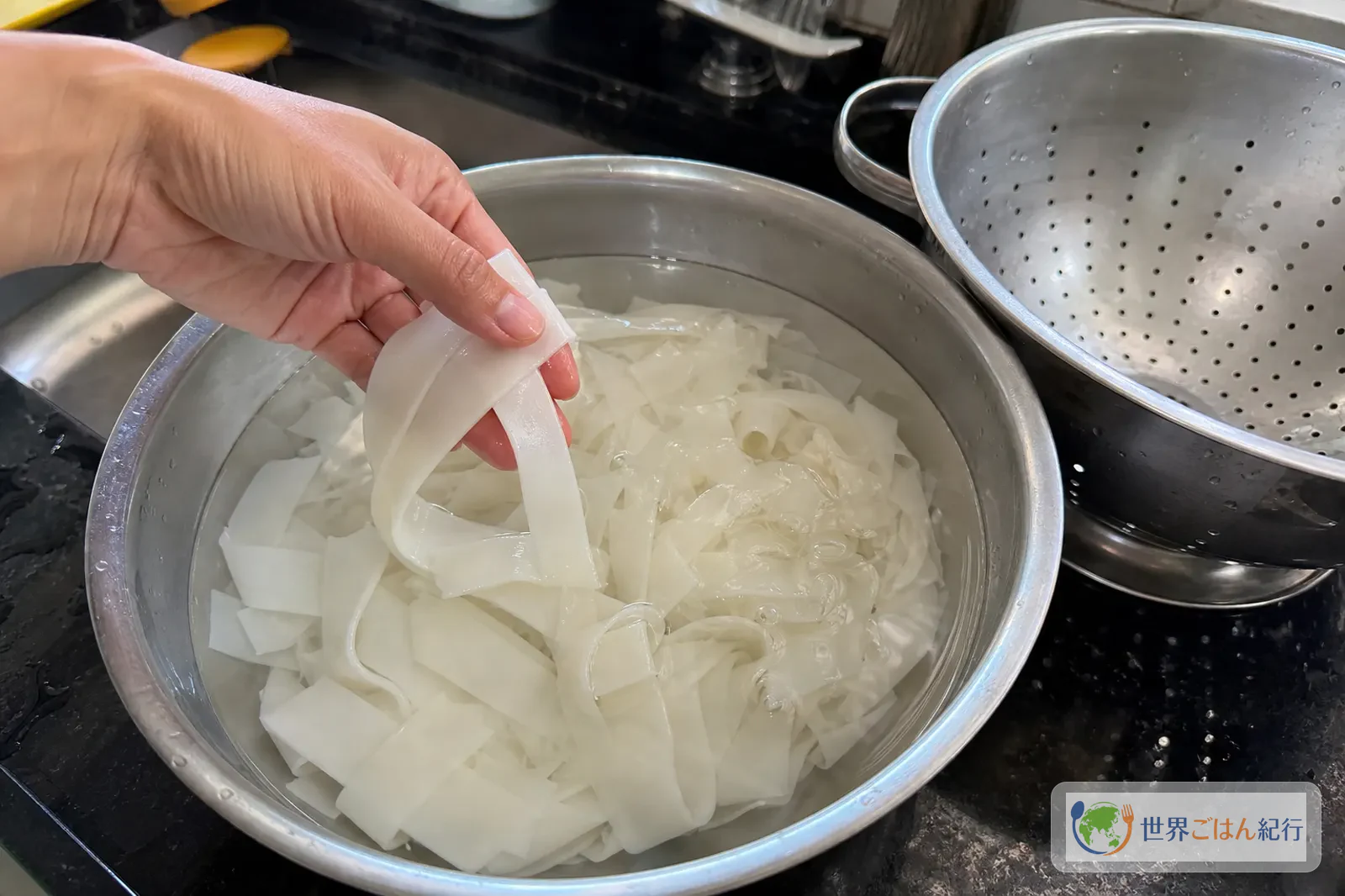
At street stalls in Thailand, cooks often use wide fresh rice noodles called sen yai. They're chewy and don't tear easily, and only the parts touching the wall of the pan scorch slightly. Fresh sen yai is hard to find elsewhere, so use dried pho or wide rice noodles and soak them on the short side. Over-softened noodles hold water before they ever reach the wok, and then they tear.
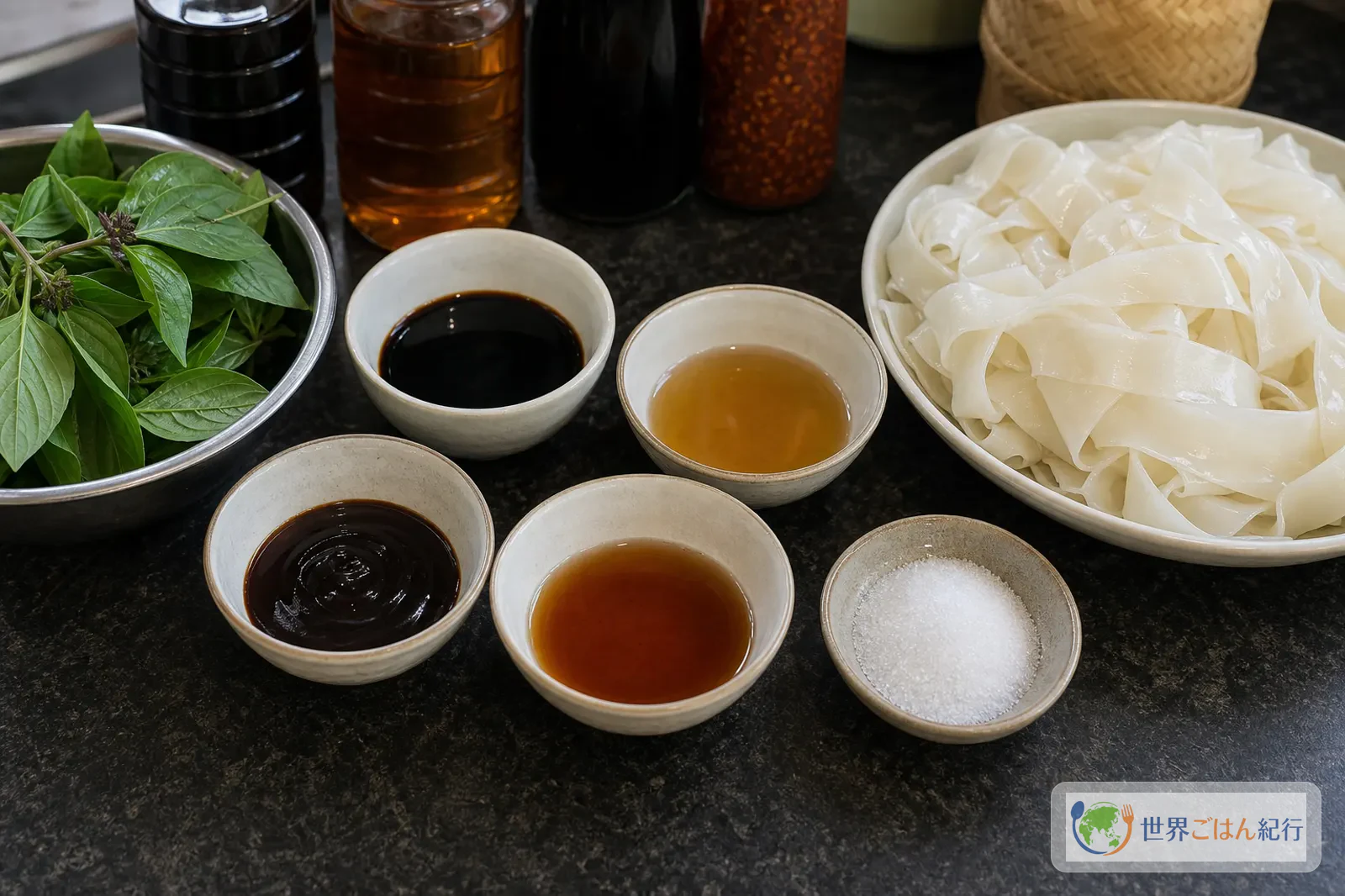
The flavor rests on four things: the color and roundness of dark soy sauce, the saltiness of fish sauce, the body of oyster sauce and a small sweetness from sugar. Thai see ew dam works much like Chinese dark soy sauce, giving the noodles a black gloss and a caramel-like aroma. With ordinary soy sauce alone, the color stays pale and only the salt comes through, so even a little dark soy sauce gets you much closer to a street noodle.
If you have no dark soy sauce, mix 2 tsp regular soy sauce with 1/2 tsp brown sugar. It won't taste exactly the same, and since regular soy sauce pushes the saltiness forward, cut the fish sauce to 2 tsp and adjust at the end.
Holy basil is what you want if you can get it. It's green, slightly spicy and a little medicinal, and its aroma stands up the moment you add it right before the heat goes off. Sweet basil is easier to find and makes a perfectly good pad kee mao, just sweeter and closer to Italian cooking. Thai basil works too. Shiso shifts the aroma toward a green-shiso stir-fried noodle, but the chile and fish sauce keep it on course, and it's a very usable weeknight substitute; add it after turning off the heat and let the residual heat wake it up. Whatever you choose, use fresh leaves, since dried basil has almost no aroma.
What can be swapped, and what to keep
| Element | What to keep | What can substitute | Why |
|---|---|---|---|
| Noodles | Wide rice noodles | Dried pho, flat rice noodles | The seared edges and chewy center are the core of the dish |
| Soy sauce | A little dark soy sauce | Regular soy sauce plus brown sugar | Color and caramel aroma are needed |
| Basil | Fresh leaves | Thai basil, sweet basil, shiso | Dried basil is weak in the final aroma |
| Greens | Leafy greens with stems | Gai lan, komatsuna, water spinach | The bite of the stems cuts the weight of the noodles |
| Heat | Warming chile in oil | Fewer chiles, seeds removed | Chile powder alone hardly gives aroma |
Sprinkling chile at the end makes the dish spicy, but the character of pad kee mao comes from chile and garlic carried into the oil. Even if you're shy about heat, crushing a small amount of seeded red chile into the oil keeps the dish recognizable.
Method
Before you put heat under the pan, set the noodles, sauce, cut toppings, egg and plate all within reach. Once you start stir-frying pad kee mao, it doesn't stop. Open the refrigerator midway and the noodles stick to the bottom of the pan or water comes out of the greens.
Pad kee mao problems and fixes
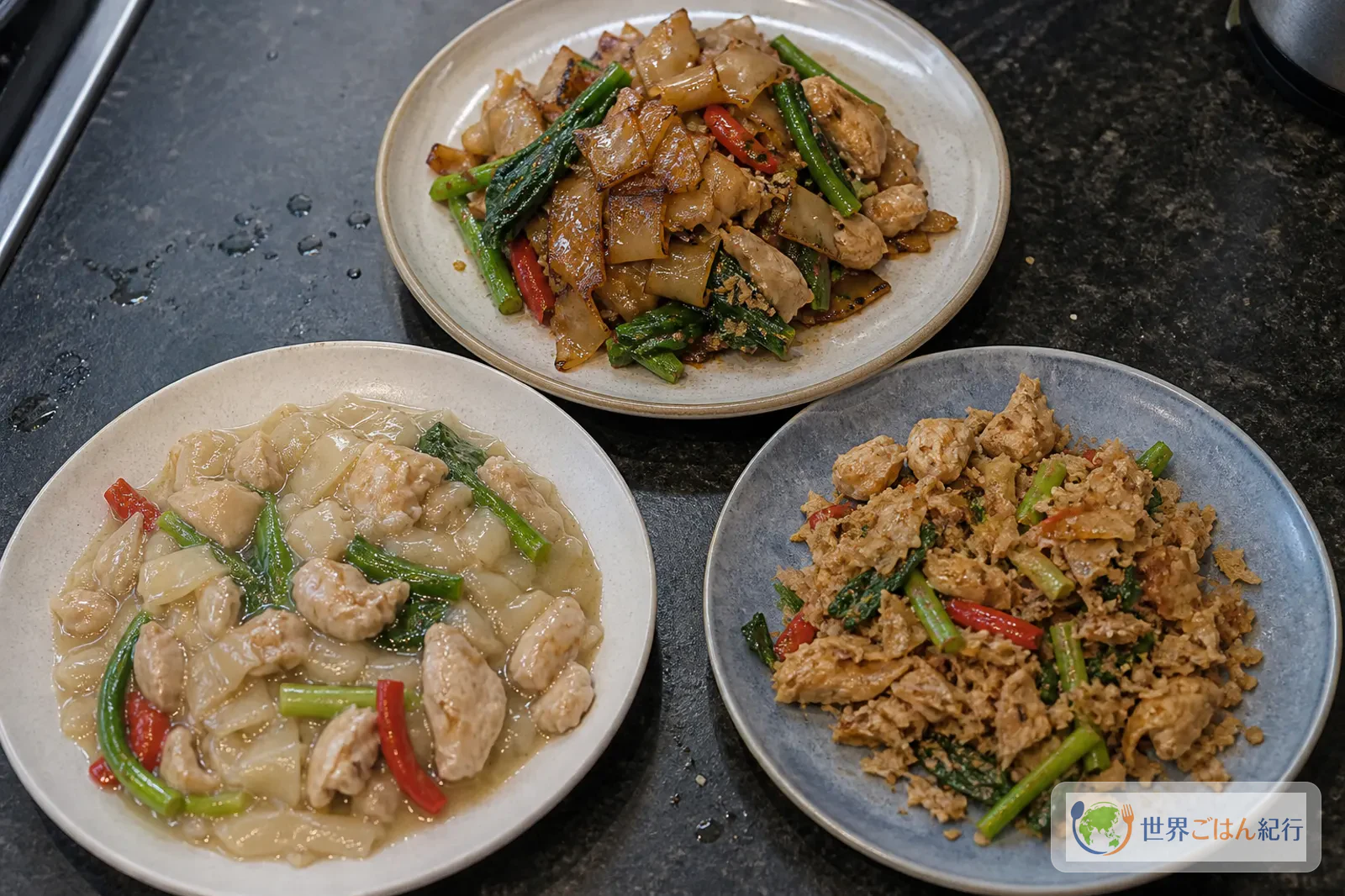
Pad kee mao succeeds or fails on the moisture in the pan more than on the ingredients. A home stove can't match the firepower of a street stall, so keep the toppings few, even for two servings. Chicken, greens, egg and noodles are plenty; bean sprouts, onion or mushrooms add water and leave the noodles pale and steamed.
The most common cause of wateriness is over-softened noodles. Soaking them in boiling water is fine for soup but too much for stir-frying. Stop when a taste before cooking still feels "a little firm"; the sauce and residual heat in the pan bring them the rest of the way.
The second cause is a pan that isn't hot enough. A nonstick skillet shouldn't be heated dry for long, so cook one serving at a time instead. With a cast-iron pan or wok, heat it well before the oil goes in, and once the noodles are in, give them a moment to sear before you start tossing everything.
The third is too many toppings. If you want more vegetables, serve cucumber and lime on the side rather than adding more greens. Every extra watery vegetable in the pan pulls pad kee mao away from a strongly aromatic stir-fry and toward a heavily seasoned steamed noodle.
Serving, storage and FAQ
Pad kee mao smells best straight out of the pan. Hold back on the lime at first and squeeze it in after you've eaten about half, so the flavor doesn't go flat. A little chile vinegar cuts through the oil and soy sauce.
For a Thai street-stall table, add a small bowl of tom yum goong, whose heat runs in a different direction, and the green sourness of som tam. If you want a main alongside, low-liquid kai yang competes less with the noodles than a curry like gaeng phet.
Storage and reheating
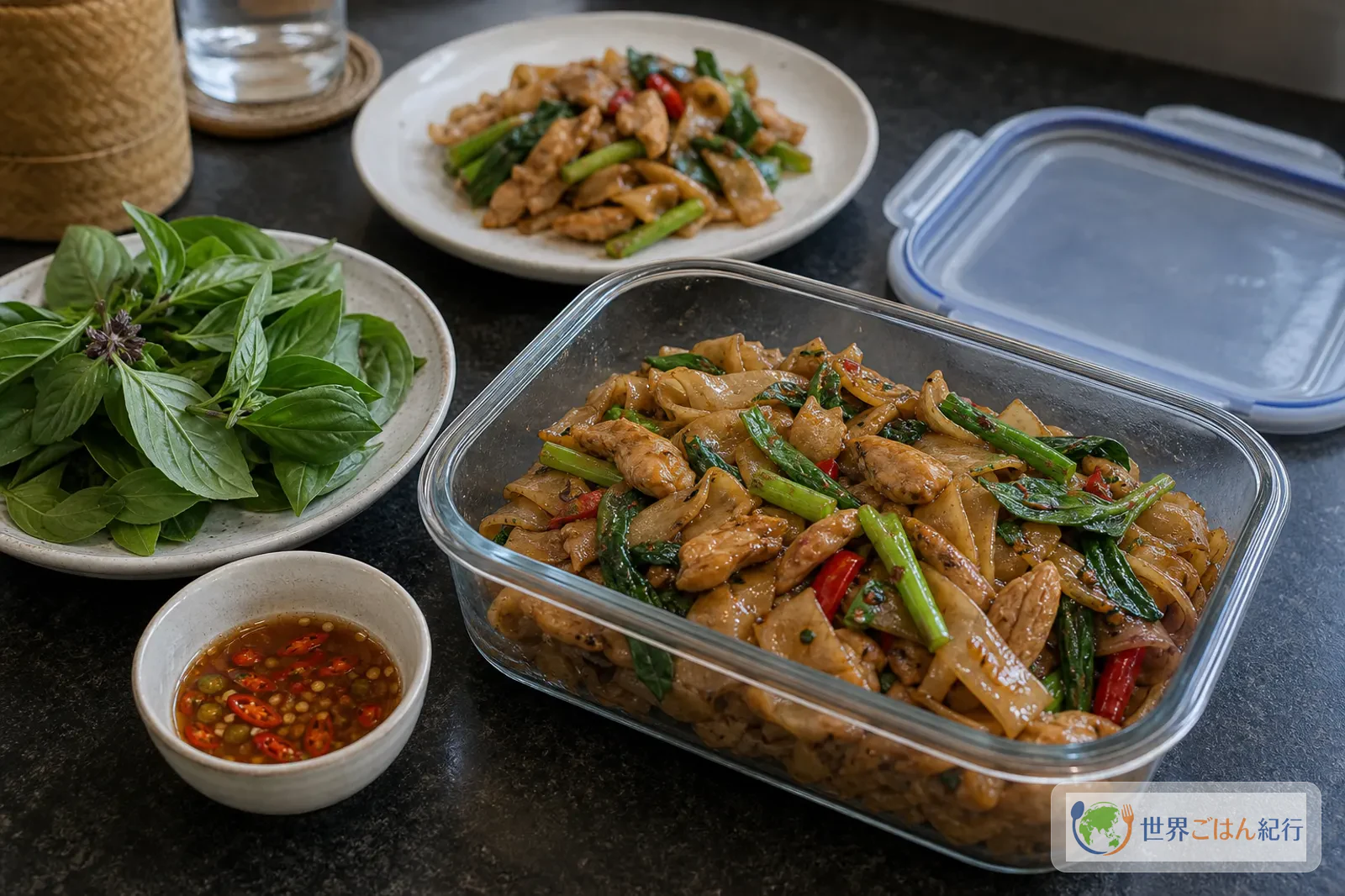
Pad kee mao is best eaten the same day. To store it, spread it in a shallow container, let it cool slightly and refrigerate until the next day. To reheat, put 2 tsp water and 1 tsp oil in a skillet, warm over medium heat for 1 minute, add the noodles and toss only 1 to 2 minutes. In a microwave, heat 40 to 50 seconds at 600 W, loosening once partway. Overheating breaks the noodles and blackens the basil.
Don't freeze it: rice noodles break easily when thawed and the sauce separates. Leftovers are nicer re-stir-fried the next day with an egg than eaten on their own.
Q1. I can't get sen yai. Can I make it with regular pho noodles?
Yes. With dried pho, choose flat ones 8 mm to 0.375 inch (10 mm) wide or more and soak them shorter than the package says. Thin rice vermicelli takes on flavor too, but it lacks the chewy, seared texture and ends up closer to a spicy fried vermicelli than pad kee mao.
Q2. What if I want to reduce the heat a lot?
Use 1 chile and remove the seeds, warming it in the oil so the aroma stays. When everyone wants a different level of heat, keep the pan mild and put chile vinegar or chile flakes on the table.
Q3. Can I make it with something other than chicken?
Thin-sliced pork, thin-sliced beef, shrimp or thick fried tofu all work. Cook the pork 2 minutes over high heat. Take shrimp out as soon as the surface turns white and return them at the end so they don't toughen. For thick fried tofu, cut it into 0.5 inches (1.5 cm) cubes and brown 2 minutes over medium heat before combining with the noodles.
Q4. Can I put it in a lunch box?
You can, though the basil aroma and the spring of the noodles fade. Cook the egg fully and drive the moisture off the greens before packing, and avoid leaving soft-cooked egg or fresh herbs at room temperature for a long time. If it will be reheated, keep the chile modest and add a little lime or vinegar just before eating to bring the flavor back.
Sources
- Wikipedia contributors. "Drunken noodles." https://en.wikipedia.org/wiki/Drunken_noodles (accessed 2026)
- Wikipedia contributors. "List of Thai dishes." https://en.wikipedia.org/wiki/List_of_Thai_dishes (accessed 2026)
- Pailin Chongchitnant. "Pad Kee Mao." Hot Thai Kitchen. https://hot-thai-kitchen.com/pad-kee-mao/ (accessed 2026)
- Mark Wiens. "Thai drunken noodles recipe." Eating Thai Food. https://www.eatingthaifood.com/drunken-noodles-pad-kee-mao-recipe/ (accessed 2026)
- Thai Taste Therapy. "Pad Kee Mao." https://www.thaitastetherapy.com/dish/pad-kee-mao (accessed 2026)