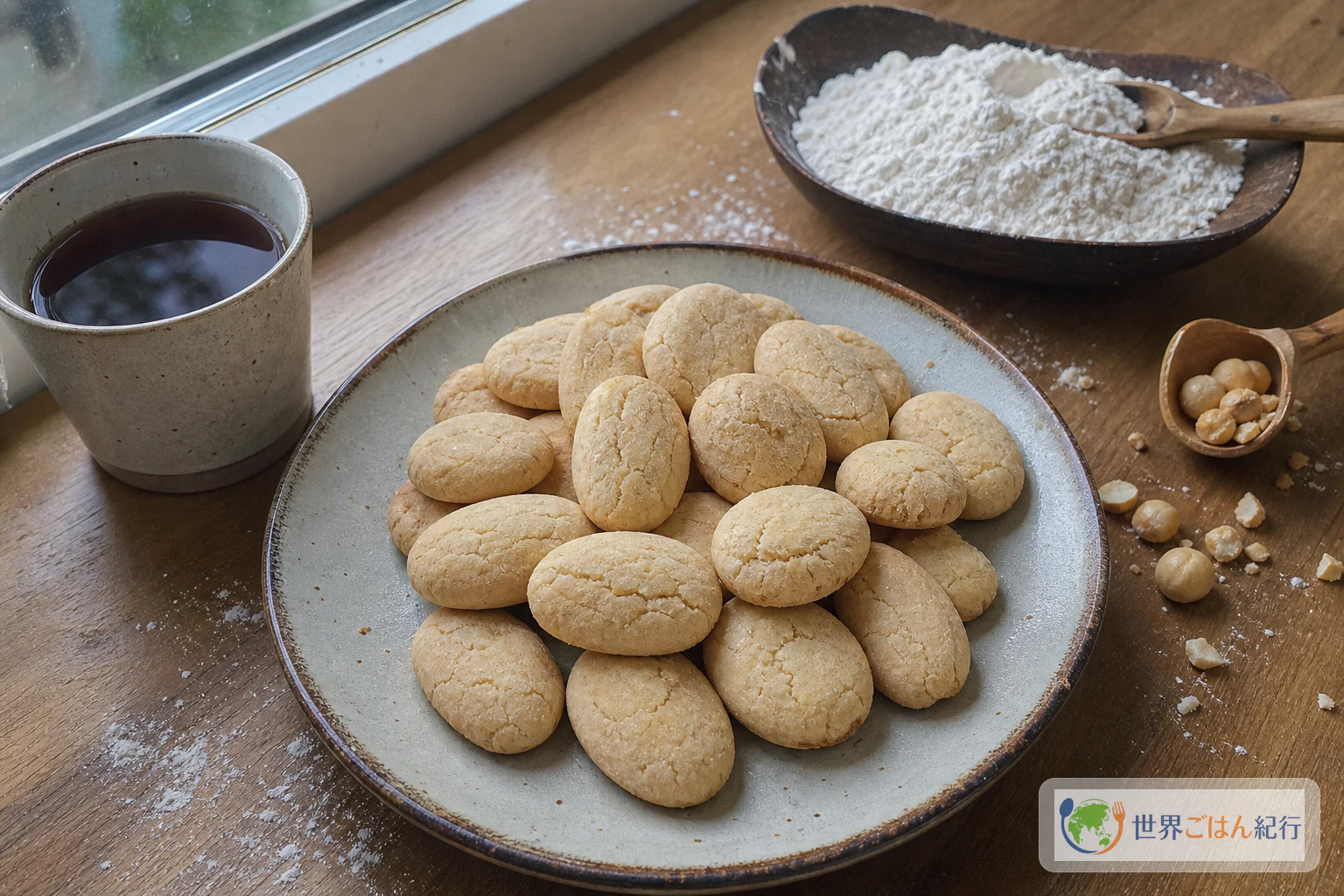
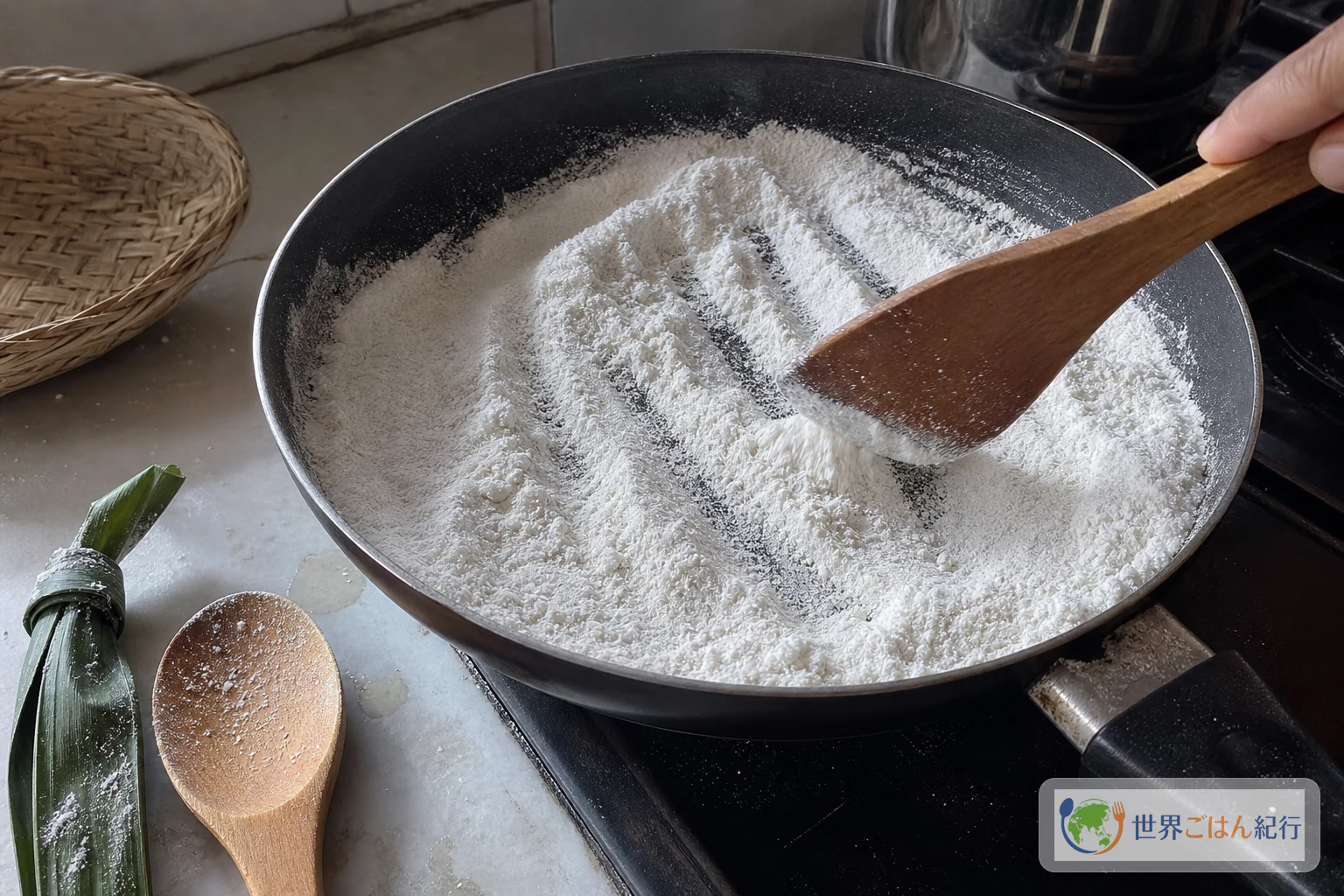
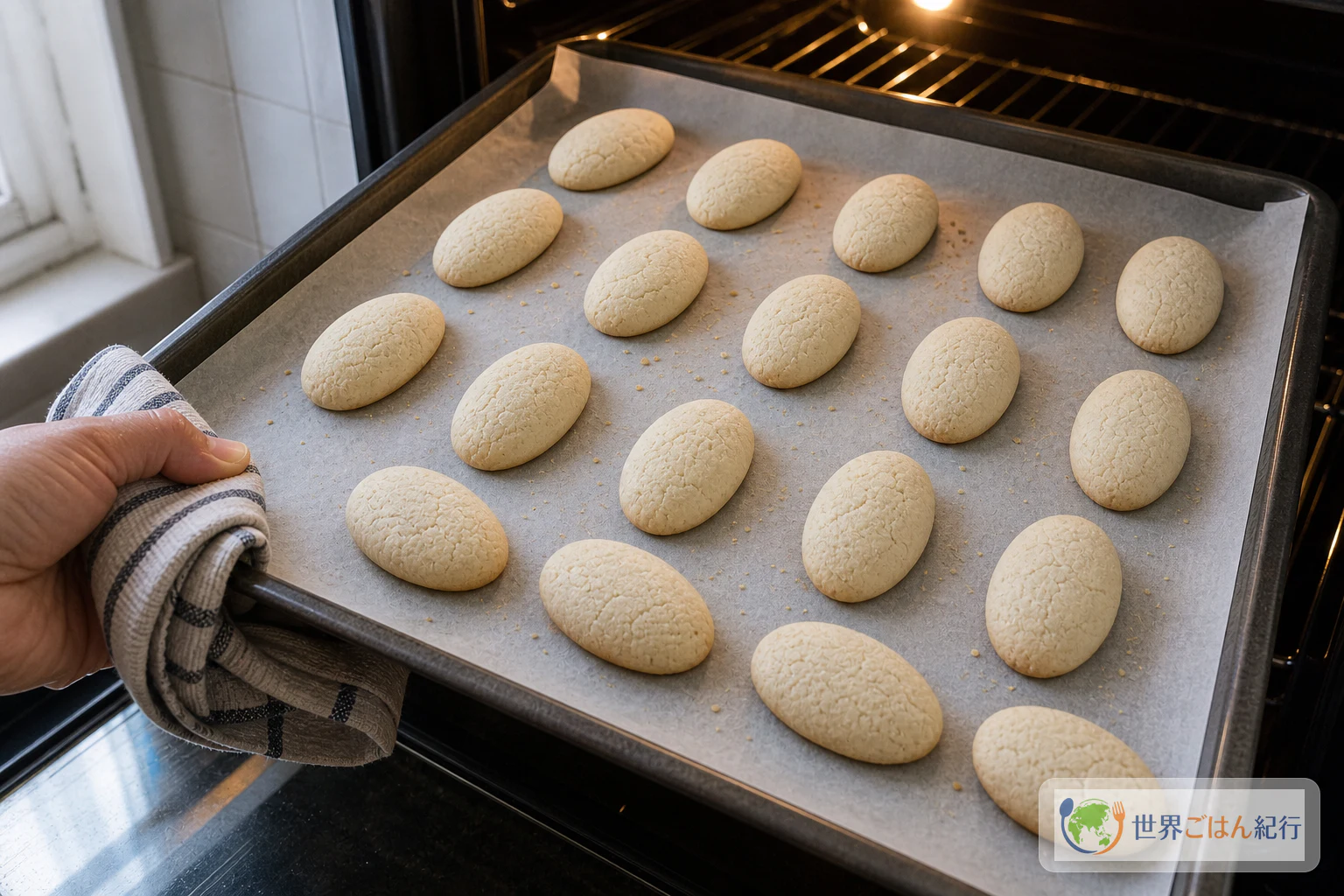
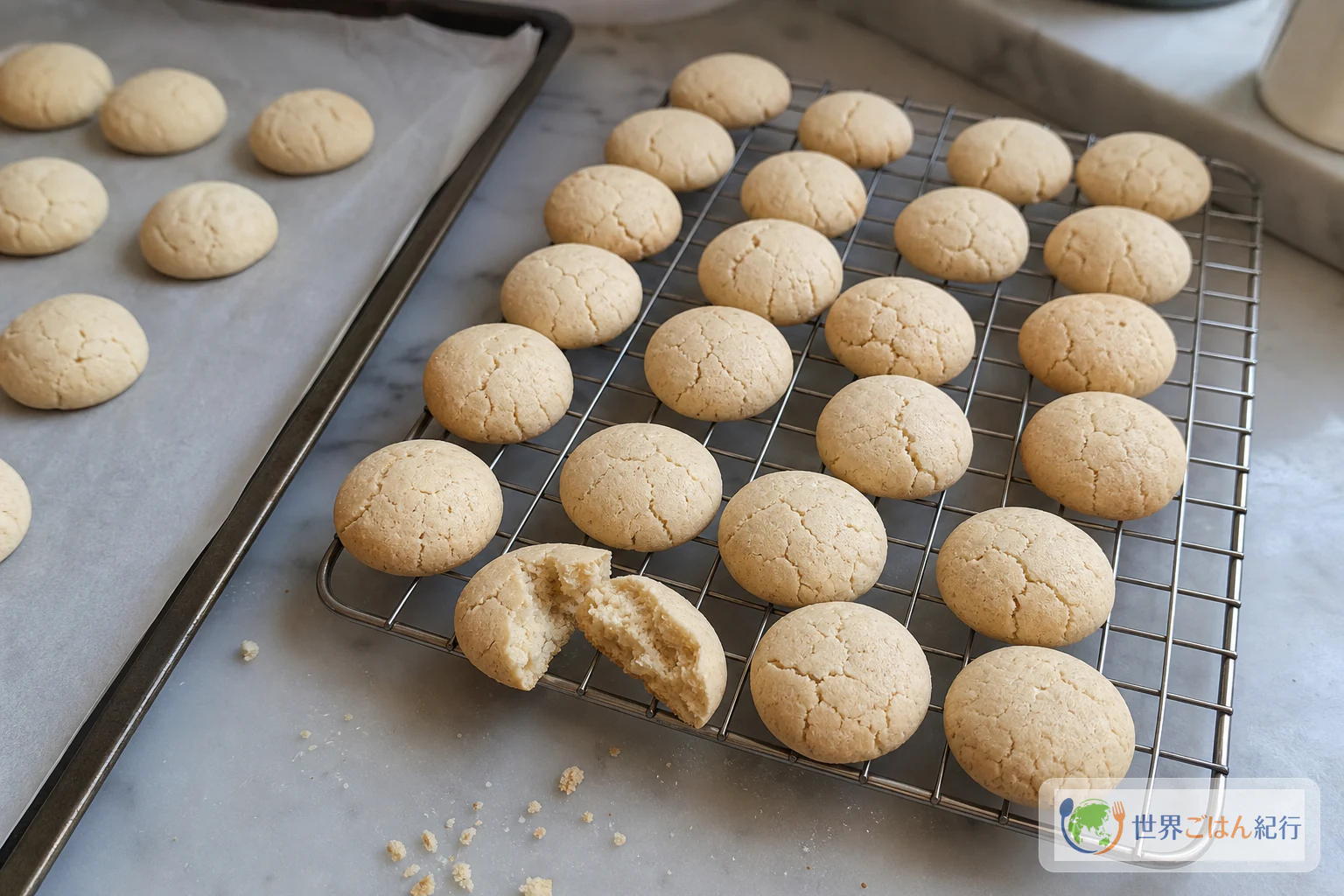
Stir sago flour slowly in a dry frying pan and, at some point, the flour that looked plain white turns loose and light. It smells of dry, toasted starch, nothing like rice flour or wheat flour. Mix in coconut milk and nuts, bake it low as if you were drying it, and you get a modest little sweet that crumbles tenderly the moment you bite it. This is bagea (kue bagea), a baked sago-flour sweet from eastern Indonesia, especially Maluku and North Sulawesi, and an easy way into the food of a region where sago is both a staple and a sweet.
About bagea
Bagea is associated with Ternate and North Maluku, and people also love it in Gorontalo and Southeast Sulawesi. Unlike a wheat-flour butter cookie, it doesn't depend on gluten to hold its shape. The sago starch is dried out, and the nuts and sugar give it that melt-in-the-mouth crumble. Sago palm starch is everyday food in the region. It goes into porridges like papeda and into baked sweets like this one. If you've tasted papeda, you'll be struck by how differently the same starch behaves once it becomes a cookie.
If you like dry, floury sweets such as kue satu, bagea will feel familiar right away.
In Indonesian it is written Bagea or kue bagea. Kue is a broad word for sweets and light snacks. Here, "bagea" means a dry baked sweet of sago flour.
Ingredients (makes 24 small cookies)
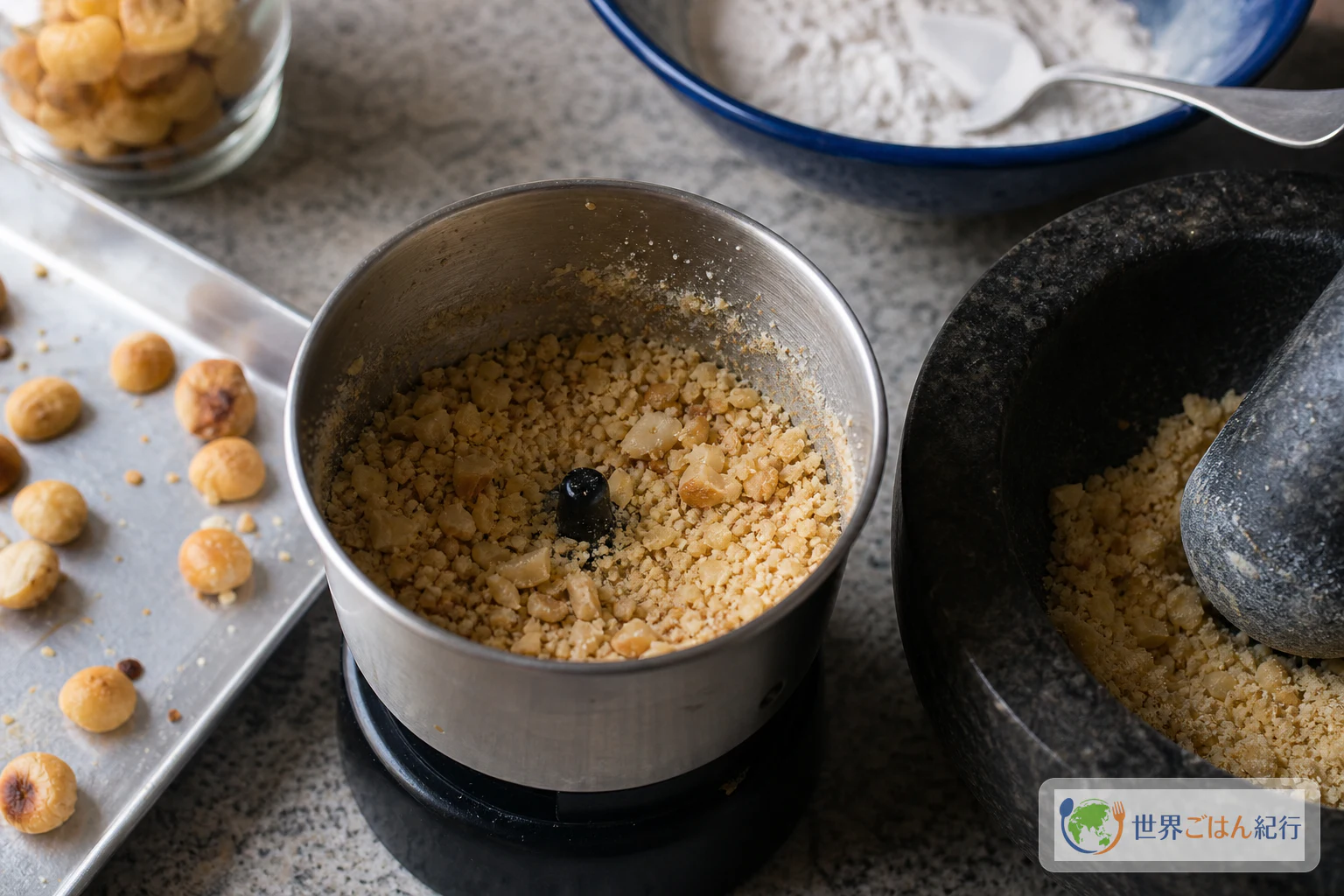
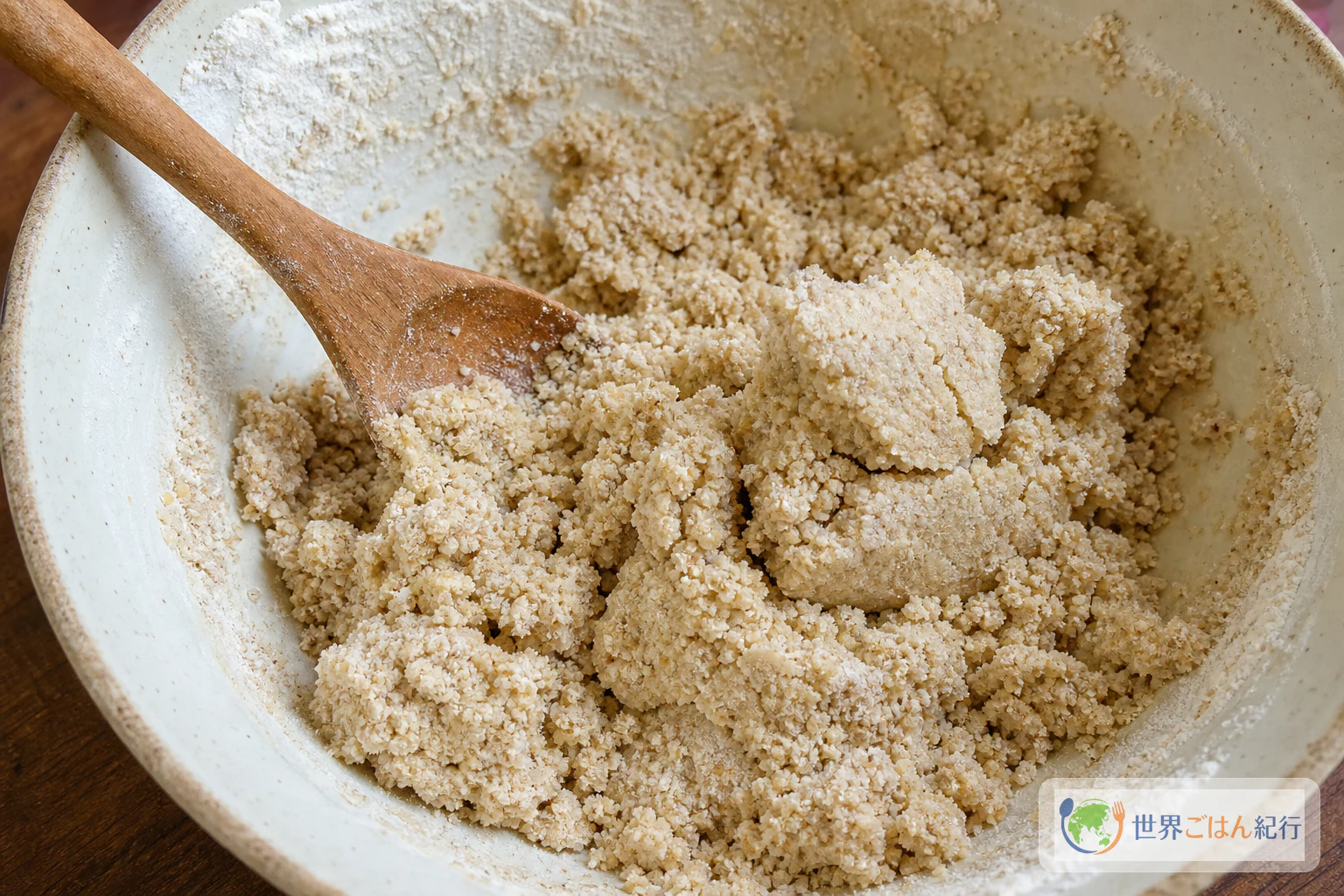
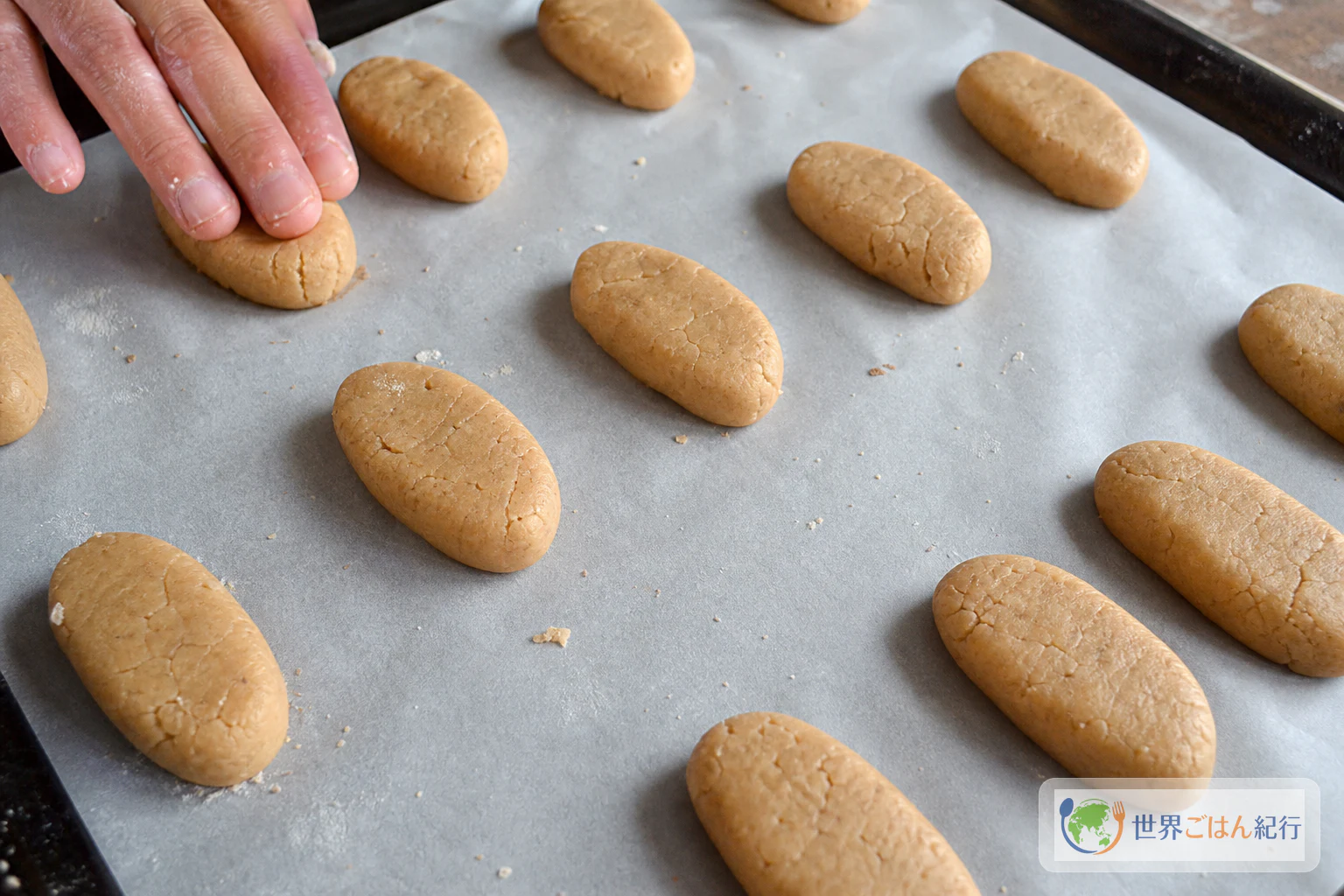
Grind nuts too fine and they release oil and turn to paste. Stop when coarse powder and small grains are mixed; the aroma stays when you eat. Sago flour and tapioca starch absorb liquid a little differently, so in the final dough look for a state where it holds when pressed and leaves fine cracks when you release your fingers.
This dish contains egg and nuts. Some canned coconut milk and processed nuts are made with or near dairy, wheat or soy, so read the labels if you have allergies.
Choosing ingredients for bagea
Flour
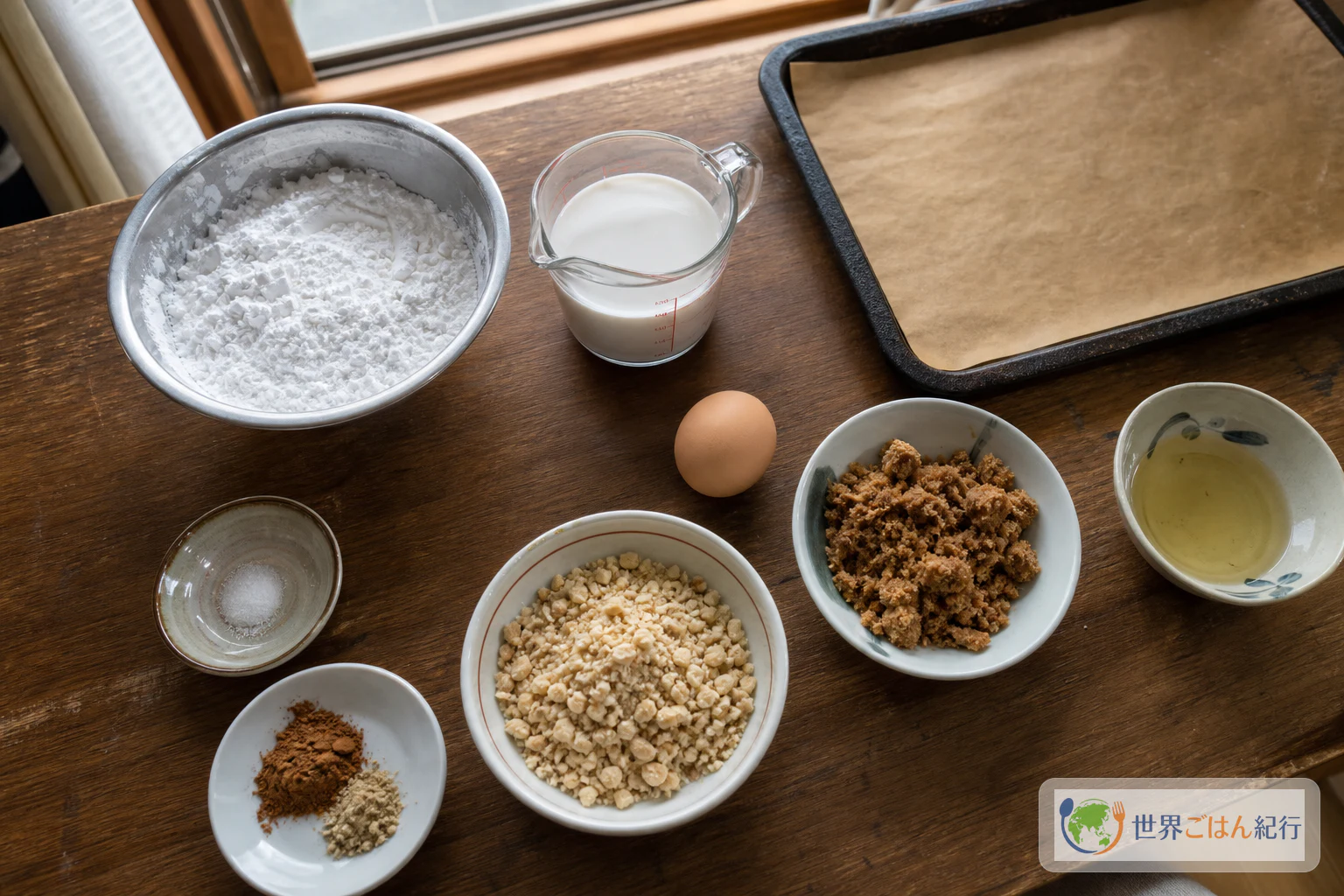
Sago flour is hard to find outside the region, so use it if you can and tapioca starch if you can't. The flour is where your money should go. Eggs and oil can come from anywhere. If you're unsure, start with a small bag of tapioca starch. It isn't sago, but it gives you that dry, starchy texture, and the leftovers are good for thickening or for dim sum-style doughs.
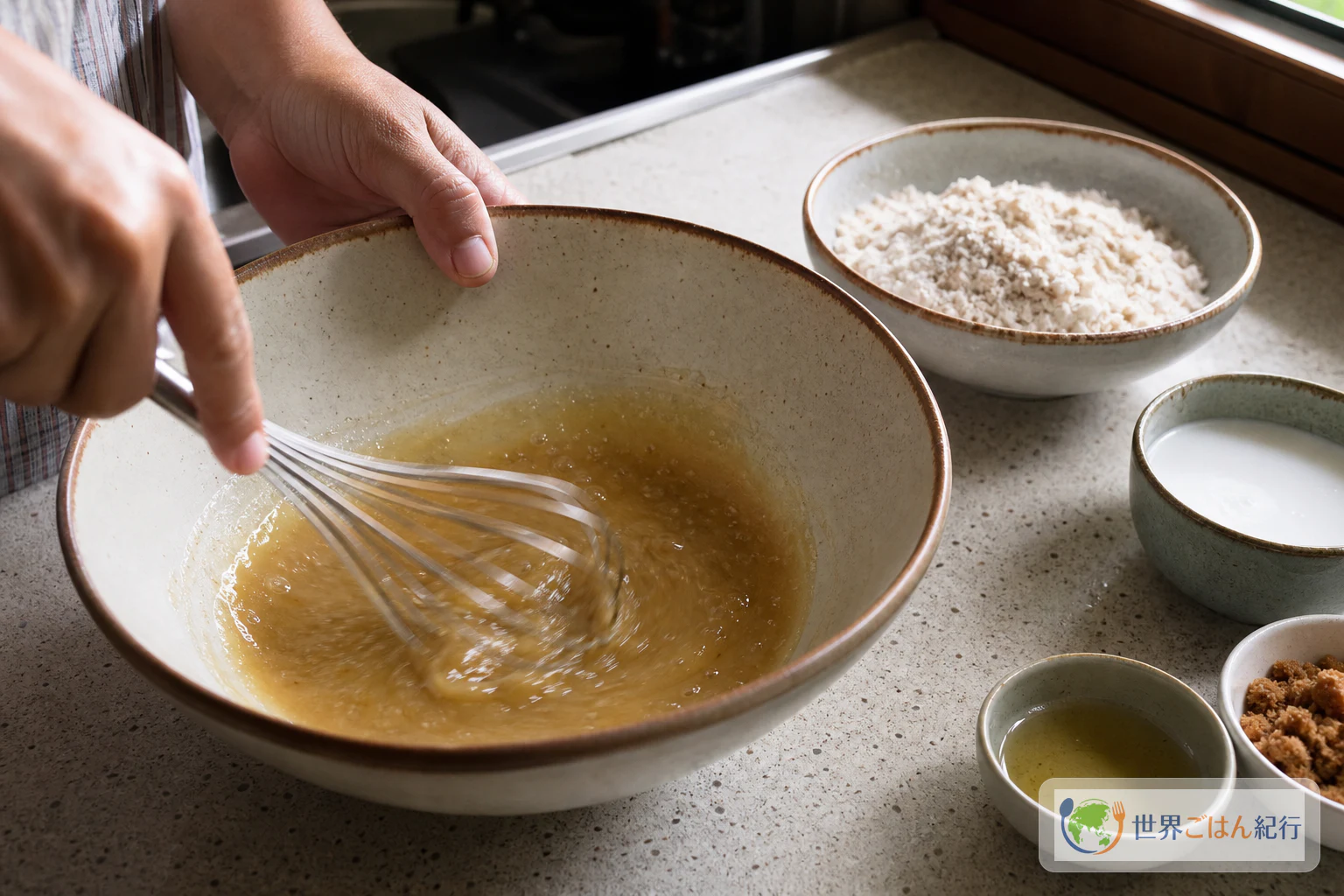
Tapioca starch makes a slightly tighter dough than sago flour, so add the last of the coconut milk a teaspoon at a time. Sago flour is lighter and tends to crumble when you shape it. Either way, rest the dough 5 minutes after mixing in the egg mixture so the flour can absorb the moisture, and it will be much easier to handle.
Nuts
Kenari is a rich, fatty nut that turns up in sweets and savory dishes across eastern Indonesia, but it's rare elsewhere. Instead of hunting for it, use macadamia for its round richness or blanched almonds for a lighter toastiness. Cashews work too, but they read sweeter, so cut the sugar by 5 g to keep the cookies from tasting heavy.
Keeping the nuts coarse is what gives bagea its crumble. You can chop them by hand. For macadamia, a small mill run in short bursts gets you a coarse powder without pushing out too much oil.
Coconut milk
Coconut milk is the liquid that brings the flour together into a crumbly dough. Too much and the center stays heavy even after baking. Too little and the dough cracks as you shape it. Before measuring, stir the can so the thick part and the liquid are evenly mixed. Leftovers can go into nasi uduk or bubur cha cha (Japanese page), which is handy if you cook Southeast Asian food often.
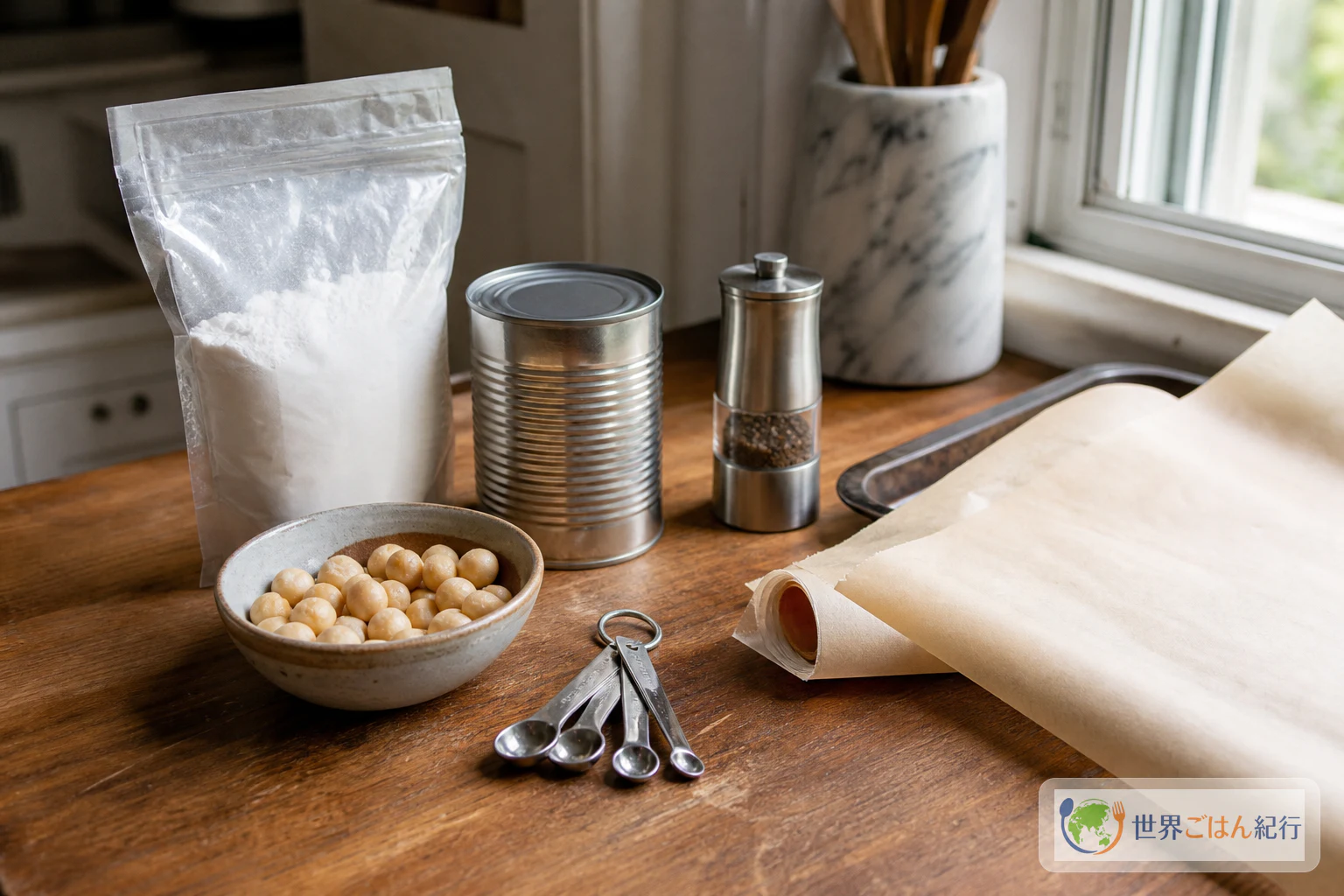
Local ingredients and home substitutes
Sago flour and kenari are ideal, but what matters most is keeping the flour dry, the nuts coarse and the oven low. Skip those and even the right ingredients give you nothing more than a hard cookie.
| Point of doubt | To get closer to local | At home | Where it goes wrong |
|---|---|---|---|
| Flour | Sago flour | Tapioca starch | Too much liquid leaves the center heavy |
| Nuts | Kenari nuts | Macadamia, blanched almonds | Making a paste turns oily |
| Sweetness | Palm sugar | Raw cane sugar, a little dark brown sugar | 100% dark brown sugar is too strongly aromatic |
| Aroma | Pandan, spices | A little cinnamon and ginger | Too much aroma erases the flavor of the flour |
| Baking | Low heat, drying | Watch at 300°F (150°C) | Chasing color makes it hard |
Method: dry-toast, then dry low
Bagea is not a sweet baked fast at high heat. Dry the sago flour or tapioca starch first to bring out the aroma, gather it with little liquid, and bake slowly at 150°C (300°F). If you push the color, the bitterness of scorch outweighs the toastiness, so stop when the surface is pale and only the bottom is a light beige.
Bagea troubleshooting
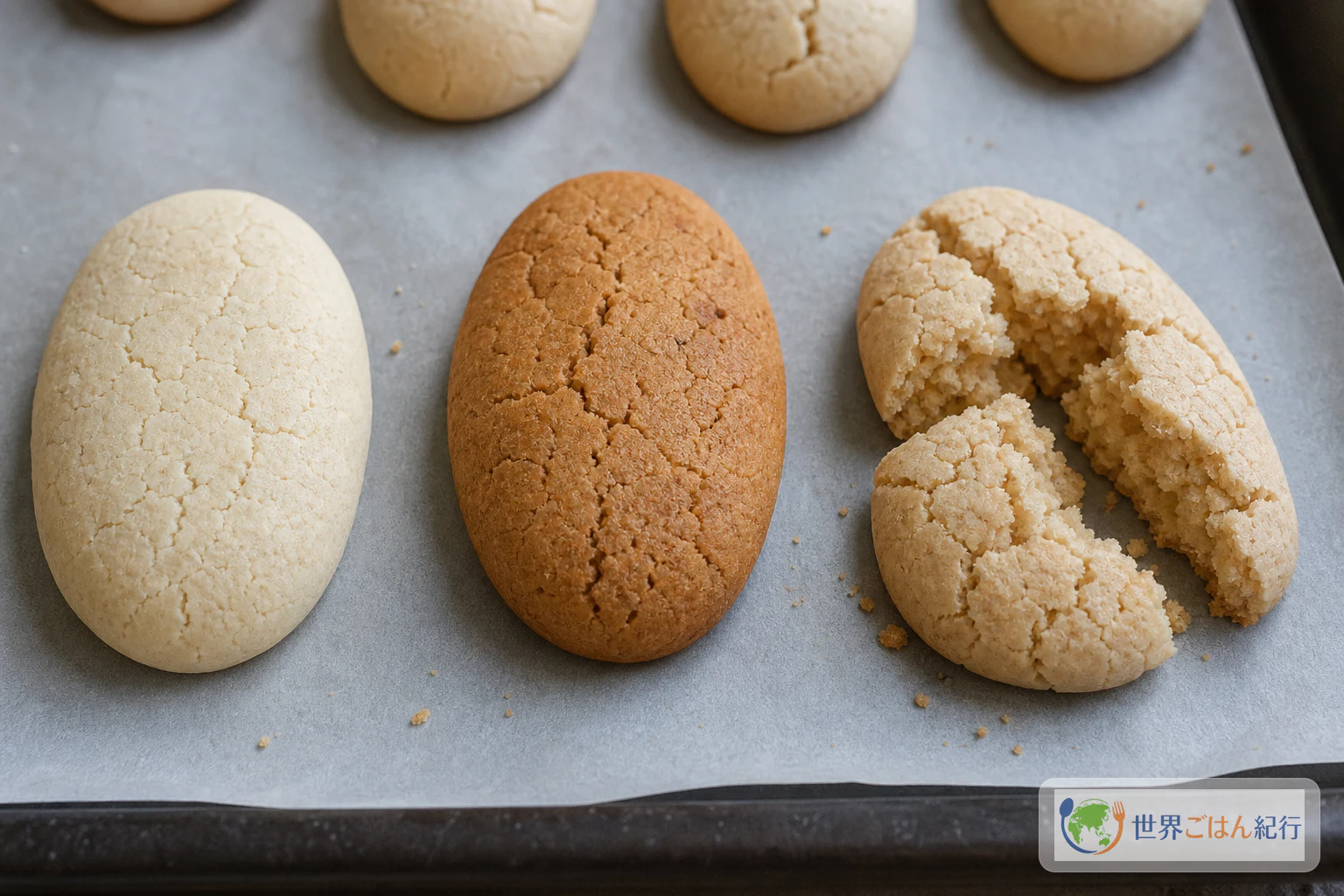
Most bagea failures come from treating it like an ordinary cookie and baking for color. Aim for a pale bake that's dry and crumbles lightly. Even if the color looks weak, the cookies are done once the bottoms are firm enough to move to a rack.
| Symptom | Cause | How to fix |
|---|---|---|
| Surface is dark brown | Temperature too high, overbaked | Next time lower to 300°F (150°C) and check from 18 minutes |
| Hard as stone when eaten | Short of moisture, packed too tightly | Shape gently without squeezing; add 1 tsp coconut milk |
| Cracks widely on the sheet | Dough too dry | Add a little coconut milk to the rest of the dough and rest 5 minutes |
| Sticky in the center | Too much moisture, underbaked | Dry 5 more minutes at 250°F (120°C) and cool completely on a rack |
| Only a floury taste remains | Flour not toasted enough, too few nuts | Toast until loose, and keep the nuts coarse |
If the dough cracks and won't hold together, add 1 tsp coconut milk to the remaining dough, press it together by hand and rest it 5 minutes before shaping. Add the liquid a little at a time, because adding a lot at once leaves the centers sticky.
Serving and storing bagea
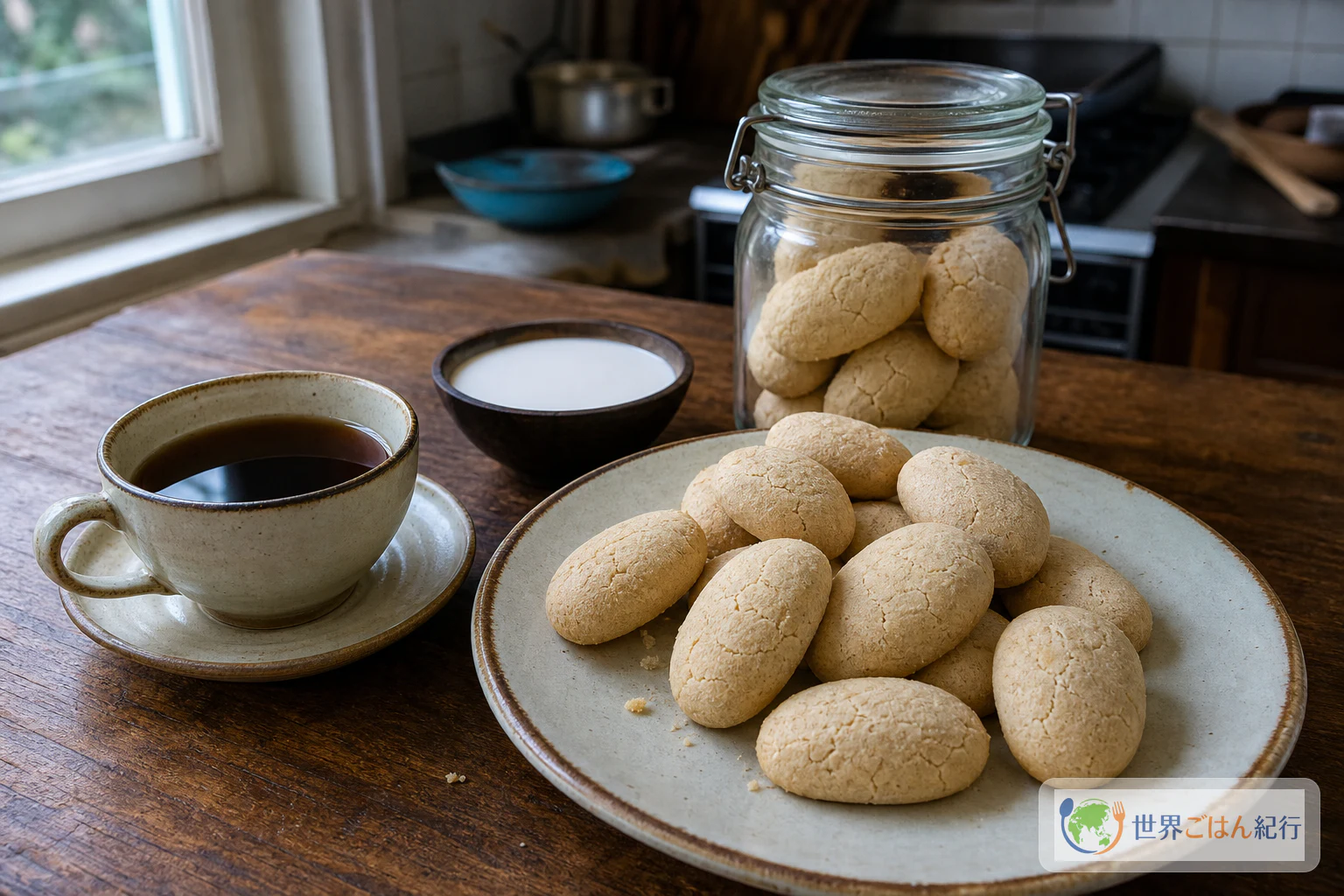
Bagea is a sweet for tea or coffee. It soaks up moisture in your mouth, so a warm drink brings back the scent of the flour better than a cold one. Strong black coffee brings out the fat in the nuts, and unsweetened black tea draws out the roundness of the coconut. It looks light, but it's flour, sugar, nuts and oil, so 2 or 3 with a cup of tea is plenty.
| When serving | Drink to pair | Reason |
|---|---|---|
| Just baked, slightly cooled | Unsweetened black tea | The scent of the flour is light, and the roundness of coconut comes out |
| Dry, the next day | Strong black coffee | The fat and bitterness of the nuts fit, and the sweetness does not feel heavy |
| For children or older people | Warm barley tea, weak green tea | Not too dry in the mouth, and the edge of the spices does not stand out |
| As a small after-meal sweet | Milk tea without sugar | Even one satisfies, and you notice the floury quality less |
| Per cookie | Value |
|---|---|
| Energy | about 78 kcal |
| Protein | about 1.2 g |
| Fat | about 3.4 g |
| Carbohydrate | about 10.8 g |
| Fiber | about 0.4 g |
| Salt equivalent | about 0.10 g |
If the cookies taste a little under-sweet, serve them with strong coffee or a slightly bitter tea instead of dusting them with powdered sugar. That keeps more of what makes bagea bagea. Steamed sweets like sapin-sapin are all about moisture, and bagea is the opposite: its dryness is the appeal.
Once the cookies have cooled completely, store them in an airtight container at room temperature for 4 to 5 days. If you box them while they're still warm, steam collects inside and they'll be soft by the next day. In humid weather add a desiccant, and if the surface turns damp, dry them for 5 minutes in a 250°F (120°C) oven, cool them on a rack and put them back in the container. Skip the refrigerator. It passes odors to the cookies, and they pick up moisture when you take them out.
FAQ
Can I make it with a formula without coconut milk?
Water alone will hold the dough together, but you lose a lot of aroma and that melt-in-the-mouth quality. Coconut milk binds the flour and also carries the scent, so even a small amount makes the cookies much more satisfying.
Can I bake it in a toaster oven?
Yes, if your toaster oven holds a steady temperature, though it scorches easily and takes more care. Lay aluminum foil loosely over the top and bake about 15 minutes at 140 to 150°C (285 to 300°F), then take the tray out once to check the color of the bottoms. Bake until the outside is dry enough to pick up, without letting the surface brown deeply.