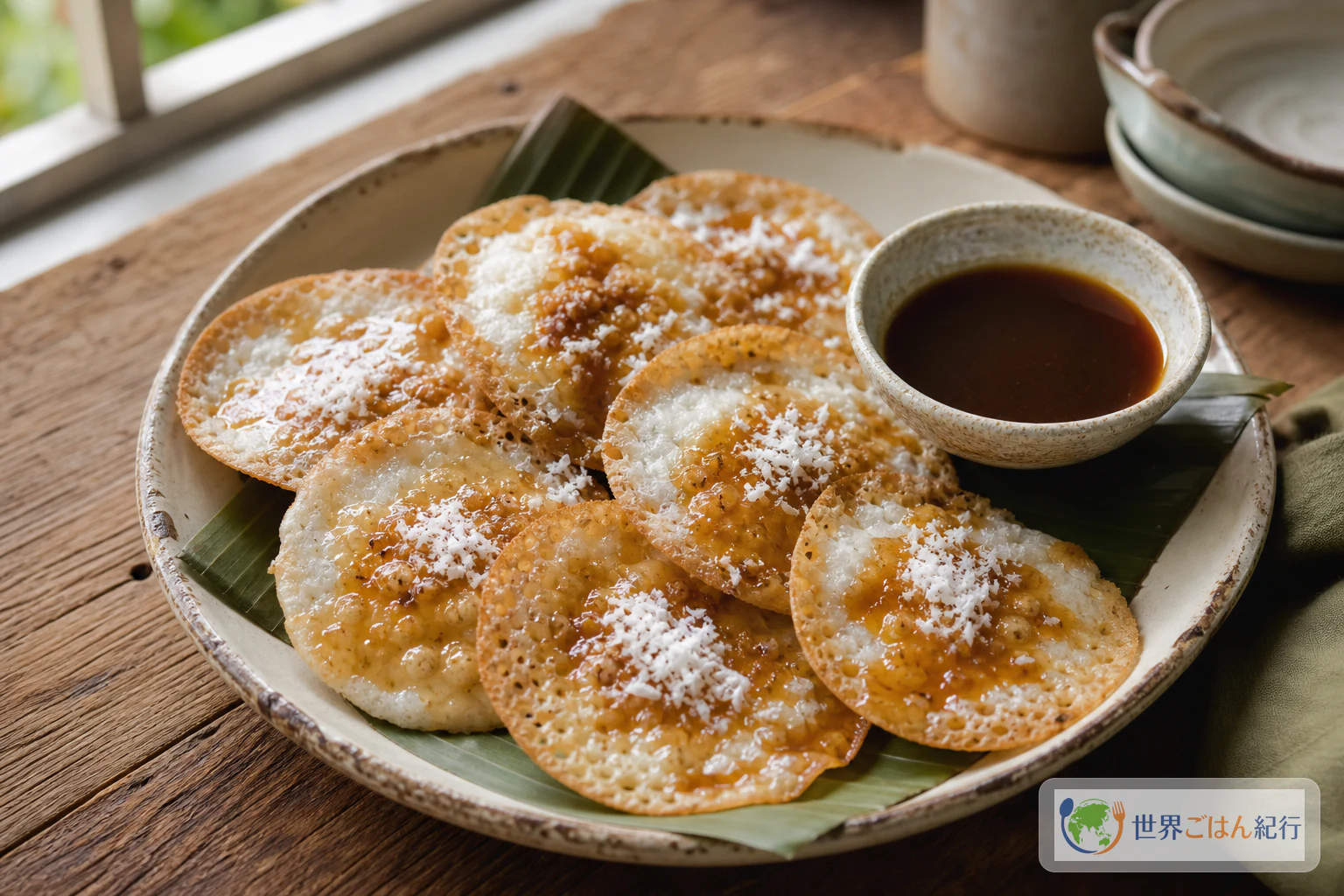
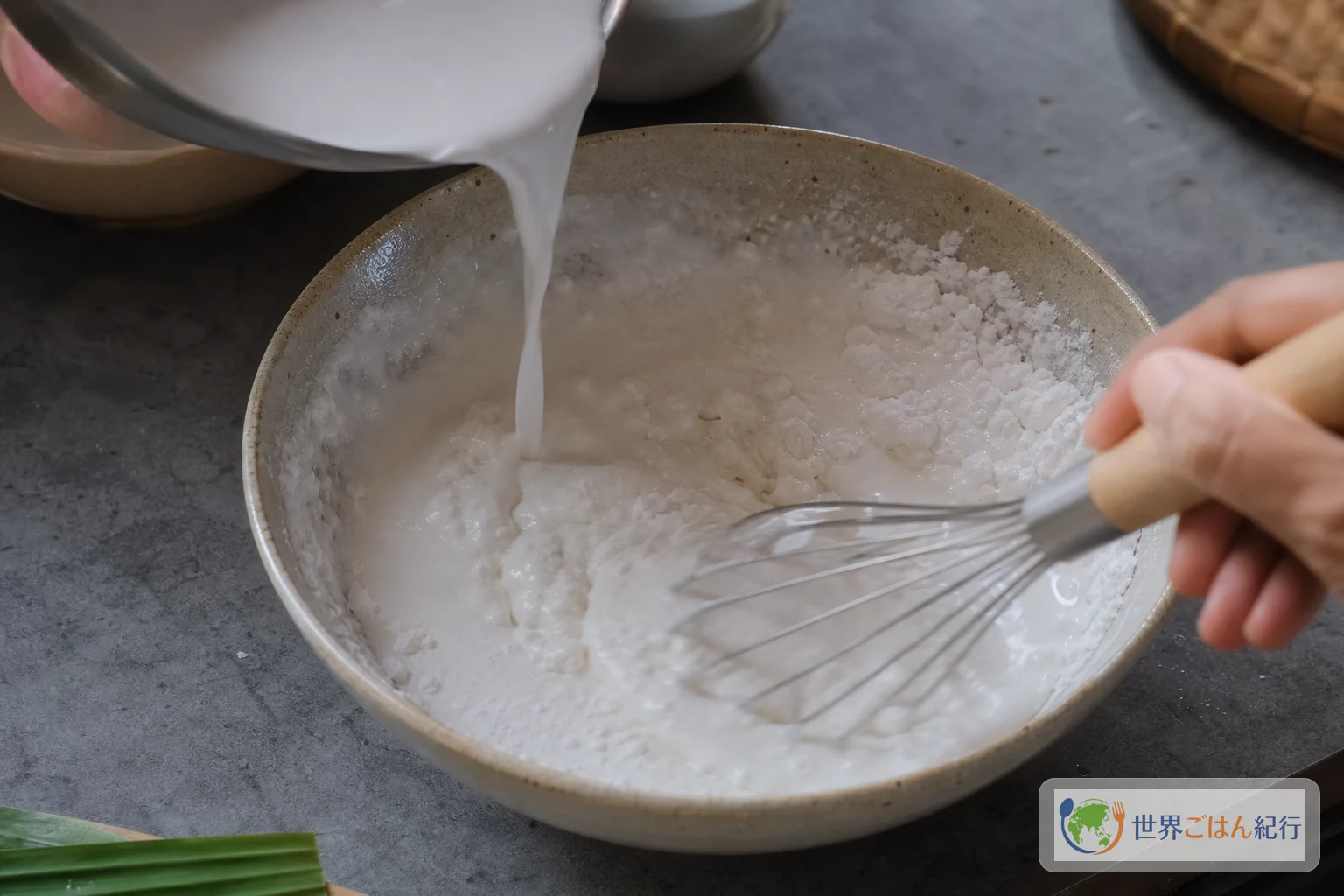
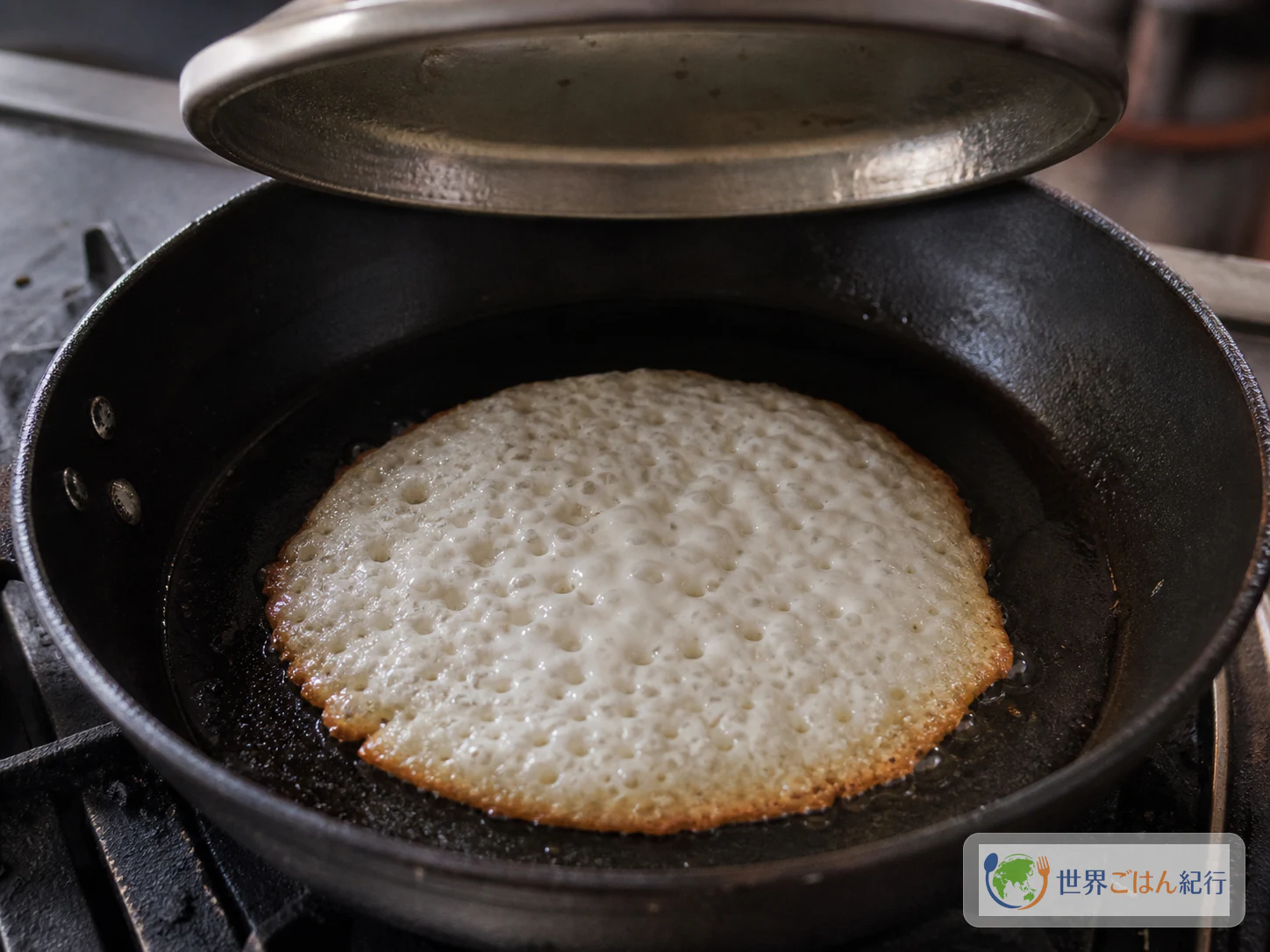
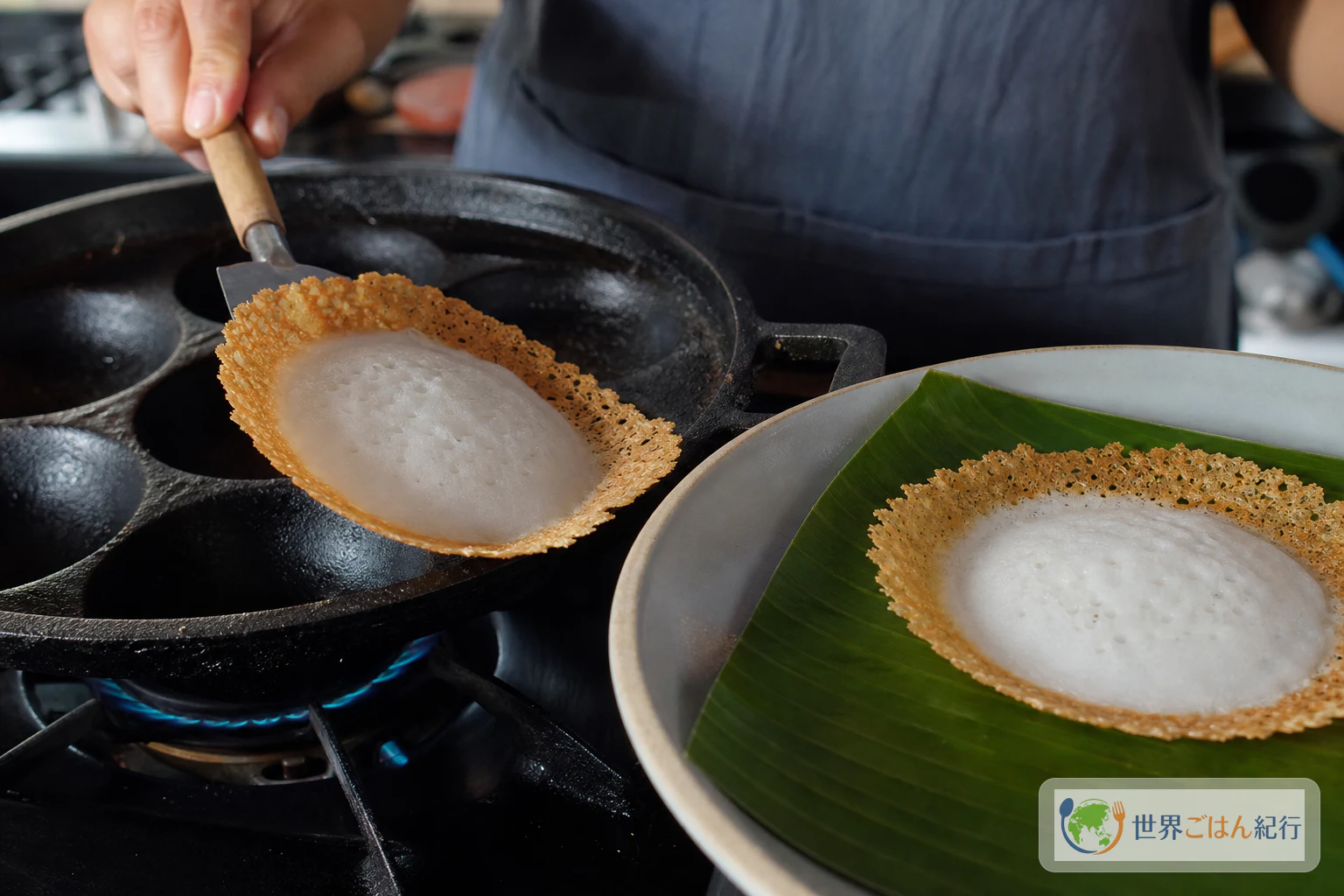
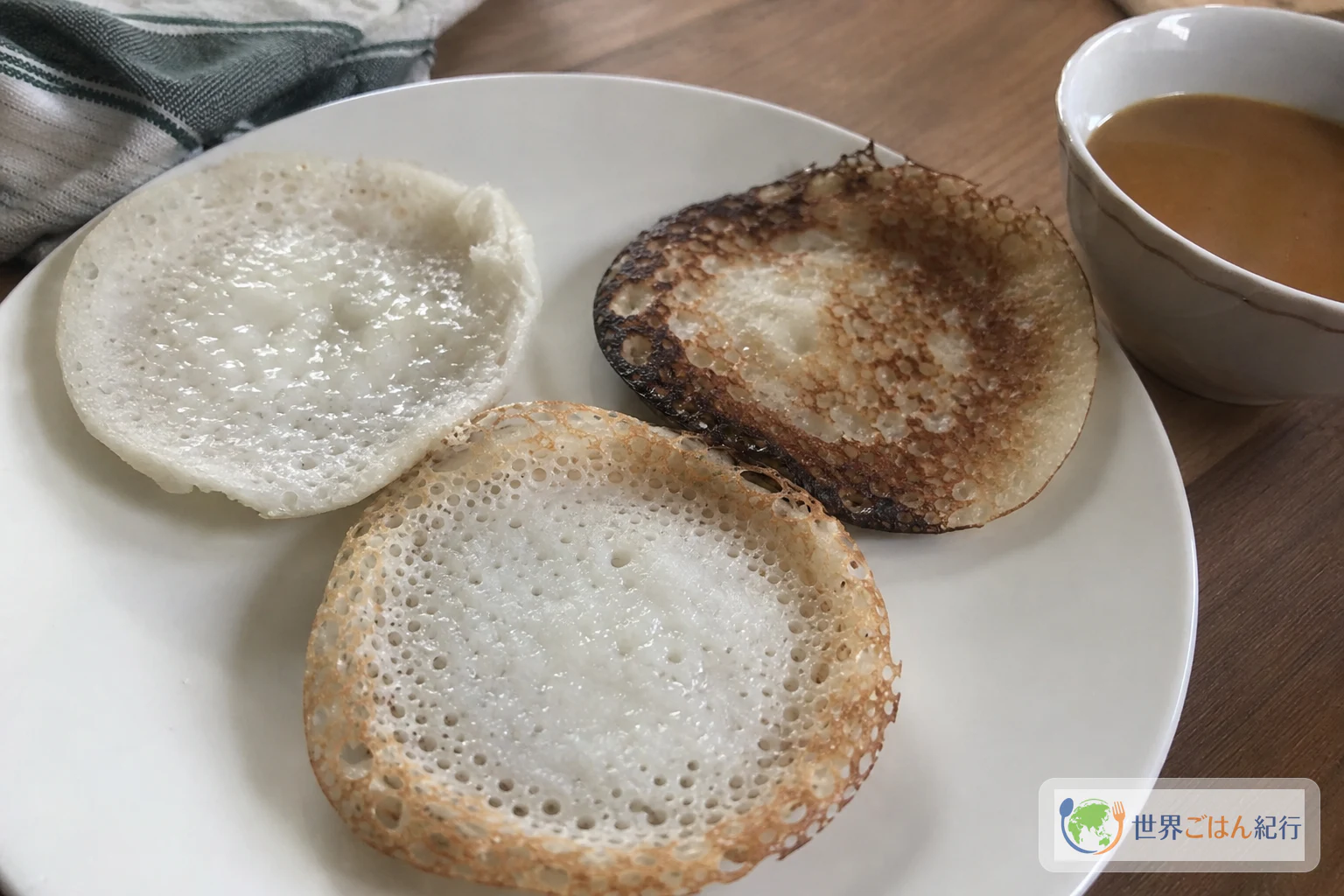
Pour a white batter of rice flour and coconut milk into a hot little pan, and fine bubbles rise from the edge. Lift the lid a little and the sweet smell of coconut drifts up with the steam; the edge has turned golden just short of burning, while the center stays white and soft. Spoon palm sugar kinca over the top, and a plain flour-and-pan job tilts at once toward a Javanese street sweet. Serabi (also written surabi or srabi) is a small griddled cake of rice flour and coconut, loved in Java and Bali, where a toasty edge meets the deep sweetness of kinca in one small round.
About Serabi
The traditional way is to bake serabi in small clay pans or molds lined up over charcoal. Batter goes in a little at a time, and only the edge is browned and set. At a street stall, kinca is spooned on right there, and it feels less like breakfast than a light sweet after school or in the late afternoon. At home, a small frying pan, a mini egg pan, or a cast-iron mold with hollows gets you close enough.
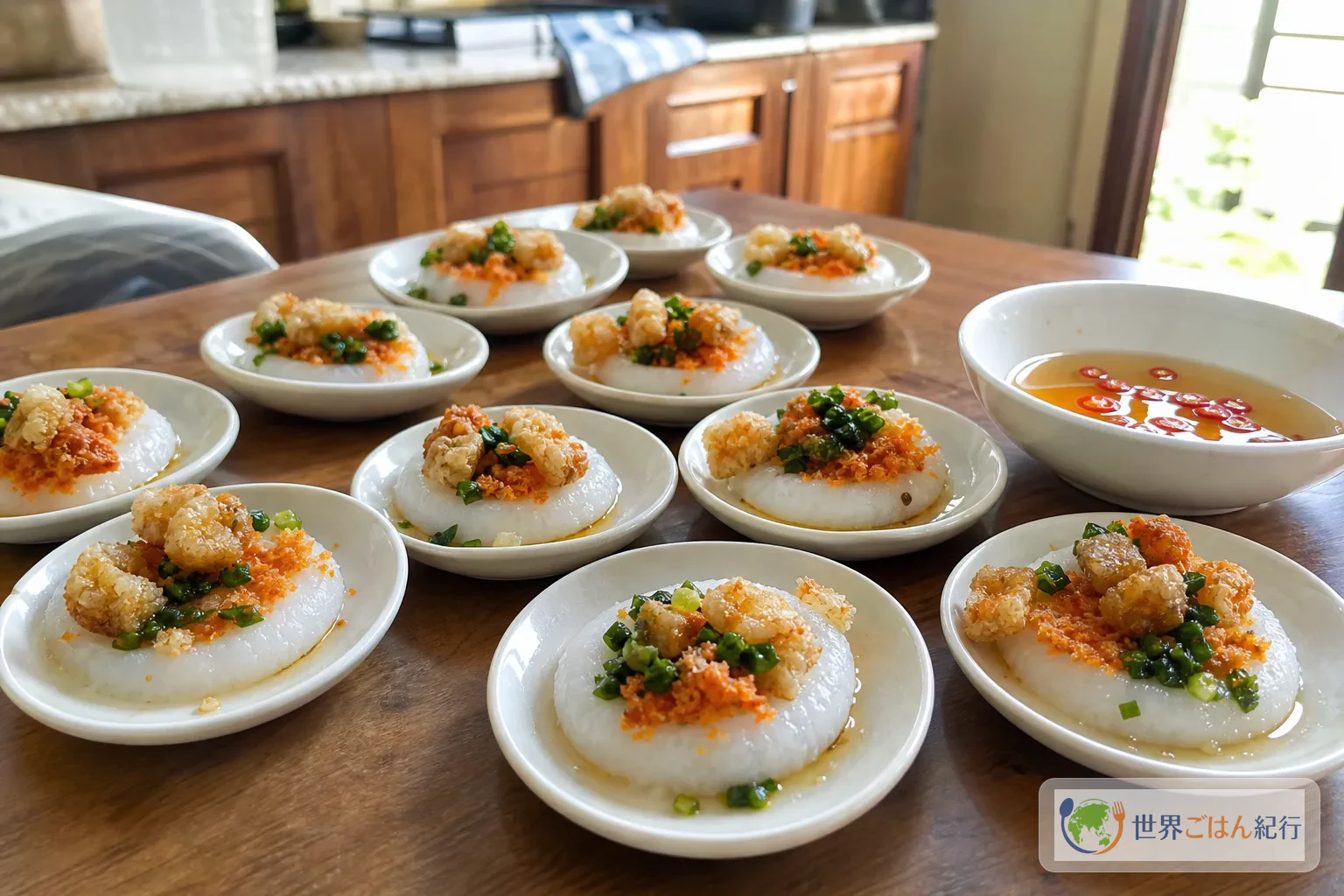
Serabi belongs to a wider family of rice flour and coconut dishes. Southern Vietnam's banh khot uses oil to lighten the edge, and Malaysia's bubur cha cha wraps root vegetables in a coconut soup. Serabi sits somewhere between them.
Serabi is written serabi or srabi in the Javanese-speaking world and surabi in the Sundanese-speaking world. You will also see it with place names, such as Bandung's surabi or Solo's serabi notosuman.
Serabi at Community Events
Serabi also turns up at community events. In Bandung, Playen, Srabi Kocor is linked to a rain-calling ritual, with the white rice flour cakes and the palm sugar juruh standing for land moistened by rain. In Pemalang Regency, the custom of "Serabi Likuran" takes place near the end of Ramadan, when serabi with kinca is shared with neighbors and relatives. One piece on the table is both a home sweet and a community memory.
Regional Differences
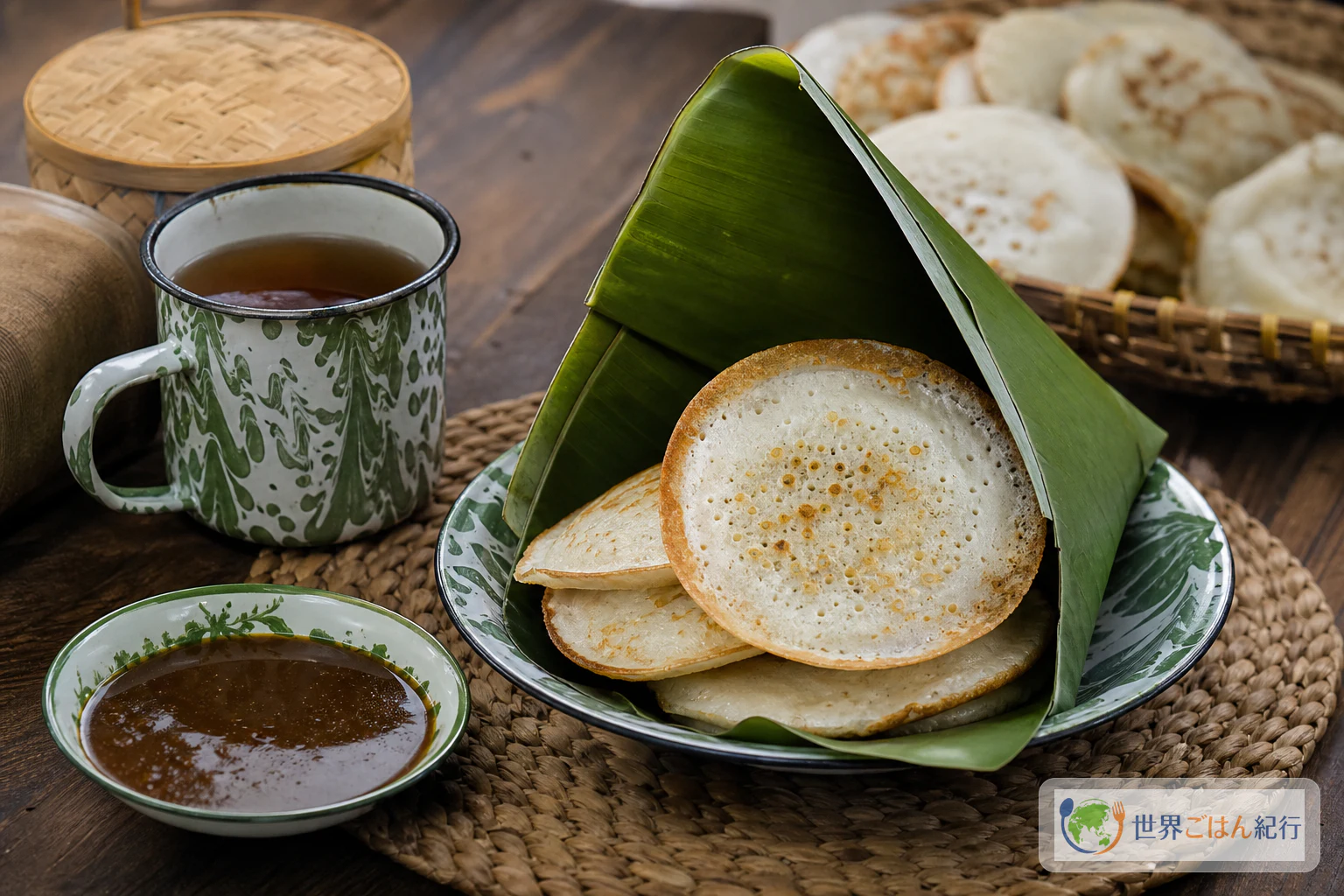
Regional styles vary a lot. Bandung's surabi is baked relatively firm, and its toppings extend to savory ones such as oncom. Solo's serabi keeps a moist center, a thin edge, and a strong coconut flavor. Modern toppings like cheese or sausage exist too, but for a first batch, sticking to rice flour, coconut milk, and palm sugar kinca gives you the clearest sense of the dish.
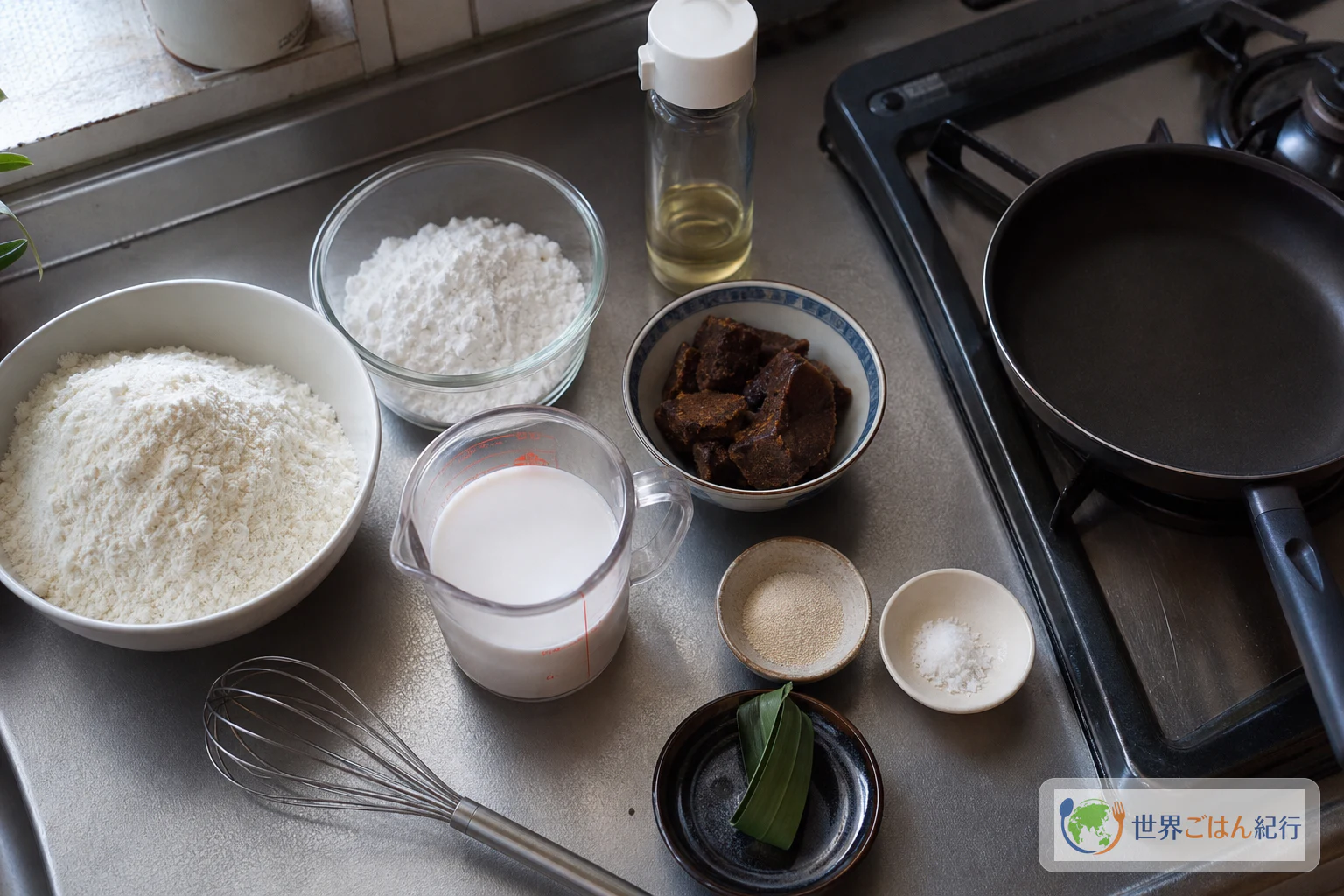
Ingredients (makes 8 small pieces)
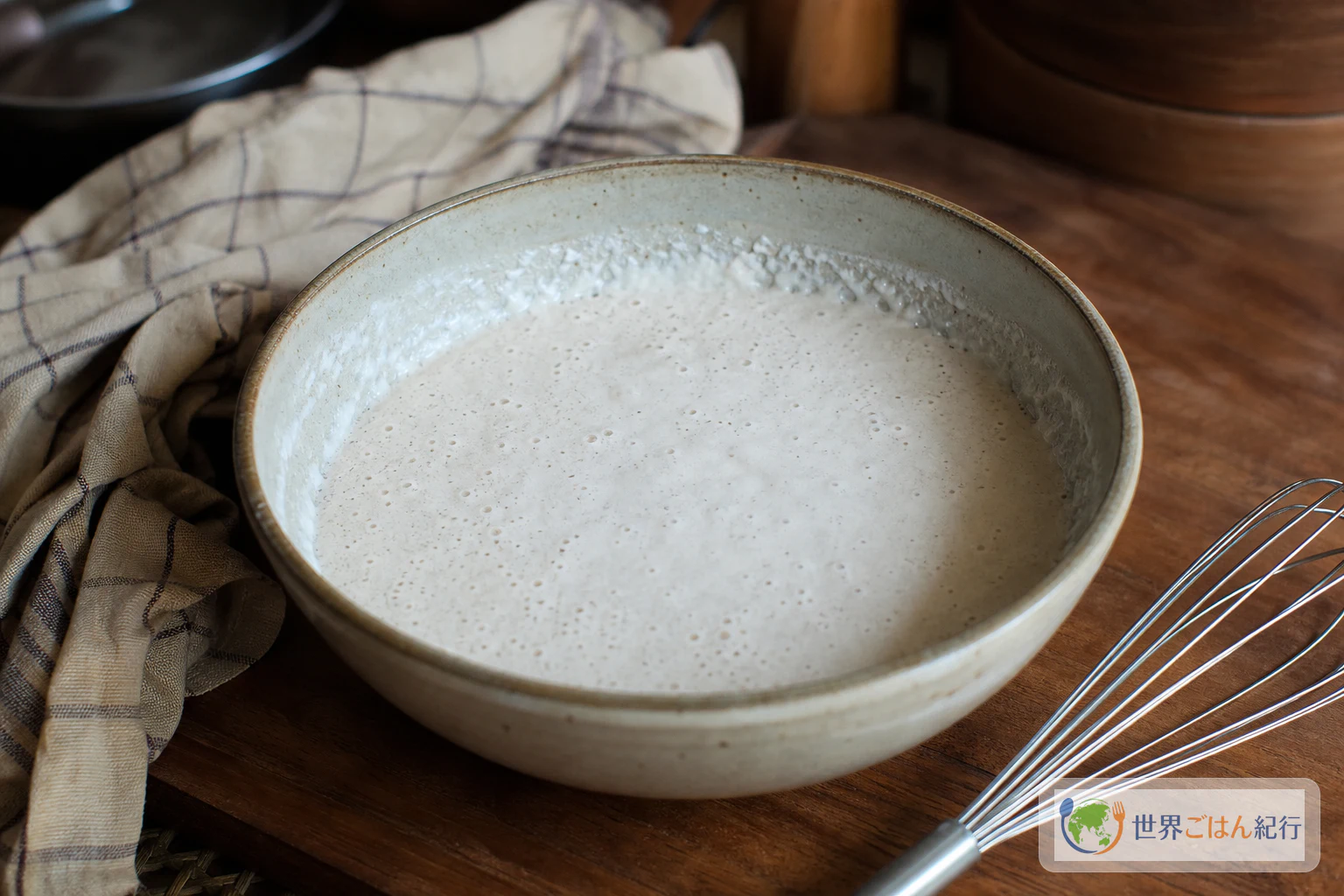
You get about 8 small serabi, 10–12 cm in diameter. That is 4 servings as a light snack, or 5–6 servings if you serve a little after a meal. The batter rises through fermentation, so do not stir it much just before baking; bring it back from the bottom once.
Allergies and substitutes
This recipe uses coconut. The mix is rice-flour based. Check the labels of tapioca starch and rice flour for the manufacturing line, since they differ by product. If you want to avoid gluten completely, make it with just rice flour and tapioca starch.
Choosing Ingredients and Substitutes for Serabi
Three things carry the dish: the white center from the rice flour, a coconut aroma that is not overcooked, and a kinca with real depth. Rice flour is easy to find in the baking aisle of many supermarkets and in Asian grocery stores. For a first batch, rice flour, coconut milk, a little tapioca starch, and brown sugar work well, and palm sugar is worth using if you can find it.
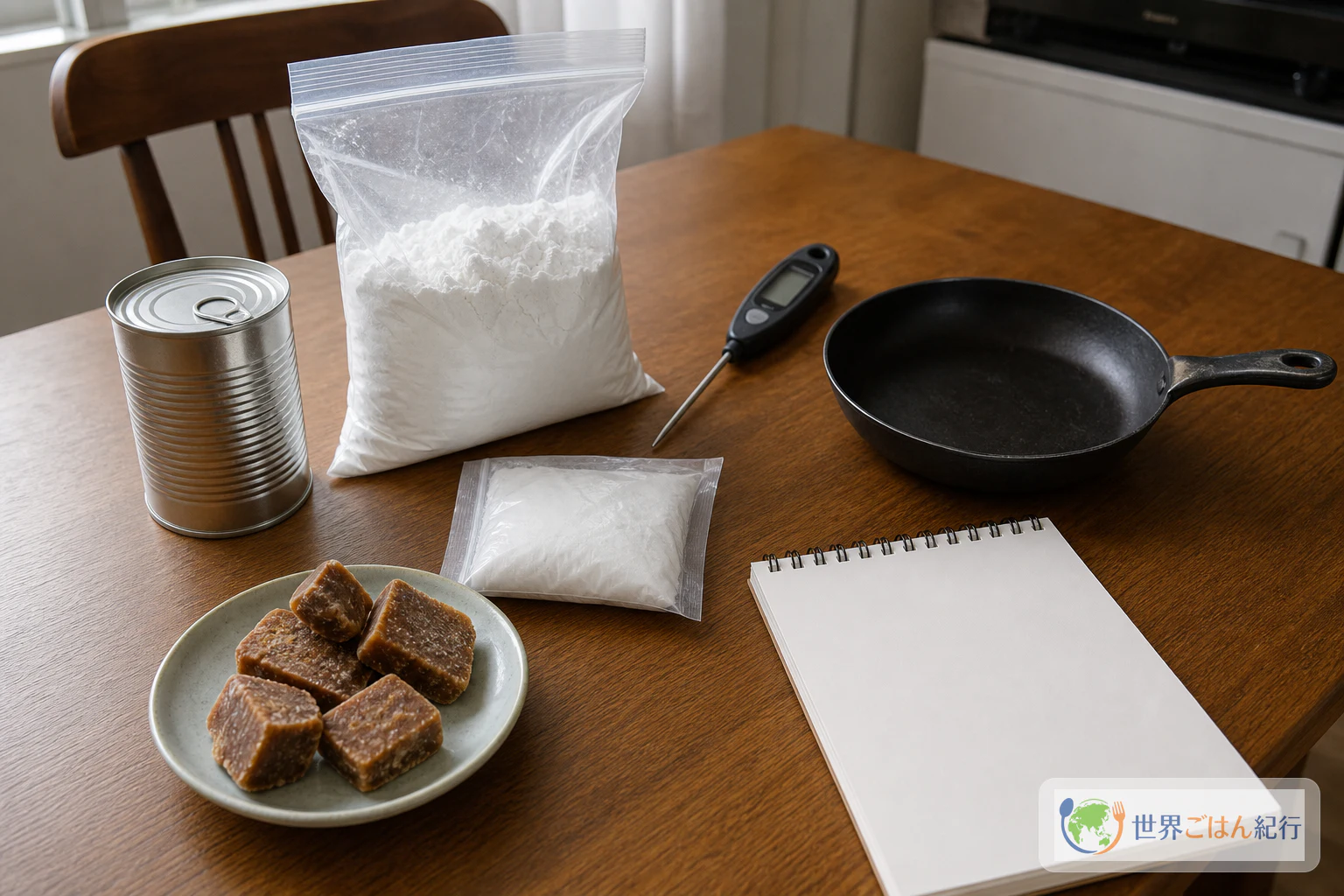
Coconut milk goes into both the batter and the kinca, so one 1¾-cup (400 ml) can is used up between them, with nothing left to forget in the fridge. It also matters for texture: rice flour dissolved only in water is light when freshly baked but turns floury once cooled, and coconut milk rounds that off. The same idea runs through rice cooked in coconut, as in nasi uduk; rice and coconut blend so naturally that this pairing feels very Indonesian.
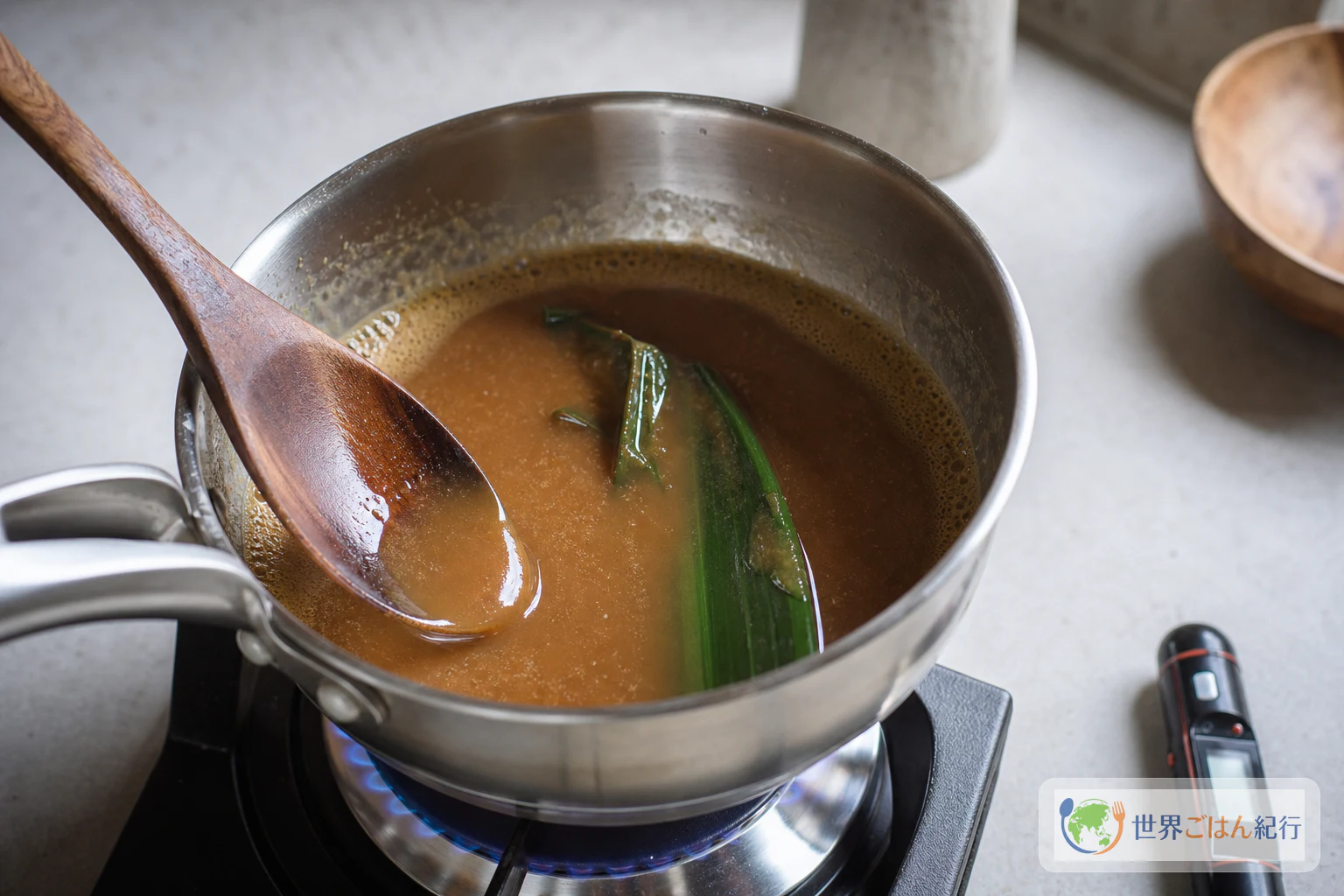
Tapioca starch gives a lighter edge and a slightly chewy center more easily than potato starch does. You use only a little, but it carries over to other Southeast Asian sweets. A thermometer is optional, though it is the one tool worth relying on for a first batch: it tells you when to stop reducing the kinca before it turns hard once cooled.
| What you wonder about | Why keep it | Practical answer |
|---|---|---|
| Rice flour | Makes the white center of serabi | Use finely milled baking rice flour; do not use glutinous rice flour alone |
| Coconut milk | The core of aroma in both batter and kinca | Do not replace it with milk or soy milk |
| Palm sugar | The round bitterness of kinca | Substitute 2 oz (60 g) dark brown sugar and 20 g raw cane sugar |
| Pandan | A grassy aroma | Can be omitted. No more than 1 drop of vanilla |
| Mold | Sets the edge first | A small frying pan, a mini egg pan, or a pan with hollows |
| Oil | Lightens the edge | Brush on a scant 1 tsp thinly. Too much turns it into a fried sweet |
Method: Keep the White Center Apart from the Browned Edge
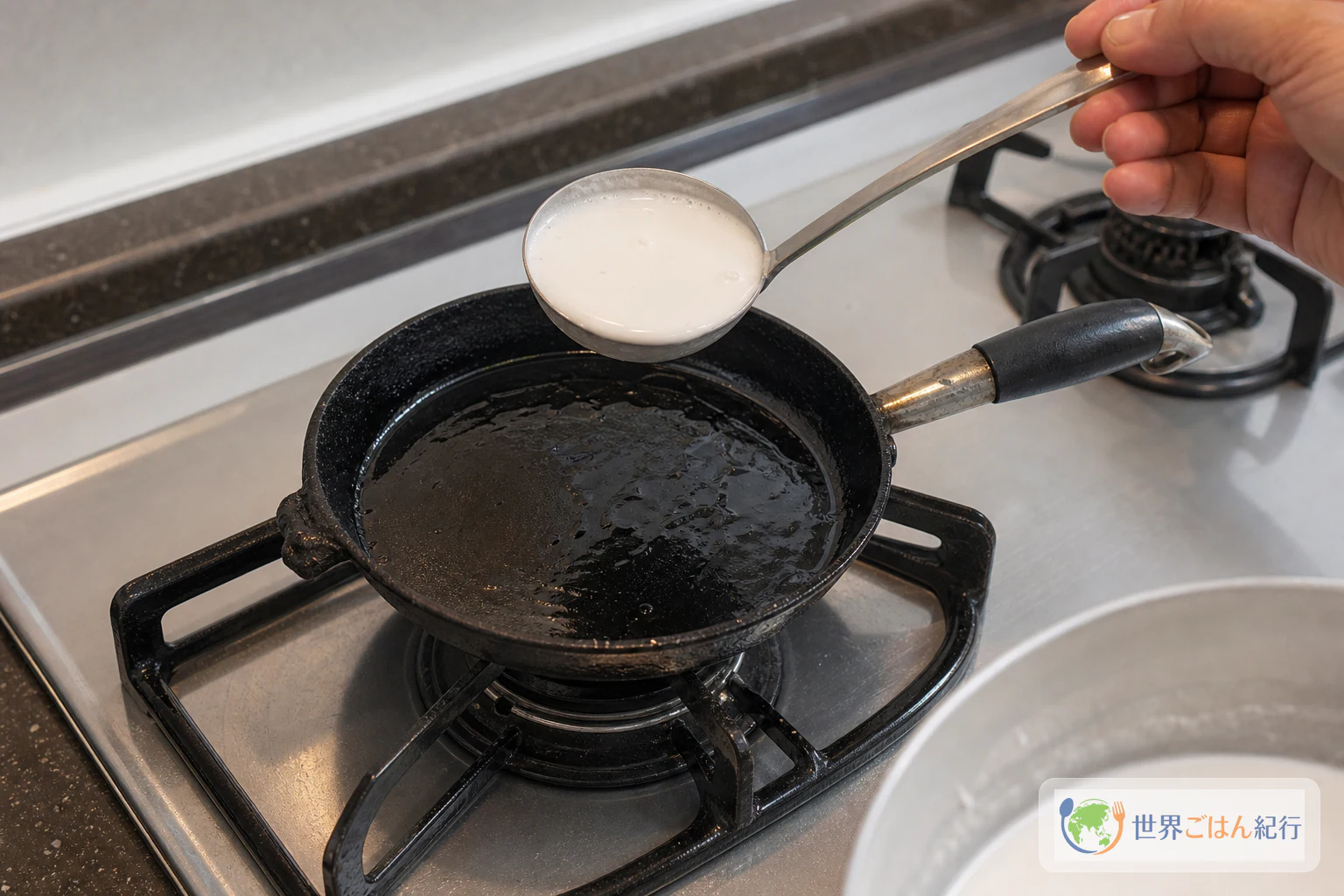
The first piece is a test. If the edge stays white and wet, the pan was not preheated enough or there was not enough oil. If only the bottom burns, the heat is too high. With serabi, rather than baking everything evenly, it tastes more like itself when only the edge is crisp and the center stays white.
Common Serabi Problems and Fixes
What matters more than the mold is to bake each piece small, use a lid, and give the edge and the center different textures. Spread the batter quickly in a large frying pan and the center gets thin too, so you end up with something close to a plain rice flour crepe. Keep it small, a little thicker, and leave the center white.
Even a failed piece shows you the cause: the batter, the heat, or a kinca reduced too far. Find the symptom below and fix the next one.
| Symptom | Cause | What to fix next |
|---|---|---|
| The edge is white and wet | Not preheated enough, not enough oil | Preheat 1 more minute over medium-low and add 1/4 tsp oil |
| Only the bottom burns | Heat too high | After pouring in the batter, lower to low heat and cover for longer |
| The center is raw | The batter is thick or the lid time is short | Keep to ¼ cup (70 ml) per piece and cover for 5–6 minutes |
| It is hard overall | The batter was stirred too much or fermentation was weak | Stir only 5 times before baking and rest 10 minutes longer |
| The kinca sets like candy | Reduced too far | Stop at about 103 degrees C. If it sets, add 1 tbsp water and return it over low heat |
| Only the brown sugar flavor is strong | Substituted with brown sugar alone | Mix in 20 g raw cane sugar and shape it with 1 g salt |
Serving and Storing Serabi
Serabi can feel heavy after a meal if the sweetness is too strong. Rather than pouring kinca over the whole plate, put it in a small bowl and let each person dip the edge in. If you serve banana alongside, slice one that still has some firmness so it doesn't fight the rice-flour center.
For an Indonesian day, serve nasi uduk, a fragrant rice, as the meal, serabi as the light sweet, and kue satu, a bean-flour confection, as a dry palate cleanser; you'll taste the thread of rice, beans, and coconut. Or set it next to banh khot to see how the same rice flour changes between pan-frying in oil and steam-baking.
Serabi is best eaten within 2 hours at room temperature. To store it, wrap each piece in plastic wrap without the kinca and refrigerate until the next day. Reheat in a frying pan over low heat, 1 minute on each side, with the lid on for only the last 20 seconds. The microwave alone makes the edge soggy, so finish in the pan to dry it and bring back the texture.
Frequently Asked Questions
Is serabi the same as a pancake?
The shape is close, but the texture and aroma are quite different. Serabi is built on rice flour and coconut milk, with a light edge and a white, moist center. It helps to think of it as a different kind of flour dish from a pancake, which rises evenly from wheat flour, eggs, and milk.
Can I use baking powder instead of fermenting?
You can, but the aroma and the way the holes form will change. Use 4 g baking powder in place of the 2 g dry yeast and shorten the rest to 10 minutes. It is light when freshly baked, but the sweet fermented smell of rice flour is weaker.
Can I bake it in a takoyaki pan?
Yes, a cast-iron or electric pan with hollows works. Pour batter into the bottom of each hollow, cover, and bake one side only, leaving it flat rather than turning it into balls. Because the pieces come out smaller, reduce the batter to about 1 1/2 tbsp each.