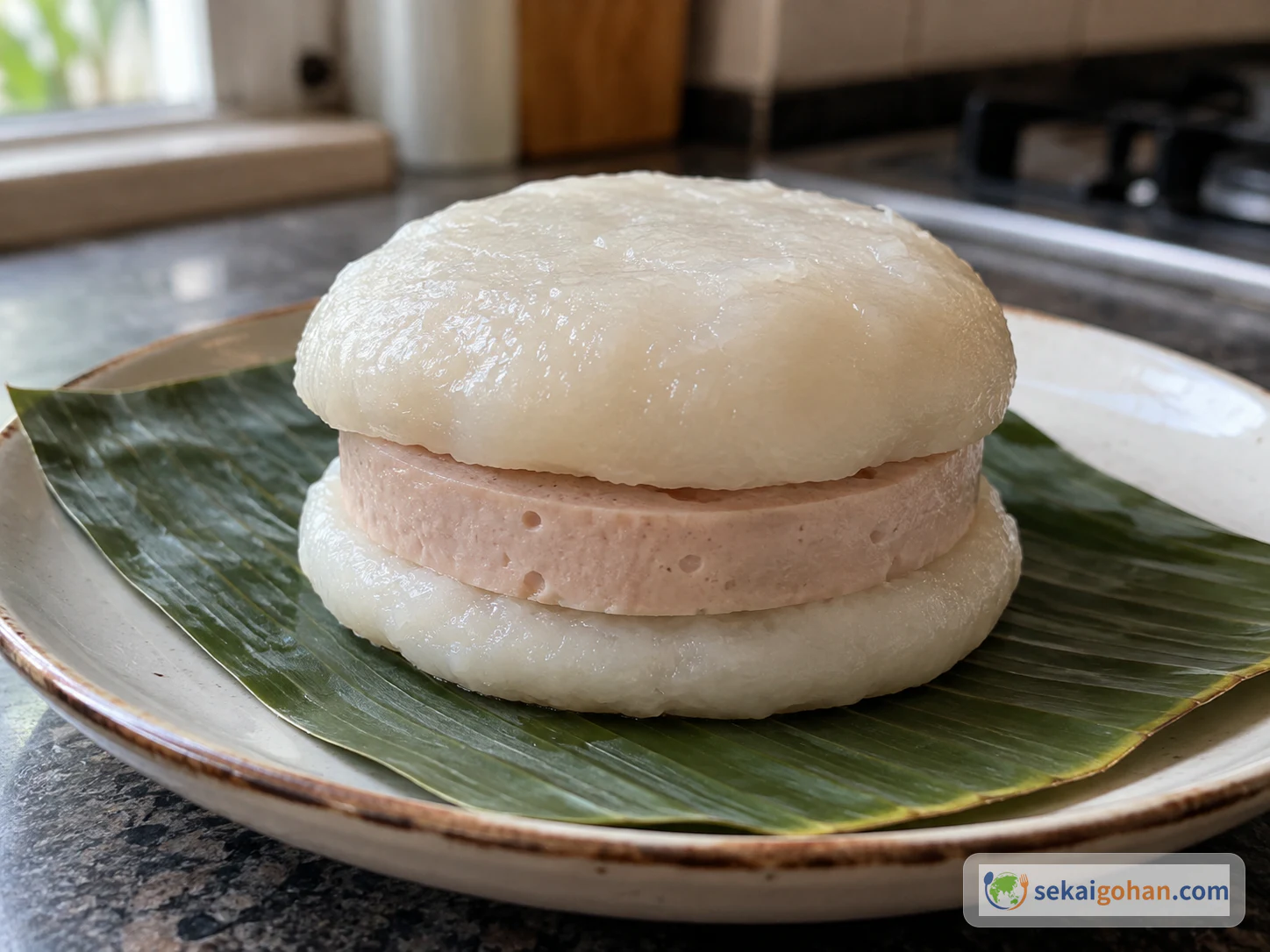
Lift the steamer lid and there they are: small white rounds in rows, glossy through the steam, each with a shallow dimple in the center. Drop dried shrimp into the dimple, drizzle on scallion oil until it shines, and add a spoonful of sweet-sour nước chấm. Bánh bèo looks quiet, but the rice flour, fish sauce, shrimp, and oil all come through in a single bite. These steamed rice cakes in small dishes come from central Vietnam, especially Huế.
Bánh Bèo and the Small Dishes of Huế
Bánh means a dough made from rice or flour. Bèo means duckweed, the floating water plant, which the thin round of batter resembles. In English the dish is also called steamed rice cakes or water fern cake. Each one is steamed in its own small dish, then topped with finely ground dried shrimp, scallion oil, and something light and crispy like fried shallots or breadcrumbs. Nước chấm goes on last. You eat it with a spoon, scooping from the edge of the dish, not with a fork.
Around Huế, bánh bèo shares the table with other small steamed cakes made with rice flour and tapioca starch, such as bánh nậm and bánh lọc. People don't eat them only as a tourist dish. They're a snack, eaten several in a row, and the pleasure is the thin batter and the layers of aroma, not lavish toppings.
The fun part is that the eater finishes the dish. You decide how much sauce to pour, how much to break up the shrimp, and whether to reach for the next dish. Unlike a platter served all at once, eating several lets you find the strength you like.
The same city also gives you the spicy beef noodle soup bún bò Huế, which runs on the force of its red broth. Bánh bèo builds up aromas in a small dish instead, so even within central Vietnam the two kitchens work very differently. If you'd like to try more steamed Vietnamese dishes, bánh bao wraps pork, mushrooms, and egg in a white fermented dough. Bánh bèo is a light bite, while bánh bao is a steamed bun filling enough to be breakfast or a snack on its own.
Ingredients (serves 4, about 20 small dishes)

Small dishes 8–9 cm across make about 20. Serve 4 for a light lunch, or 6 as a starter. Use heatproof small dishes with shallow rims that are not too high. Saucers, shallow ramekins, or small chawanmushi cups also work, but deep vessels make the batter thick.
This dish uses dried shrimp and fish sauce. If you avoid crustaceans or fish-derived seasonings, skip it. Rice flour, tapioca starch, fried onions, and dry breadcrumbs can be made on lines that also process wheat. For a table avoiding gluten, check the allergen labels on packages, and use crushed rice crackers instead of breadcrumbs.
What is worth buying extra
For bánh bèo, buy these at an Asian grocer or online: rice flour, tapioca starch, fish sauce, and steaming equipment. Meat and vegetables are easy to get locally. But weak flour or fish sauce turns it into a pale steamed rice cake.
Use tapioca starch to slightly reduce the rice flour's tendency to crack, not to make it chewy. Potato starch can stand in, but tapioca gives a nicer texture when cool.
An inexpensive fish sauce will do for nước chấm. But the sauce is diluted and absorbed by the rice flour, so the fish sauce's saltiness and aroma come straight through when you eat.
For steaming small dishes together, use a bamboo steamer rather than a pot. Less condensation drips from the lid, and you can swap dishes partway through, which makes the center dimple easier.
Choosing Ingredients and Substitutes for Bánh Bèo
You can make bánh bèo without every local ingredient. Substitute too much, though, and it turns into "rice-flour chawanmushi," so before you shop, decide what to keep and what to replace.
| What you are unsure about | Closer to local | Realistic outside Vietnam | Judgment |
|---|---|---|---|
| Flour | Mostly rice flour, a little tapioca starch | Baking-grade rice flour, tapioca starch | Joshinko alone is possible. Substituting potato starch makes the springiness lighter |
| Vessel | Small, shallow dishes | Heatproof small dishes 8–10 cm across, shallow ramekins | Deep vessels make it thick, and the dimple is hard to get |
| Shrimp | Dried shrimp finely sautéed | Dried shrimp, sakura shrimp | Sakura shrimp have a light aroma, so increase the amount a bit |
| Fried texture | Fried shallots, fried bread | Fried onions, crushed rice crackers | Rice crackers if avoiding wheat |
| Fish sauce | Vietnamese nước mắm | Fish sauce | Don't over-dilute; round it with sugar and acidity |
| Steamer | A bamboo steamer holding several small dishes | Pot with a steaming rack, deep frying pan | Catching condensation from the lid in a cloth keeps the surface clean |
The one thing not to skip is warming the empty dishes first. If you pour batter into cold dishes, the flour settles before the bottom sets and the surface turns watery. In hot dishes, even a thin batter sets quickly at the edge, and the shallow dimple forms more easily in the center.
Go easy on the tapioca starch. Too much and you drift toward a translucent, chewy sweet. About 1.25 oz (35 g) of tapioca starch to 6.5 oz (180 g) of rice flour keeps the rice white and soft enough to cut with a spoon.
Keep the nước chấm light enough to soak slightly into the rice batter. Otherwise the first bite is all salt. Make it a little milder than the one you'd serve with chả giò, and you'll find yourself reaching for dish after dish.
Method: Warm the Dishes and Steam Thin
It's a flour dish, but you don't knead it. Mix and rest the batter, stir the settled flour back in well, heat the small dishes until hot, then pour thin. Before steaming starts, decide where the shrimp topping, scallion oil, and nước chấm will go, so you don't scramble.
Common Bánh Bèo Problems and Fixes

What makes or breaks bánh bèo is the steaming, more than any hard-to-find ingredient. It rarely fails so badly you can't eat it, but a watery surface, a bulging center, or cracks change the texture and look right away. Most problems come down to three things: batter thickness, dish temperature, and steam strength.
| Problem | Common cause | What to fix next time |
|---|---|---|
| No dimple in the center | Batter too thick, dishes cold | Reduce to 1.5 tbsp (22 ml) per dish and warm the dishes for 3 minutes |
| Watery | Heat too weak, condensation fell from the lid | Raise strong steam over high heat first, then medium, and catch condensation with a cloth |
| Cracks on the surface | Steamed too long, heat too strong | Check from 6 minutes and don't go over 8 minutes |
| Floury bottom | Did not stir the batter back up | Stir from the bottom 20 times before pouring |
| Sticks to the dish | Too little oil, scooped right after steaming | Brush on a thin film of oil and rest 2 minutes before serving |
| Shrimp topping is hard | Sautéed over high heat, moisture cooked off too much | Over medium-low heat, stop at a fluffy crumble |
If one comes out watery, put it back in the steamer in its dish for 1 more minute before adding the sauce. You can't fix cracks. Just pile on more shrimp topping and scallion oil to cover the weaker texture, and eat it anyway.
For your first batch, steam only 3 test pieces. Keep the batter thickness the same and change only the heat. If the dimple appears, steam the rest. If they're watery, turn up the steam. If they crack, cut 1 minute. Testing a few first is quicker than pouring everything at once.
Serving and Storing Bánh Bèo
How to eat it

Bring the dishes to the table already topped with shrimp and scallion oil, and let everyone add nước chấm with a teaspoon. Pour too much at the start and the batter loosens quickly. Run a spoon once around the edge of the dish, drop a little sauce into the dimple, and scoop while breaking up the shrimp. Matchstick cucumber and mint on the side keep it from feeling heavy as the fish sauce and oil build up.
Building a Vietnamese menu
For a Vietnamese meal, serve bánh bèo as the starter and fried spring rolls, chả giò, as the main. The two share lettuce, herbs, and nước chấm, so the shopping stays simple.
If you want to see what else rice flour can do, try bánh xèo, fried thin and crisp in oil and wrapped in herbs, where bánh bèo is soft from the steamer. For something sweet, bánh rế is a thin lattice of fried sweet potato. Between them, you get a sense of how far Vietnamese bánh ranges, from small steamed cakes to thin pancakes to fried sweets.
Noodles work well too. Try bún chả with its sweet-sour sauce and herbs, or bún thịt nướng, grilled meat with rice noodles. Fish sauce, herbs, and rice carry naturally from one to the next. With a noodle soup, keep the bánh bèo portion small and let bún bò Huế be the star. That gives the meal a clearer shape than a light phở gà would.
Making ahead for guests
Bánh bèo is best within 10 minutes of steaming, while the surface is still moist and the shrimp and scallion oil still smell fresh. To make it ahead, keep the batter, shrimp topping, scallion oil, and nước chấm separate, and steam just before eating.
For guests, make the shrimp topping and nước chấm the day before, mix the batter that morning, and refrigerate it. Start warming the dishes 40 minutes before you eat. Don't stack the steamed dishes, because heat from below roughens the surface. Set them out one at a time on a tray instead. Add the shrimp topping and scallion oil just before serving so the aroma holds and the surface doesn't turn sticky when the nước chấm goes on.
Storage and reheating
The batter keeps overnight in the refrigerator in a bowl with plastic wrap pressed against the surface. By morning the flour will have settled on the bottom, so let it sit out for 20 minutes and stir from the bottom 30 times before using. Cold batter cools the dishes, so preheat them 1 minute longer.
Steamed bánh bèo keeps in its dishes in the refrigerator until the next day. Before the toppings go on, reheat by steaming over medium heat for 3 minutes. Once topped, cover loosely with plastic wrap and microwave at 600 W for 20–30 seconds, then add just 1/4 tsp of scallion oil. Keep the heating brief, because long heating hardens the batter and dries out the shrimp.
| Component | Storage |
|---|---|
| Shrimp topping | 3 days in the refrigerator or 2 weeks in the freezer |
| Scallion oil | 3 days in the refrigerator |
| Nước chấm | 3 days in the refrigerator, but the garlic aroma gets stronger. For guests, make it on the day |
Frequently Asked Questions
Can I make it with rice flour only?
You can, but with rice flour alone it cracks a little more easily and tastes floury as it cools. For your first try, the blend of rice flour and tapioca starch is easier to handle. If you use potato starch instead, keep it to 20 g and mix well after adding the boiling water.
I don't have 20 small dishes.
Steam in several rounds with 5–6 dishes. While one batch steams, give the rest a light wipe without washing, brush them with oil again, and get the next batter ready. Warm the empty dishes for 2–3 minutes before every new batch, because the results change once the dishes cool.
What if I dislike dried shrimp?
Chicken crumble or sautéed mushrooms give a similar texture, though the dish changes a little. Sauté 2.75 oz (80 g) of ground chicken with 1 tsp of fish sauce and 1/2 tsp of sugar, and break it up fine. The classic bánh bèo aroma comes from fish sauce and dried shrimp, so if you can eat crustaceans, even a little dried shrimp gets you closer.
Can I make it without a bamboo steamer?
Yes. A pot with a steaming rack works, or put water in a deep frying pan, set in a heatproof plate or rack, and put the small dishes on top. Condensation dripping from the lid roughens the surface, so wrap the lid in a clean kitchen towel or wipe off the drops partway through. Make sure the water stays low enough that it can't get into the dishes.
Can I substitute store-bought sweet chili sauce for the nước chấm?
You can, but it tastes different. Sweet chili sauce is thick and very sweet, and it doesn't soak into the rice batter easily. All you need for nước chấm is fish sauce, water, sugar, and acid, and homemade is nicer with bánh bèo.
How do I make it without heat for children?
Leave out the red chili and halve the garlic. For a gentler nước chấm, use 2.5 tbsp (40 ml) of fish sauce, ½ cup (140 ml) of water, 1.25 oz (35 g) of sugar, 1.5 tbsp (25 ml) of lime juice, and 1 tbsp (15 ml) of rice vinegar. Adults can add sliced chili at the table.