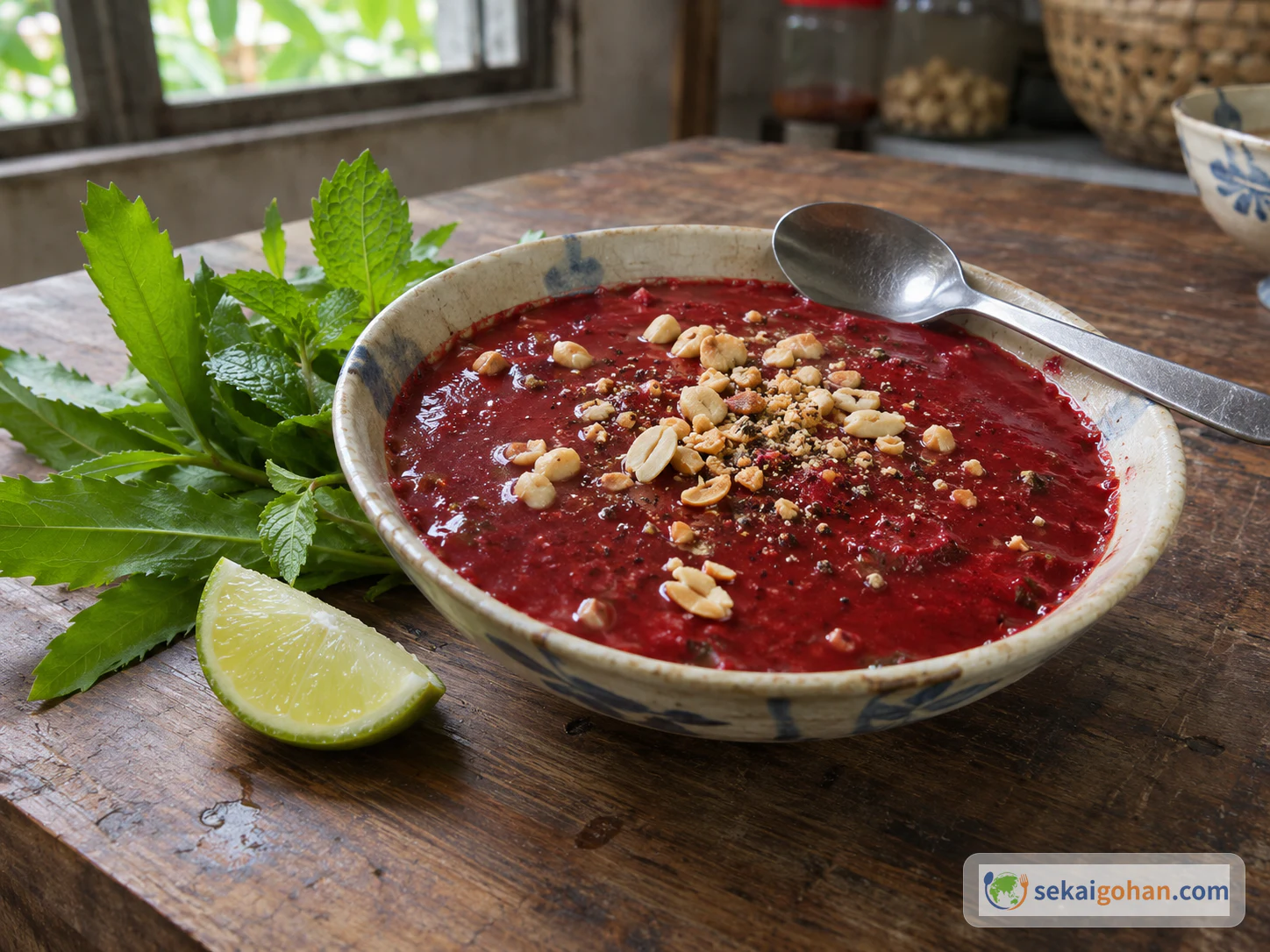
Pound lemongrass in a morning kitchen and the scent reaches you before the sound of the knife: green and citrusy, rising from the cutting board while beef shank and pork spare ribs tremble in the pot. Drop in red chili-annatto oil and a vermilion ring spreads across the broth. Bún bò Huế, the spicy beef noodle soup of Huế in central Vietnam, has none of the clear gentleness of phở. Its fragrance makes you sit up a little straighter. The chili turns it red, but what makes it a Huế noodle is where lemongrass, the savory depth of fermented shrimp, and a broth of beef and pork meet over thick round rice noodles.
Bún Bò Huế and the Food of Huế

What's in the bowl
Bún is rice noodles, bò is beef, and Huế is the old imperial capital. The name says beef, but in practice the pot often holds beef shank and beef bones together with pig's trotter, pork shank, or pork spare ribs. The broth is seasoned with lemongrass, mắm ruốc (fermented shrimp paste), fish sauce, and chili oil. On top go beef, pork, Vietnamese ham, herbs, and lime.
In English it is often called "spicy beef and pork noodle soup," and the pork is the part that tends to get lost in translation. The gelatin from pork bones and trotter gives the broth its thickness and roundness. Take the pork out entirely and the soup drifts toward a spicy beef phở, losing the weight that makes it a Huế noodle.
A dish from a palace town
Huế carried the court culture of the Nguyễn dynasty, and its cuisine combines the refined aesthetics of palace cooking with the everyday food of its townspeople. Bún bò Huế belongs to the second: a noodle soup people eat in morning alleys, strong enough to start the day on. In July 2025, the traditional knowledge of bún bò Huế was inscribed on Vietnam's national intangible cultural heritage list, recognized as folk knowledge that includes the lives, memories of taste, and food wisdom of Huế people.
Huế cooking is known for delicate appearance and carefully layered aroma, and this soup is more composed than it looks. Beef and pork make the broth thick, lemongrass makes it bright, fermented shrimp sets the base, and annatto chili oil brings the red. Shredded banana blossom, bean sprouts, mint, and lime come alongside, and everyone adjusts their own bowl at the end.
How it differs from phở
Phở is built on flat rice noodles, while bún bò Huế uses thick round rice noodles. In the broth, lemongrass, mắm ruốc, and chili oil come to the front rather than star anise and cinnamon.
If you have made phở gà, you'll feel the difference at once. Phở gà is a clear chicken broth tuned with herbs; bún bò Huế builds body with bones and meat, adds aroma and color with annatto chili oil, and brings freshness back with the herb plate. That habit of adding herbs at the table is shared with bánh xèo.
Ingredients (serves 4): A Realistic Blend You Can Assemble Elsewhere

A bowl in Huế can include pig's trotter, pig's blood, chả Huế, beef shank, beef tendon, and an herb plate. In a home kitchen, there is no need to force in pig's blood. If trotter is not for you, pork spare ribs are enough. What to protect: not making it with beef only, not skimping on lemongrass, and using mắm ruốc even in a small amount.
This dish uses beef, pork, fish sauce, and a fermented seasoning made from shrimp. If anyone has a shrimp allergy, leave out the mắm ruốc and substitute fish sauce and miso. In a household that avoids pork, increase the beef shank and tendon, but the flavor will be lighter than the Huế original.
Mắm ruốc, thick round rice noodles, and lemongrass are often hard to find at an ordinary supermarket. The first time, substitute with what's nearby. Once you like the dish, order these three. Before you shop, write down the product names so you don't get lost.
If you can't find mắm ruốc itself, use a small amount of belacan, from the same family of fermented shrimp pastes, to build a fermented seafood core. It is strong, so start with 1/2 tsp.
Mix 1 tbsp fish sauce, 1/2 tsp white miso, and 1 tsp finely chopped dried shrimp. This gets you closer to the depth of fermented seafood. If someone at the table dislikes the aroma, start with this substitute.
Choosing Ingredients for Bún Bò Huế

You can make this without every ingredient from Huế, but some swaps push it toward a different dish. Knowing what to protect, what to substitute, and what to skip the first time makes shopping much easier.
| Ingredient in doubt | Local style | Realistic substitute | Decision |
|---|---|---|---|
| Noodles | Thick round rice noodles for bún bò Huế | Thick rice vermicelli, round rice noodles | Flat phở noodles change the texture |
| Broth | Beef bones, trotter, beef shank, pork shank | Beef shank, beef tendon, pork spare ribs | Closer if you don't use beef alone |
| Fermented seasoning | Mắm ruốc | Fish sauce, miso, dried shrimp | Even a small amount adds depth |
| Red color | Annatto oil, chili oil | Paprika, chili, a little chili oil | Look at aroma and color, not heat |
| Herbs | Banana blossom, water spinach, mint, assorted herbs | Shredded cabbage, bean sprouts, shiso, mint | A separate herb plate makes it easier to eat |
| Pig's blood | Blood curd | Leave out | Skip it the first time |
Lemongrass is the one thing closest to irreplaceable. Dried or frozen is fine, but get it if you can; with only ginger and scallions, the soup drifts toward a beef-and-pork ramen. Simply pounding lemongrass and simmering it brings your kitchen's aroma sharply closer to central Vietnam.
Mắm ruốc is strong, and too much will startle the family. Start by dissolving 2 tsp in boiling water, letting it settle, and adding only the clear liquid. If you want more, add it a little at a time at the table.
Heat is easy to add later, and a pot that's too spicy leaves out children and anyone who dislikes chili. Put only half the annatto chili oil in the pot and serve the rest in a small dish, and the same pot gives you both a hot bowl and a mild one. The same approach works for tom yum goong and the chili in laab.
Method: Finish with a Quiet Broth and Red Annatto Oil
Bún bò Huế takes time, but the time when your hands are busy is not long. Divide it into parboiling, a low-heat simmer, the annatto chili oil, noodle prep, and assembly, and you can make it at leisure on a weekend afternoon.
Pork spare ribs tend to soften in 1 1/2 to 2 hours, and beef shank can take 2 1/2 to 3 hours. Leaving everything in until the end makes the pork fall apart. Take out each piece as it softens and ladle a little hot broth over it so it doesn't dry out.
Bún Bò Huế Problems and Fixes

Most failures come down to heat, the fermented seasoning, and the choice of noodle. Making it spicy is easy; a broth you want to keep drinking after the noodles are gone needs a gentle simmer that doesn't cloud and a well-balanced aroma.
| Problem | Cause | Fix |
|---|---|---|
| The broth is cloudy | Insufficient parboiling, hard boiling, or noodles cooked in the broth | Parboil the meat and simmer on low heat. Boil the noodles separately |
| It smells of shrimp paste | Too much mắm ruốc added directly | Dissolve in boiling water, let settle, and use only the clear liquid |
| It is just spicy | The chili oil lacks lemongrass and sweetness | Add lemongrass, paprika, and a little sugar |
| The flavor is thin | Too few bones and meat, or too short a simmer | Add beef tendon or pork spare ribs and simmer over 2 hours |
| The noodles break | Overcooked, or thin vermicelli was used | Cook thick round rice noodles firm and pour hot broth in the bowl |
| It is greasy | All the pork fat went back in the pot | Skim some of the surface fat and go easy on the chili oil |
If the aroma is too strong, dilute the broth before squeezing in the lime. Add boiling water ½ cup (100 ml) at a time and restore it with a little salt and fish sauce, and the edge of the fermented shrimp rounds off. If it tastes thin, reach for 1 tsp of the chili oil rather than more salt; it brings back both aroma and color.
If you end up using phở noodles, think of the result as "bún bò Huế-style." The core of the flavor is there, but the dense springiness of the noodles is weaker. Unlike khao piak sen, where the starch of the noodle is the pleasure, bún bò Huế depends on thick noodles pushing back against the broth.
Don't fix the amount of chili in the pot. Put the annatto chili oil on the table, and let those who want heat add it to their own bowls. The whole family can share the same pot.
Serving, Variations, and Storage
The herb plate and the menu

Bún bò Huế is easier to eat with an herb plate beside the bowl. Red broth and meat alone feel heavy, so bean sprouts, mint, cabbage, and lime reset your mouth again and again. That's the charm of Huế cooking: a deep broth and a fresh plate of herbs on the same table, rather than heat for its own sake.
Side dishes with little oil suit it. Serving bánh xèo alongside is fun, but both use plenty of herbs, so save that for guests. On a weeknight, let the noodles be the star with just a cucumber vinegar salad, chilled tomatoes, or stir-fried greens. For a tour of Southeast Asian noodles, try the gentle chicken broth of phở gà, the fish broth of mohinga, and the sweet-and-spicy fried noodles of mie goreng.
Variations
For a milder version, reduce the chili flakes to 1 tsp and increase the paprika. With children, serve noodles, meat, and broth first, then add herbs and heat afterward.
If your household doesn't like trotter, pork spare ribs or a piece of pork shoulder are easier to handle; the broth loses a little gelatin body but keeps its aroma. Beef shank alone turns too light, so add beef tendon to bring back the satisfaction.
For a seafood allergy, leave out the mắm ruốc and fish sauce and season with salt, light soy sauce, and a little miso. Without the fermented shrimp the core of the dish is gone, so enjoy it as a lemongrass beef noodle soup in its own right.
Storage and make-ahead

Always store the broth, meat, noodles, and herbs separately. Rice noodles left in the broth soak it up and break by the next day, and herbs lose their color and freshness with heat.
Let the broth cool slightly and refrigerate it for about 2 days. Keep some of the fat that sets on top; putting back 1–2 tsp holds the aroma. Refrigerate the meat with a little broth and reheat it briefly in the hot broth. Rice noodles are best rehydrated right before eating; if some are left over, toss them with a little oil, refrigerate, and finish them by the next day.
Only the broth freezes well, since frozen meat turns a little tough and rice noodles lose their texture. Remove the lemongrass and aromatics before freezing and divide the broth into single-serving containers. After thawing, a little fish sauce and lime brings the aroma back.
Leftover broth makes a good breakfast porridge with a little rice, still fragrant with lemongrass. With the heat toned down, it also works as a small soup alongside bánh mì.
Make the broth and annatto chili oil and cut the meat the day before. On the day, you only rehydrate the noodles, warm the broth, and cut the herbs. With its big pot and assemble-at-the-table feel, it suits weekend guests.
FAQ

Q1. I don't have thick rice noodles for bún bò Huế. Can I make it with phở noodles?
You can, but the texture changes a lot. Phở noodles are flat, with a wide surface that holds broth, while the thick round noodles for bún bò Huế are chewy and stand up to the red broth. The first time, use thick rice vermicelli, and if you like the dish, look for the proper noodles.
Q2. Is it not authentic without trotter or pig's blood?
A bowl in Huế can include both, but at home you can skip them. Replace trotter with pork spare ribs or pork shoulder, and leave out the pig's blood. What matters is the framework of beef and pork broth, lemongrass, mắm ruốc, and thick round rice noodles.
Q3. How spicy should I make it?
Keep the pot mild and add chili oil at the table; that's the hardest approach to get wrong. 1 tsp chili flakes is mild and 2 tsp gives a properly hot result. Raising only the heat flattens the aroma, so use paprika and lemongrass along with it.