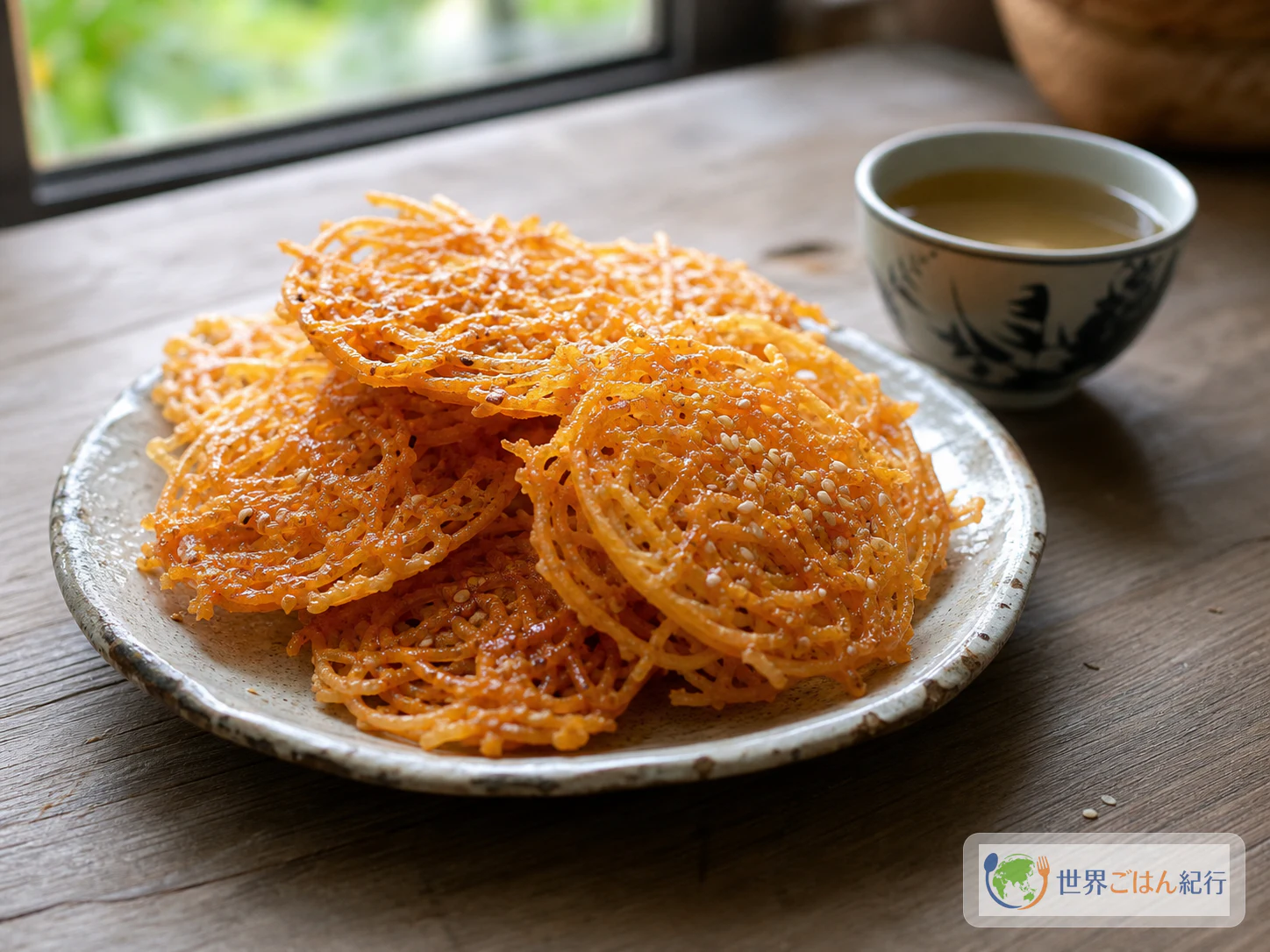
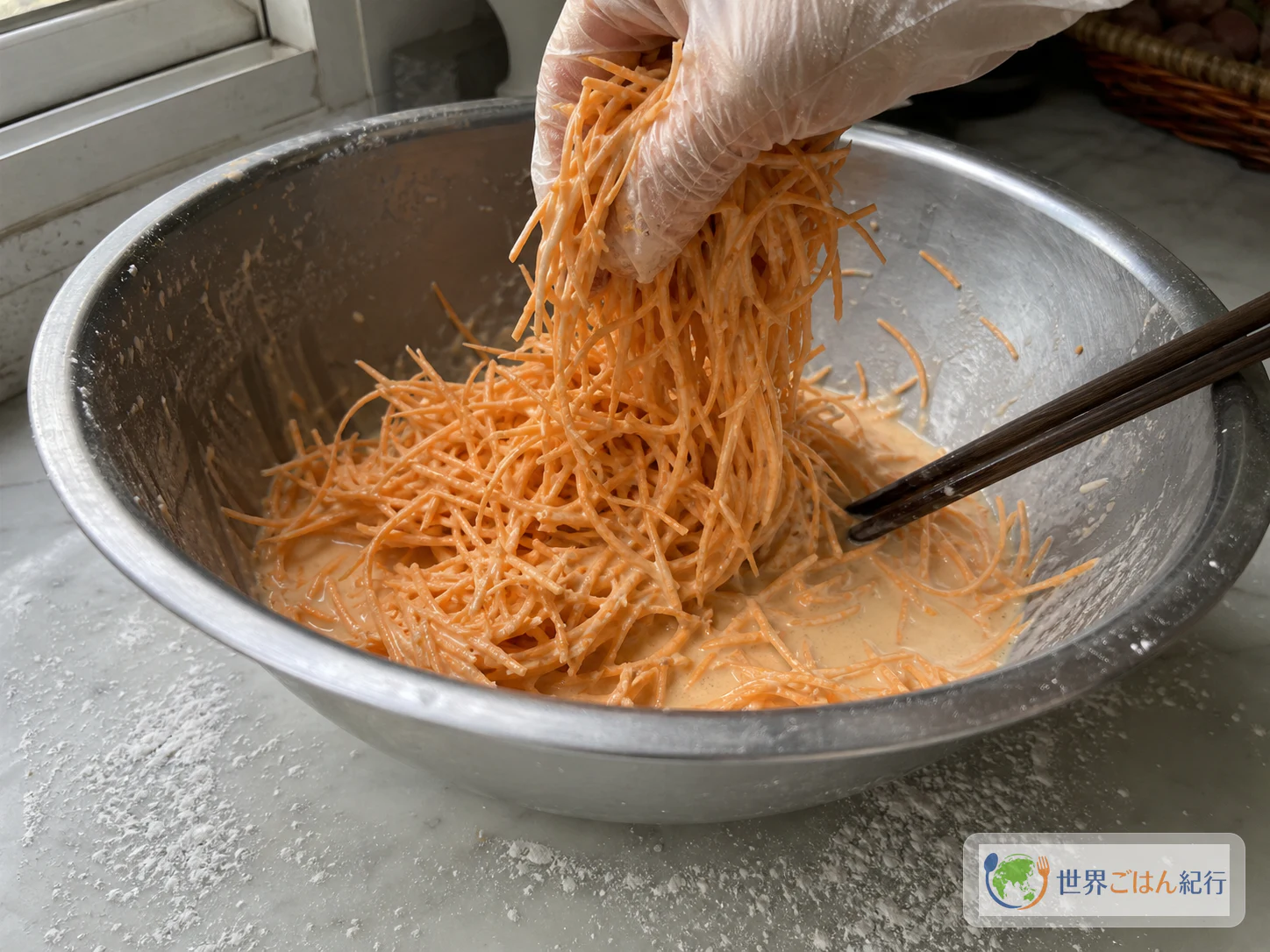
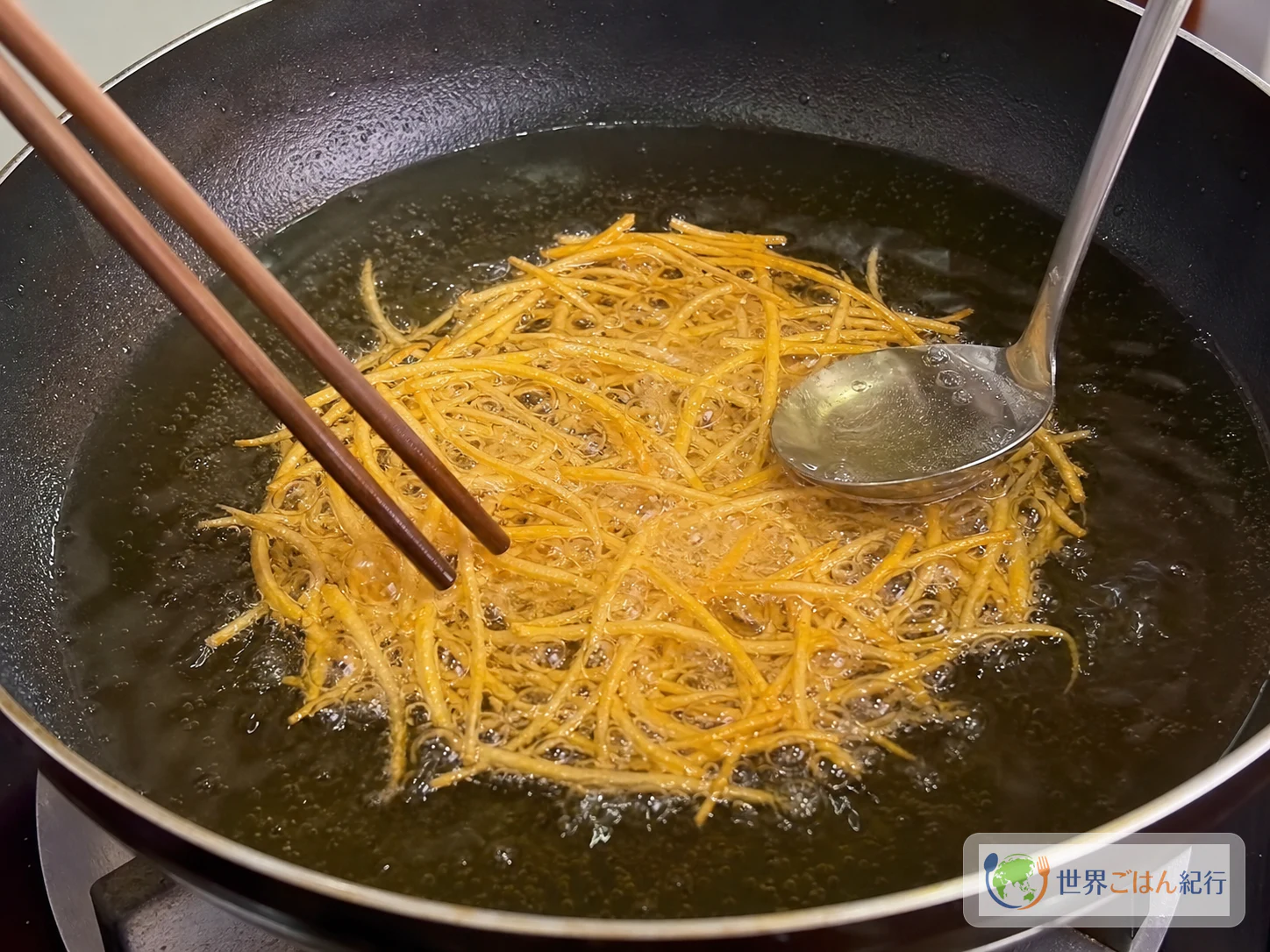
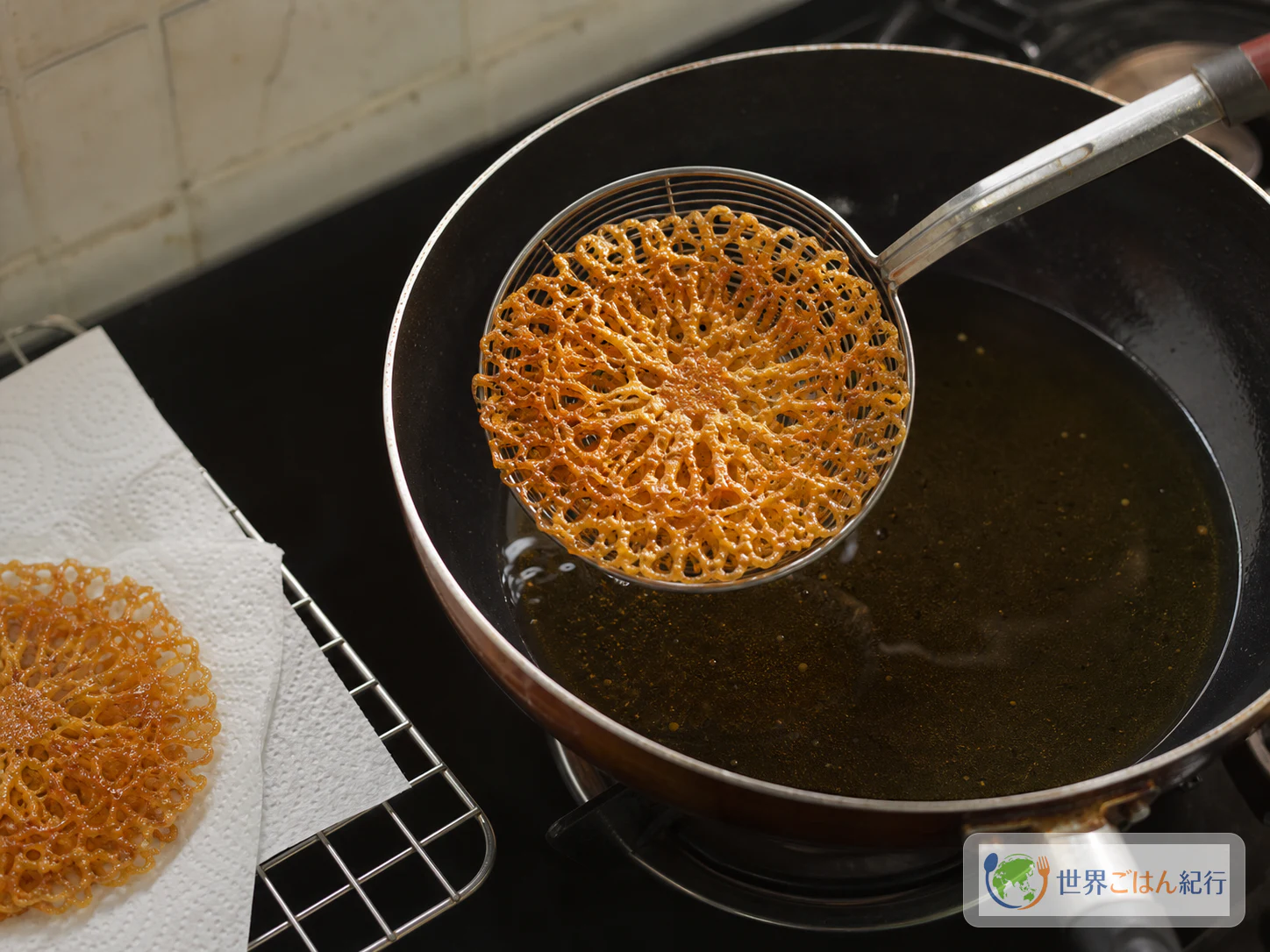
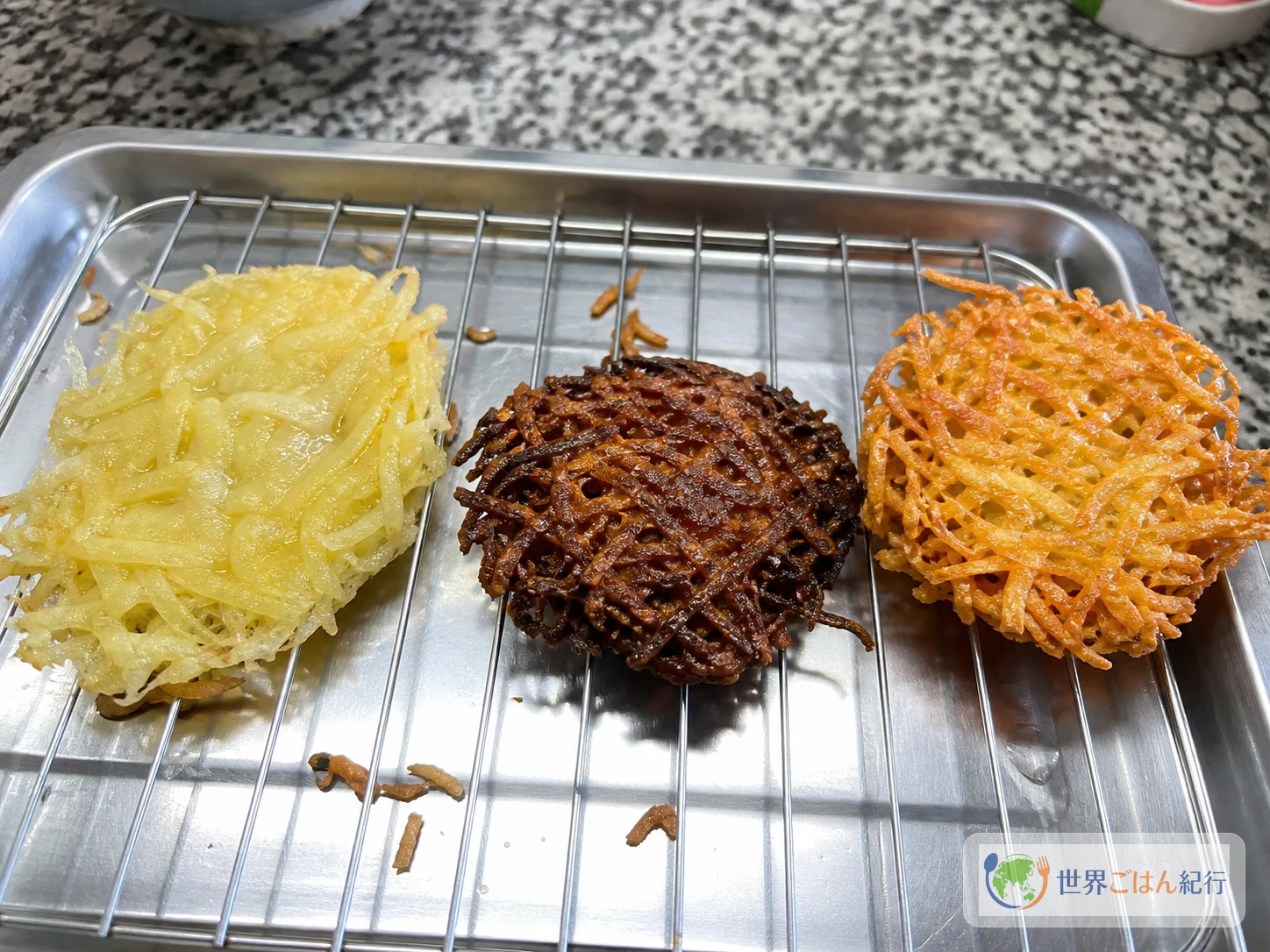
Drop thin shreds of sweet potato into hot oil and at first they look like flimsy bits of thread. Spread them out a little with chopsticks, and the bubbles turn fine, the edges go golden, and suddenly you have one sheet of lattice. Lifted onto a plate it sags a little while hot, then a few minutes later the sound changes and it turns crisp, and watching that happen is half the fun. Bánh rế is a specialty of the area around Phan Thiet in Binh Thuan province, southern Vietnam: sweet potato or cassava shaved thin, coated in sugar and fried into delicate discs. The sweetness is definite but never as deep as dark syrup, and the toasty aroma of fried sweet potato comes first.
Bánh rế, the souvenir sweet of Phan Thiet
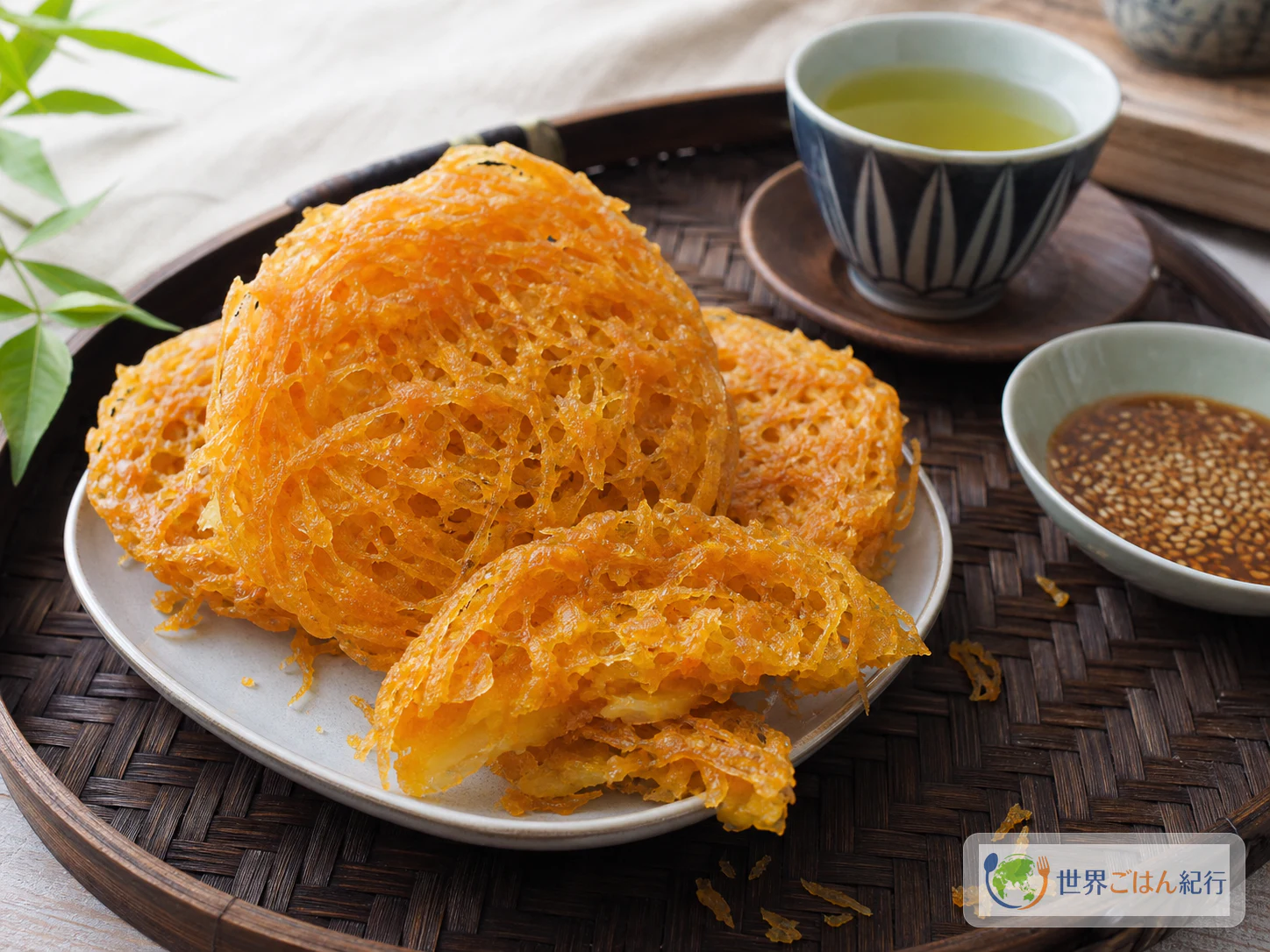
Phan Thiet is a seaside town, and among its souvenirs, alongside fish sauce and seafood, you'll find simple sweets like this one. Bánh rế is often sold stacked in thin rounds. It isn't a showy cream pastry. You eat it for the aroma of sweet potato, oil and sugar, so buy a bag on a trip and nibble it with tea at your lodging or on the way home.
It looks a bit like Japanese kakiage or imo kenpi (fried sweet potato sticks), but it eats differently. There's far less batter than in a fritter, and it's nowhere near as hard as imo kenpi eaten one stick at a time. Thin strands of sweet potato join here and there into a thin disc that breaks apart lightly when you crack it.
The difference from other Vietnamese rice-flour dishes is clear next to bánh bèo (in Japanese), which is also made with rice flour but steamed and eaten from small dishes. Bánh bèo gets its softness from steam, while bánh rế sets its lattice with oil and sugar. Add bánh chưng (in Japanese), wrapped in leaves, and bánh xèo (in Japanese), wrapped in herbs, and you can see how broadly the word bánh stretches in Vietnamese cooking, across rice flour, glutinous rice, tubers and fried foods.
In Vietnamese it is written Bánh rế. Rế evokes the shape of a net or basket, which matches the look of the sweet.
Ingredients (serves 4; makes 10 discs about 4 inches (10 cm) across)
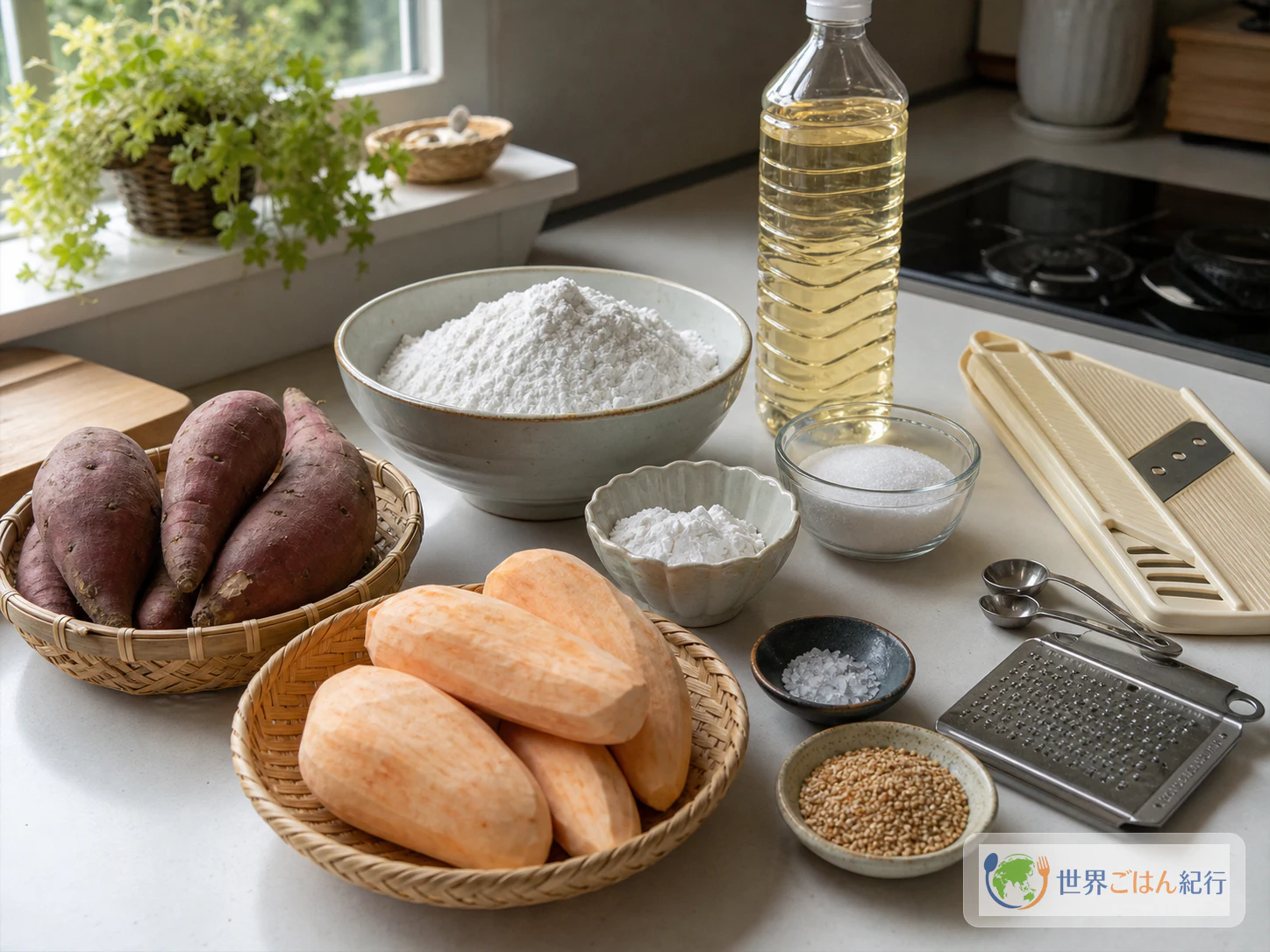
This amount makes about 10 discs of bánh rế around 4 inches (10 cm) across. It serves 4 as a snack with tea, or 5–6 people as a light dessert. Don't put in too much at a time when frying; with a home skillet it is easier to shape them one at a time.
This recipe uses rice flour, tapioca flour and white sesame. If you have a sesame allergy, leave out the sesame. Rice flour and tapioca flour can be processed on lines that handle wheat, so check the package if you avoid gluten. Keep the frying oil at least 1 inch (3 cm) deep, stay by the pot, and never put wet utensils or very wet sweet potato into the oil.
What is worth buying extra
What's worth shopping for here is the flour and oil temperature control. Sweet potatoes and sugar are fine from any supermarket, but a coarse flour makes the lattice heavy, and if you can't read the oil temperature the color changes from piece to piece. Rice flour, tapioca flour and a thermometer can all be reused if you go on to make more Vietnamese rice-flour dishes and fried sweets.
Tapioca flour is used not to make it chewy but to join the thin potato strands lightly. You can make it with potato starch, but tapioca flour gives a lighter bite once cooled.
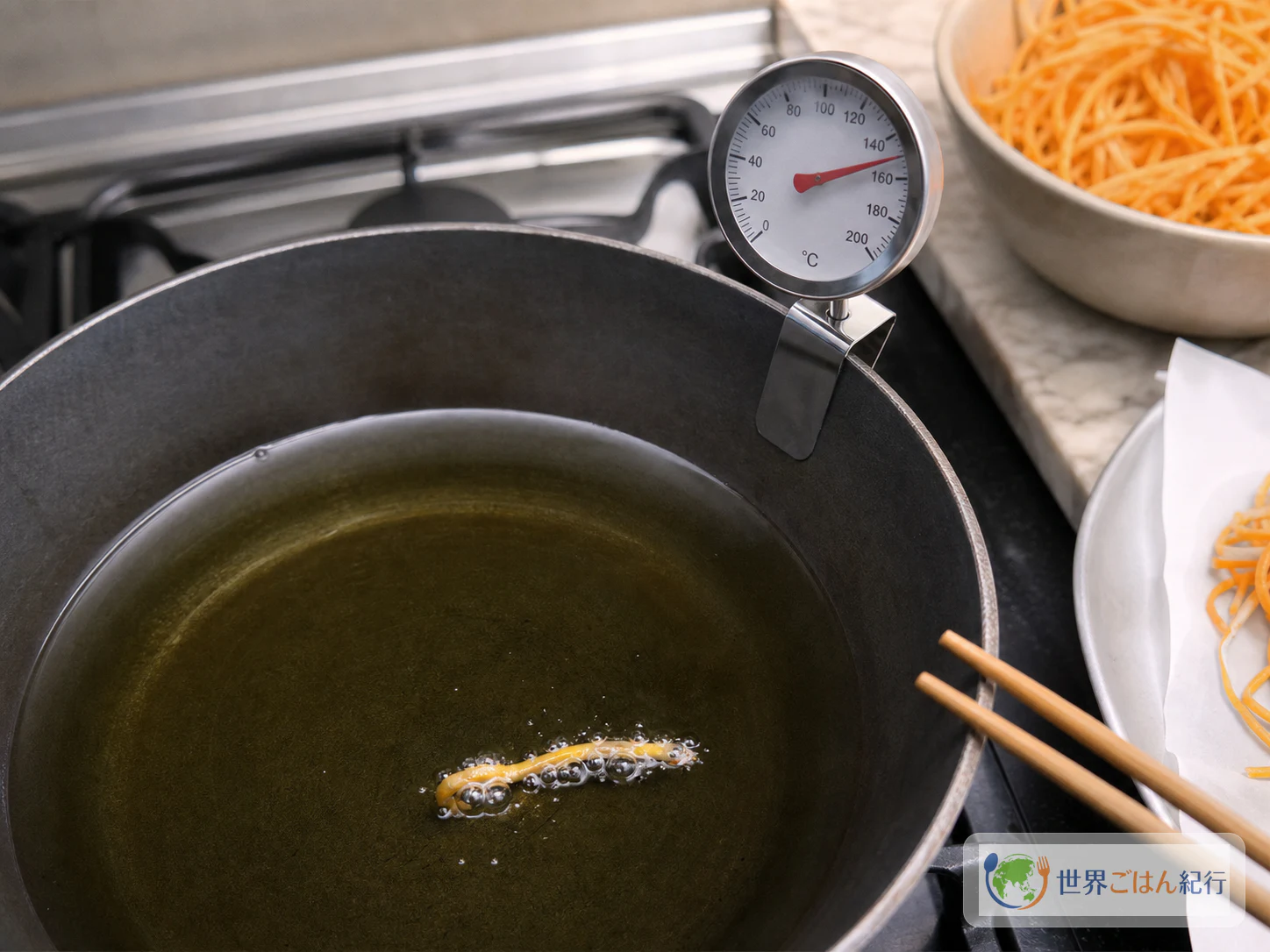
If you aren't used to deep-frying, a thermometer is a flavor tool. Bánh rế changes color fast: below 325°F (165°C) it soaks up oil, and near 350°F (180°C) only the outside scorches easily.
Choosing sweet potatoes and flours for bánh rế
Cassava is used locally, but it isn't practical to buy everywhere, so sweet potato is the star here. A moderately starchy, drier sweet potato suits it better than a very moist, sticky honey-type one. If the potato weeps moisture when cut, wipe it well before using. If it's so dry that it breaks when shredded, cut the soaking time to about 3 minutes before coating to prevent cracking.
You can shop the way you would for candied sweet potato (daigaku imo), but the goal is different. Candied sweet potato is coated in syrup, while bánh rế is all about fineness and air: a thin lattice that cracks lightly, not fluffy, mealy potato. Cut it as thick as daigaku imo and it won't form a lattice at all. Instead it clumps like a kakiage fritter.
The small amounts of rice flour and tapioca flour are only there to help the lattice hold together in a home kitchen. The sweet potato, sugar and oil do the real work.
Common bánh rế problems and fixes
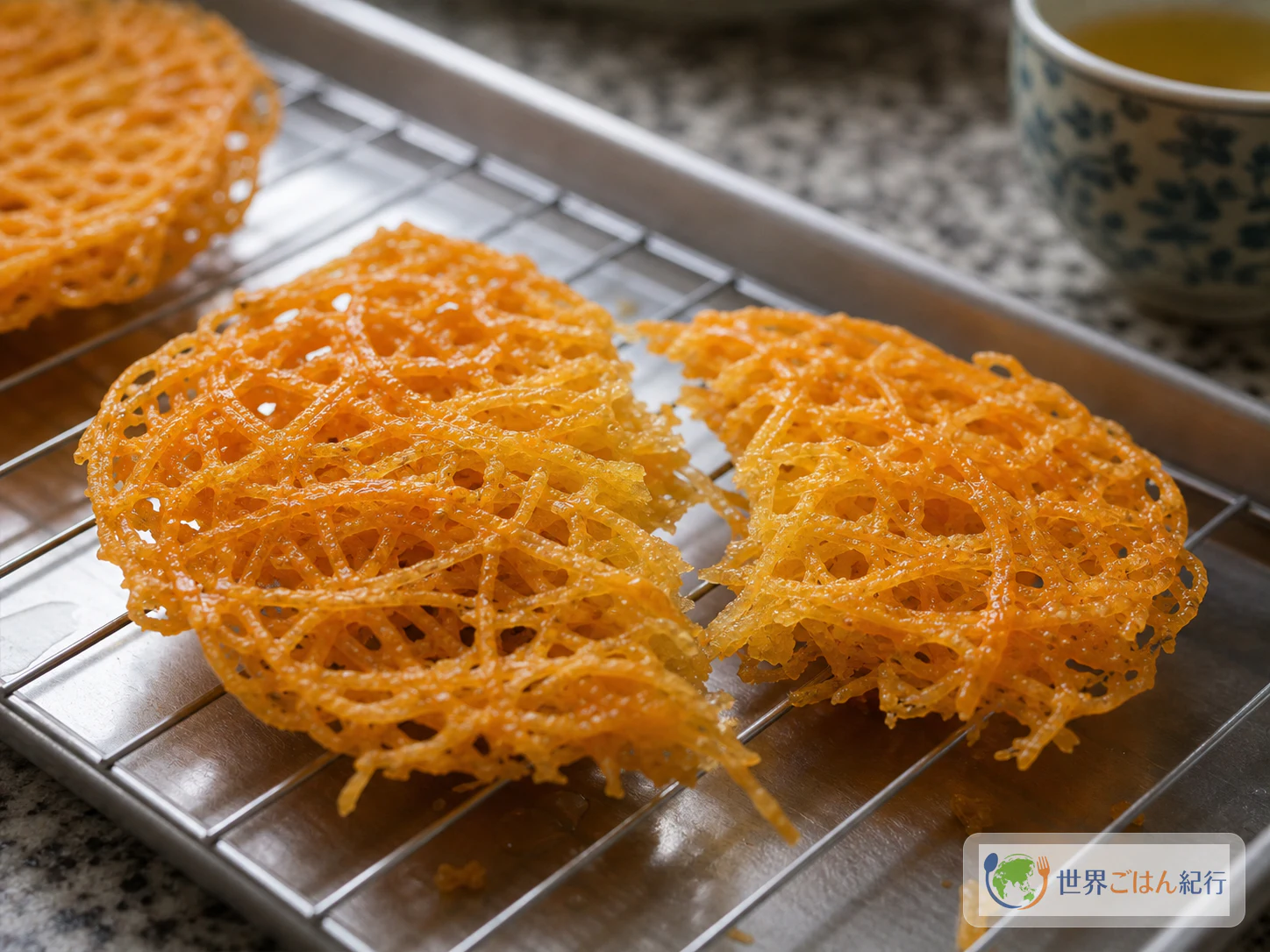
Nearly every failure traces back to how fine the potato is cut or how hot the oil is.
It turns greasy
The cause is the moisture in the sweet potato, the oil temperature or the thickness. If moisture remains, the batter loosens and the bubbles turn rough the moment it hits the oil. Below 325°F (160°C), the surface soaks up oil before it sets, and a thick disc traps moisture in the center and feels heavy once cool. Wipe the potato dry, measure the temperature, and spread it thin at 4–4.5 inches (10–12 cm) across.
It won't hold a round shape
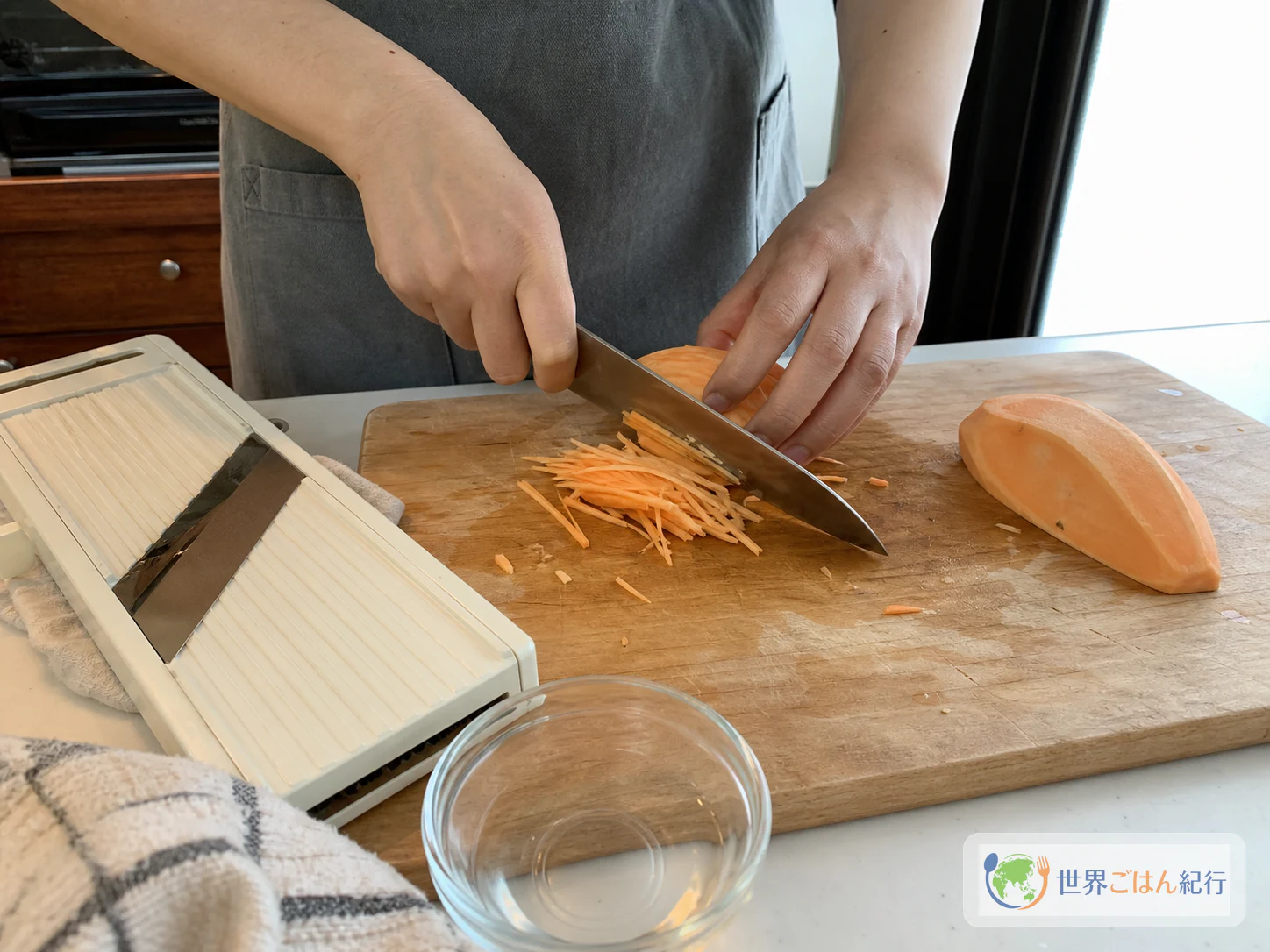
It breaks up if the potato is thick, the batter is scant, or you fuss with it right after it goes in. Cut the potato into 0.125 inch (2–3 mm) matchsticks and coat it so the batter is thin but covers everything. Leave it alone for the first 30 seconds in the oil, then, once the bubbles have set the surface a little, push the outer edge in with chopsticks. Pressing it flat closes the holes, so tidying the edge is enough.
It scorches but is soft inside
The oil is too hot. At about 350°F (180°C) the sugar colors first, and the surface browns before the moisture has left the potato. Lower the heat and bring the oil back to around 325°F (165°C) before the next piece goes in. Discard any scorched discs, and skim small burnt bits out of the oil so the bitterness doesn't carry over.
The lattice is heavy and like a cracker
The batter is too thick or there's too much rice flour. If thick white batter is pooling at the bottom of the bowl, add a little more sweet potato or thin it with 1–2 tsp water before frying the next one. It's right when you can see each strand of potato as you lift it with chopsticks.
Serving and storing bánh rế
Pairing it at the table
Bánh rế is a sweet fried snack, so it's better served a little at a time with warm tea than brought out in quantity after a big meal. Drinks that refresh the palate, such as green tea, roasted green tea, lotus tea or jasmine tea, go well. For fruit, sour ones like mandarin, orange, pomelo or pineapple are the easiest match.
On a Vietnamese menu, pair it with main dishes that use little oil. After phở gà (in Japanese), the chicken noodle soup, bún chả (in Japanese), a light dish of herbs and rice noodles, or bún thịt nướng (in Japanese), with sweet-savory pork and rice noodles, crack and share just one disc. If you're serving the fried spring rolls chả giò (in Japanese) the same day, keep both portions modest, since they're both fried.
Storage and reheating
Listen rather than look to know when it's ready to store. Right after frying it's quiet on the rack, but as it cools it gives a light, dry sound when you pick it up. Put it away before that and steam builds up in the container, softening it from the underside. On rainy days, once it's completely cool, dry it in a toaster oven at 250°F (120°C) for just 1 minute, let it cool slightly, then store.
Keep the cooled discs in a container with a desiccant and eat them at room temperature by the next day. On humid days they soften a little within half a day, even sealed. If you make them ahead, plate only what you'll eat that day and store the rest separated by paper, not stacked.
To revive soft bánh rế, preheat the toaster oven to 325°F (160°C), lay foil on the tray and warm it for 2–3 minutes. It scorches easily, so keep watching and take it out as soon as the edges feel light again. A microwave puts moisture back in and makes it softer, so skip it.
I don't recommend freezing: on thawing it absorbs moisture from the frost and the lattice turns heavy. Leftovers are good crushed lightly over vanilla ice cream or yogurt, where you still get the toasty aroma even without full crispness.
Frequently asked questions
Can I make it with cassava?
You can, but the prep and availability are tricky in many home kitchens. If you use cassava, use only cassava sold for eating, remove the peel and core, and follow the seller's prep instructions. For a first attempt, sweet potato is safer and less likely to fail.
Can I make it without rice flour?
Locally there are also versions made mostly with potato and sugar. At home, though, the moisture and cut of the potato are hard to keep consistent, so a small amount of rice flour makes it easier to form. If you leave it out, reduce the water in the batter by about 2 tbsp (30 ml), work the sugar thinly into the potato, and fry at a lower oil temperature.
Can I use potato starch in place of the tapioca flour?
Yes, reduced to 20 g. Fresh from the oil the texture is similar, but once cooled it's a little harder and the flour shows more. If rice flour alone breaks too easily, tapioca flour holds it together more lightly.
Can I make it in an air fryer or oven?
It won't turn out the same. Bánh rế depends on thin potato setting all at once in the oil, leaving gaps in the lattice. An oven or air fryer doesn't have enough oil, and the potato ends up closer to dry baked sweet potato chips. If you want to cut back on oil, treat that as a different dish, and fry on the days you want the real bánh rế.