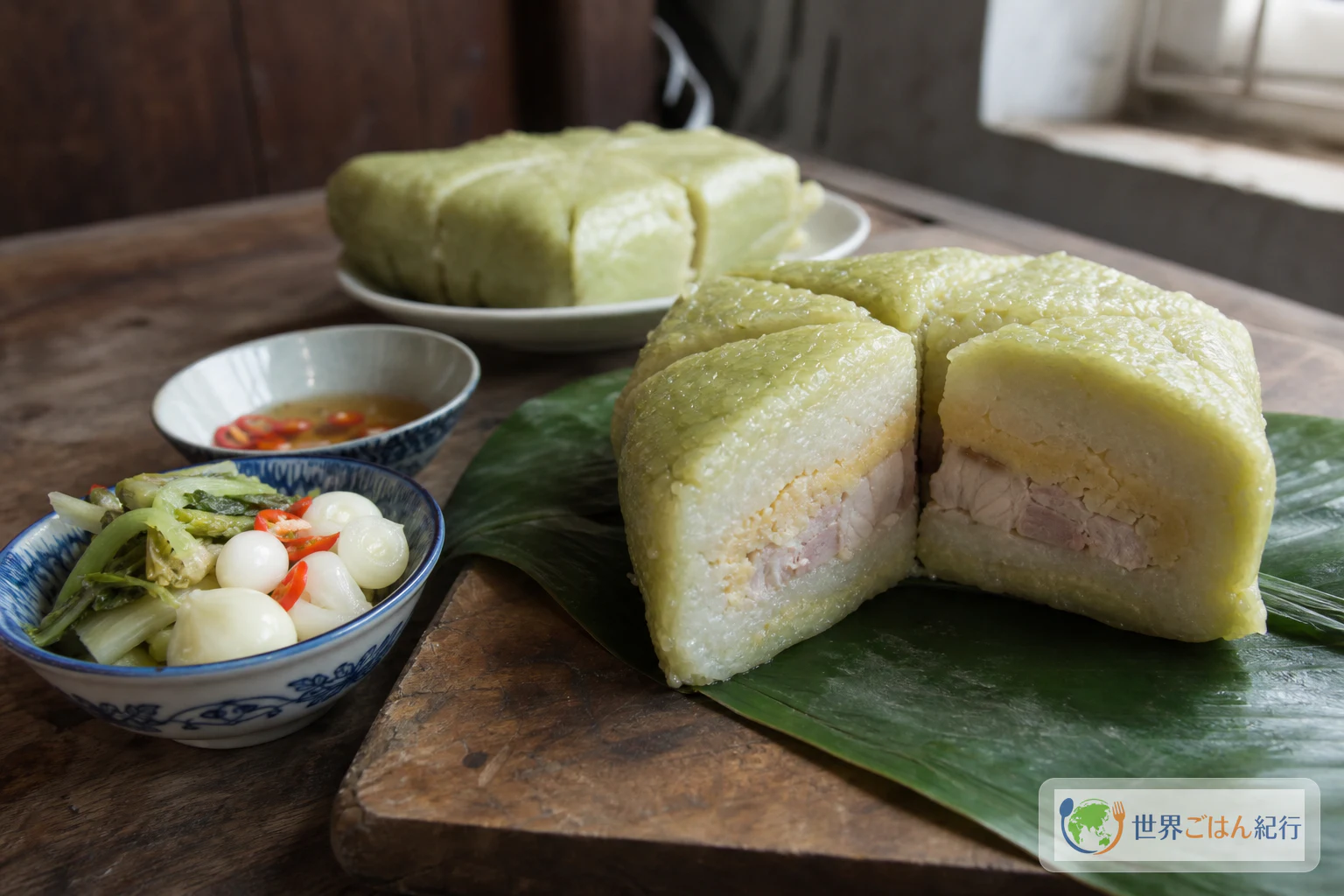
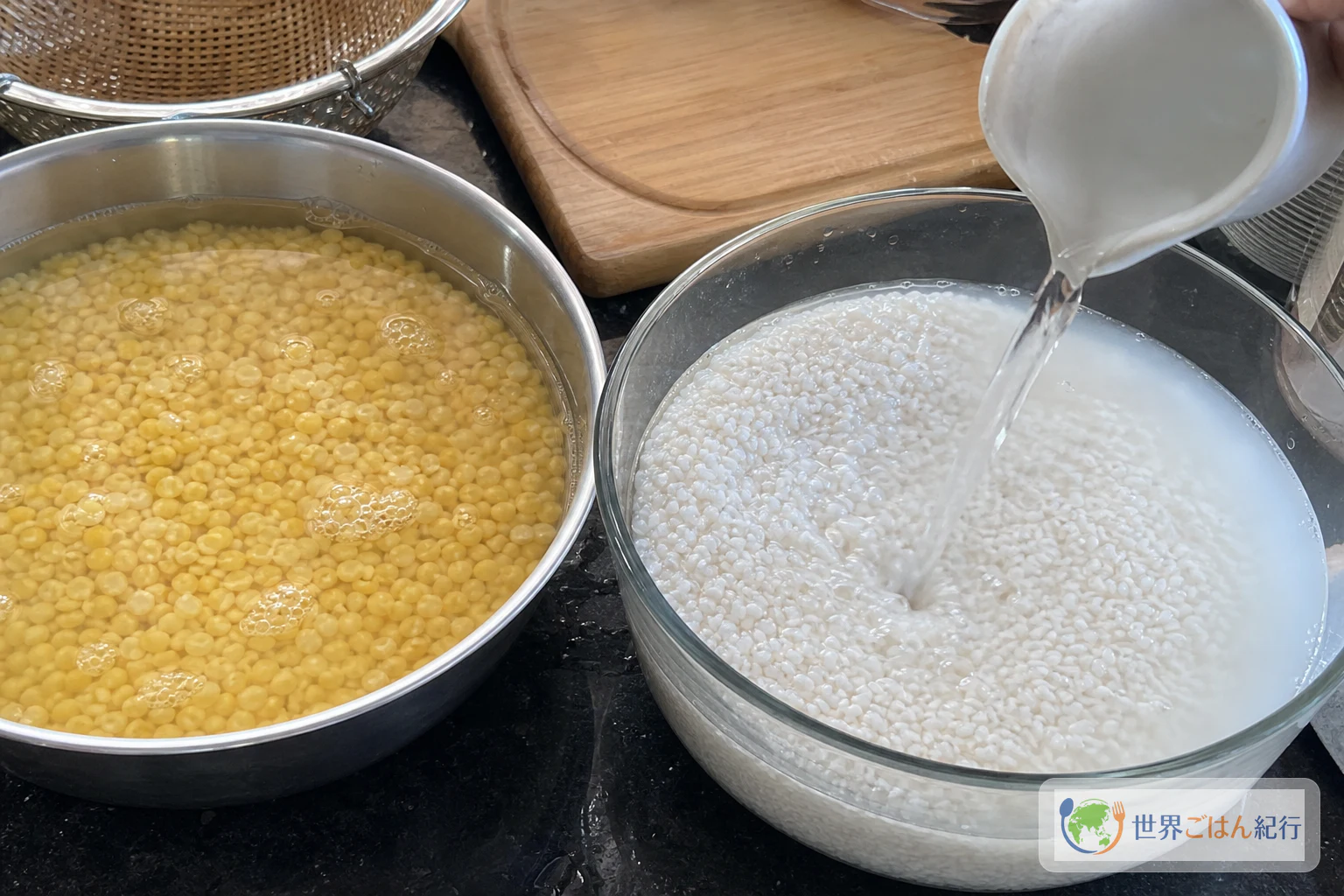
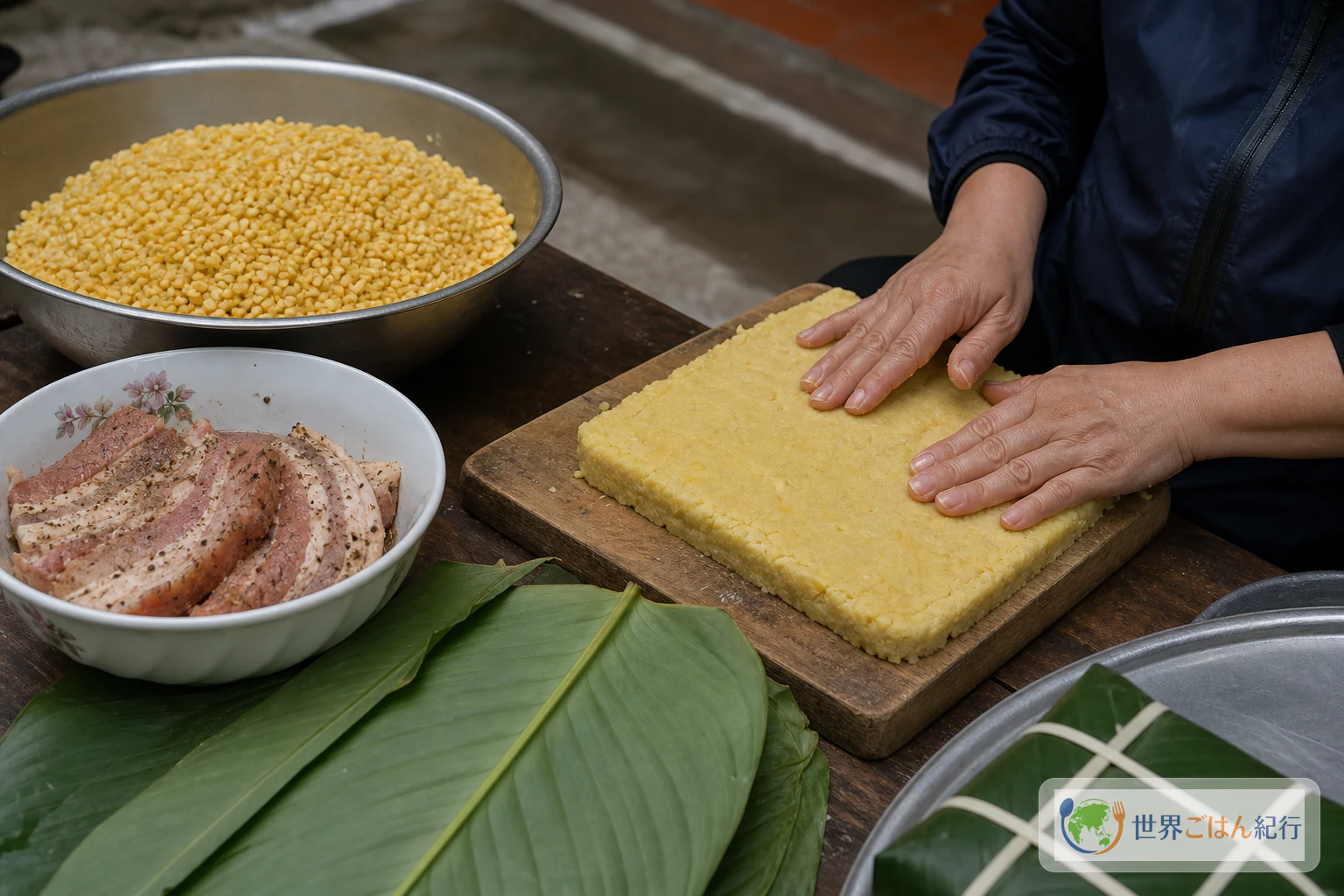
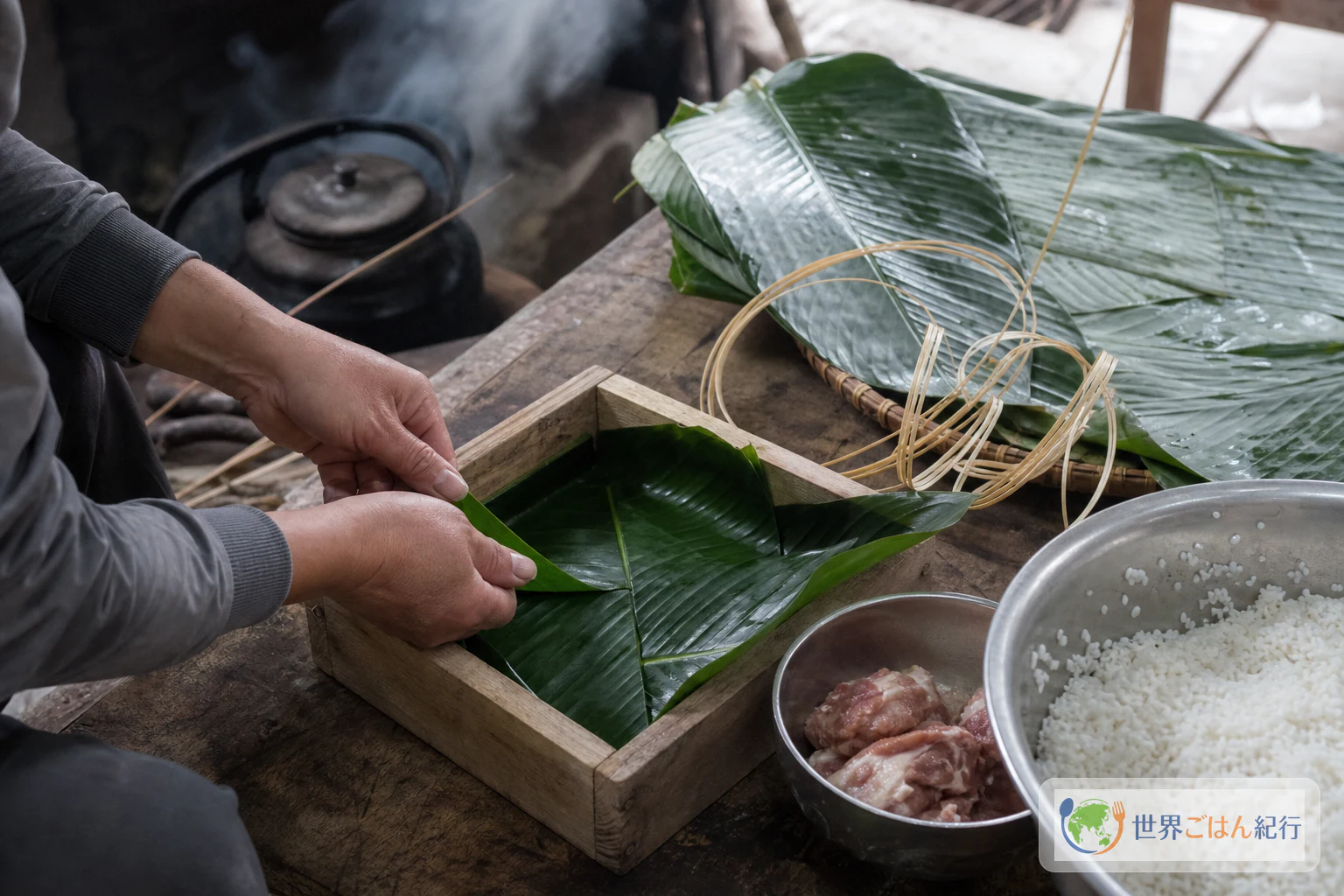
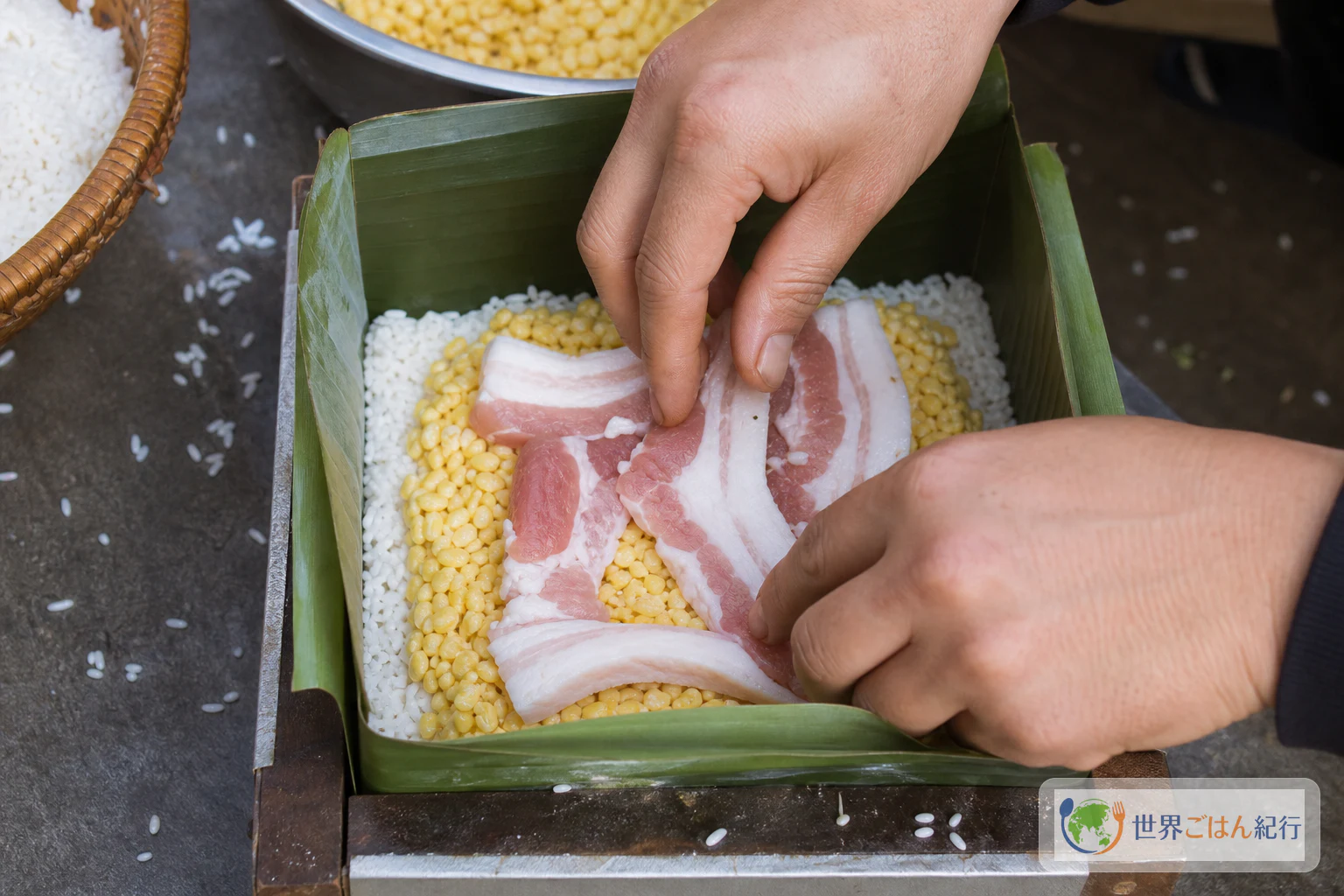
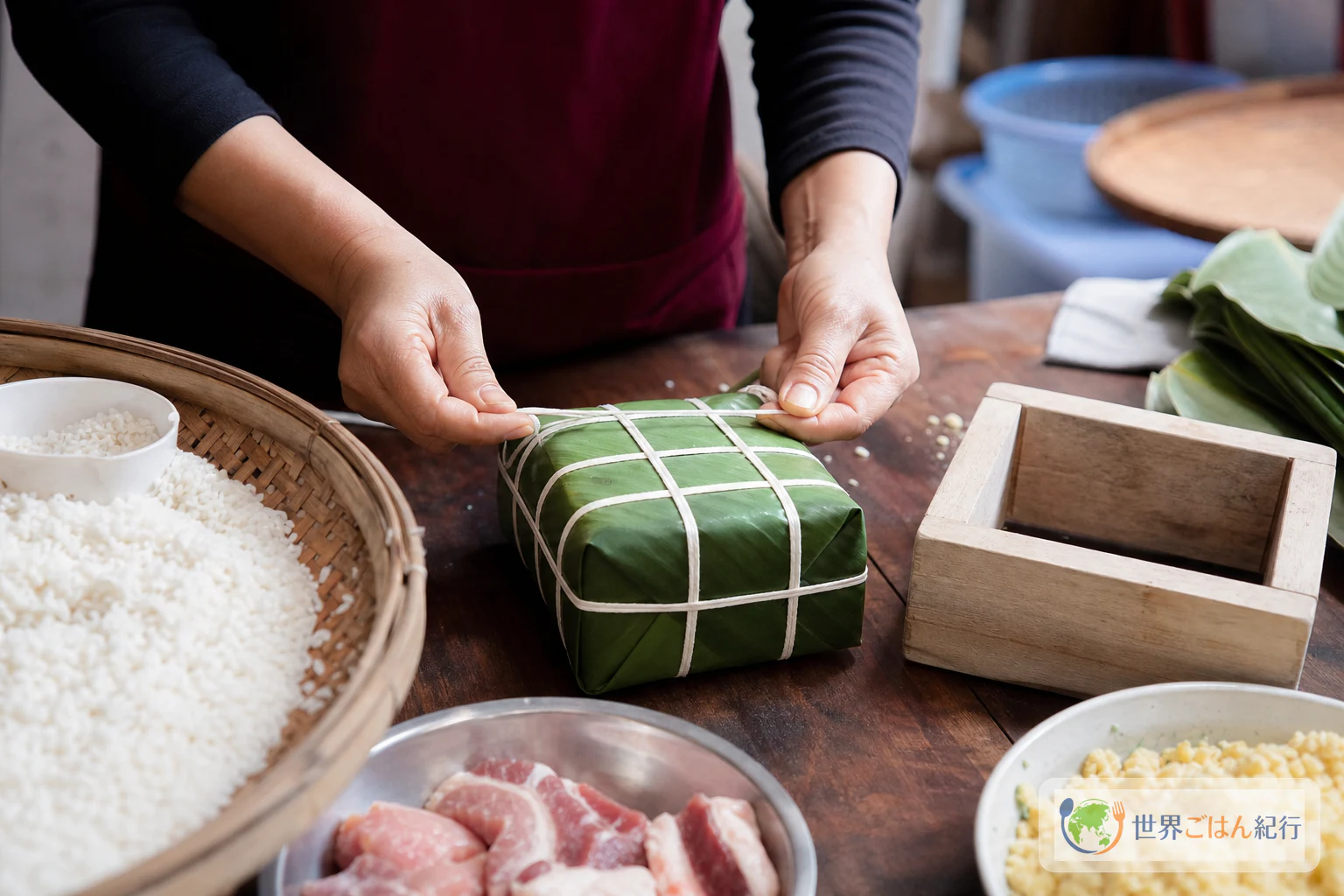
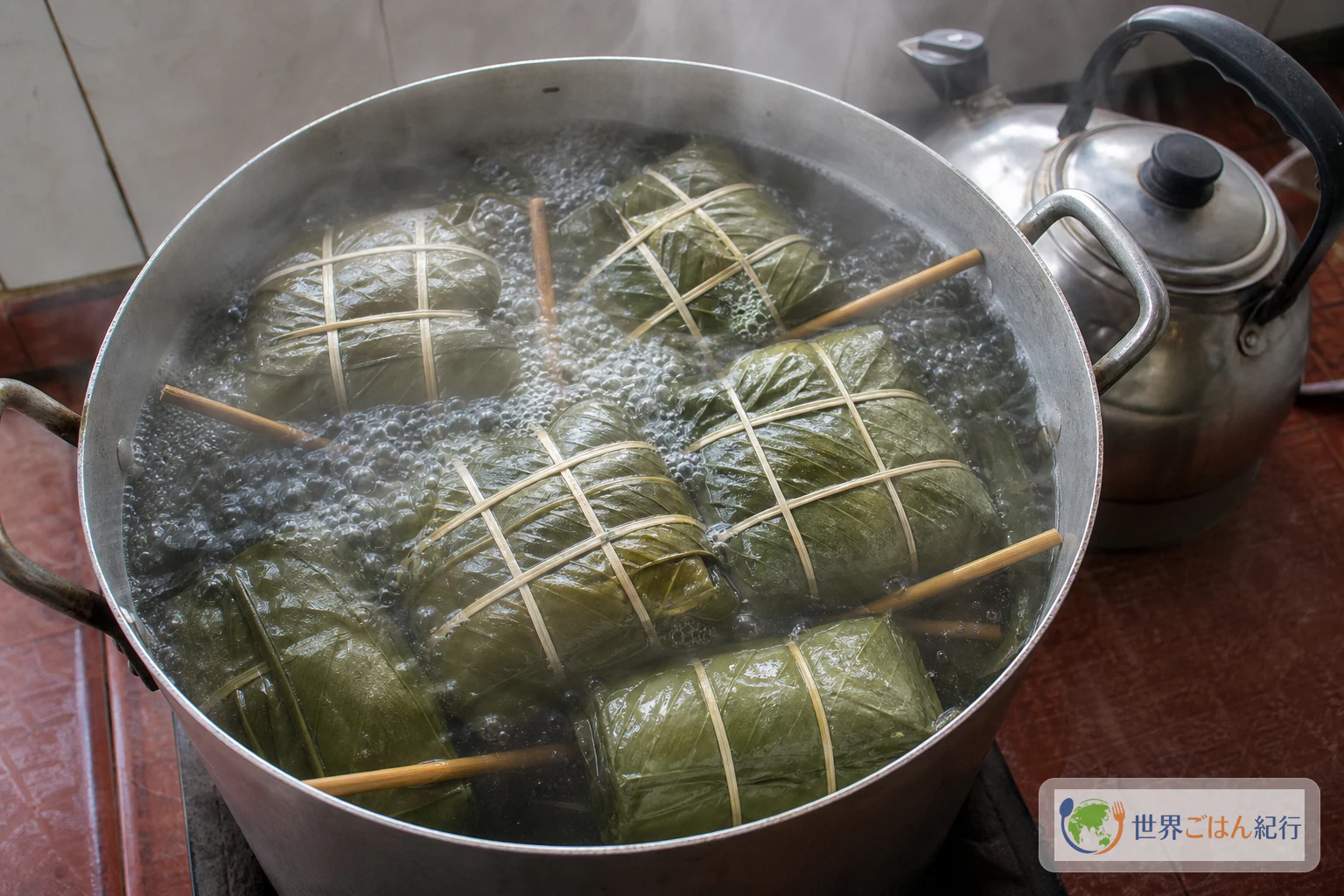
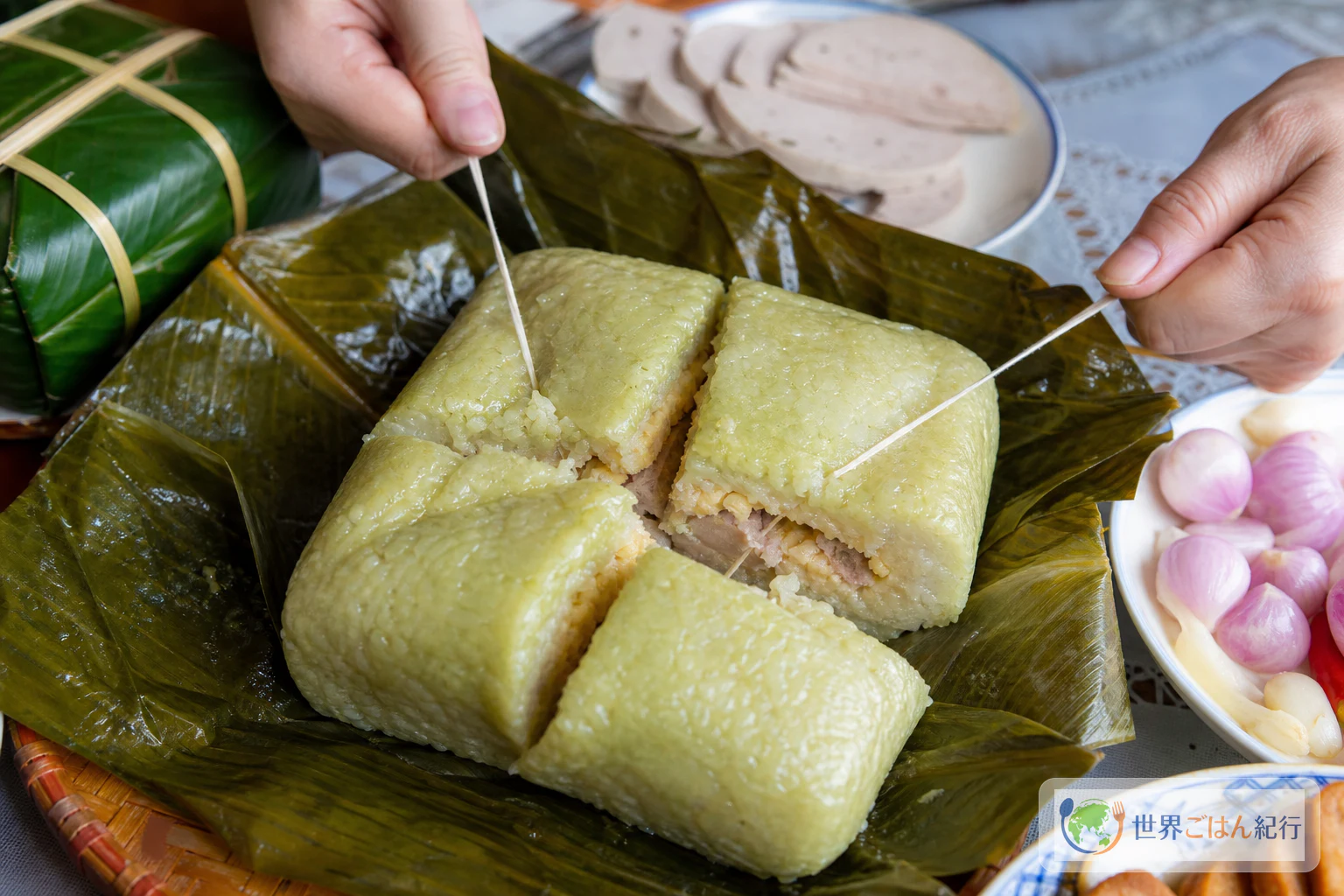
Soaked glutinous rice, steamed yellow mung beans and fatty pork all go into one square of leaves. Then the wrapped cakes sway in the pot for hours, and a green aroma drifts out from under the lid. Ordinary rice cooked with the same ingredients never smells like that. Banh chung (Bánh chưng) is Vietnam's Lunar New Year rice cake: dense and sticky, with a savory center of mung bean and pork. It takes a long time, so save it for a day when you are in no hurry for dinner.
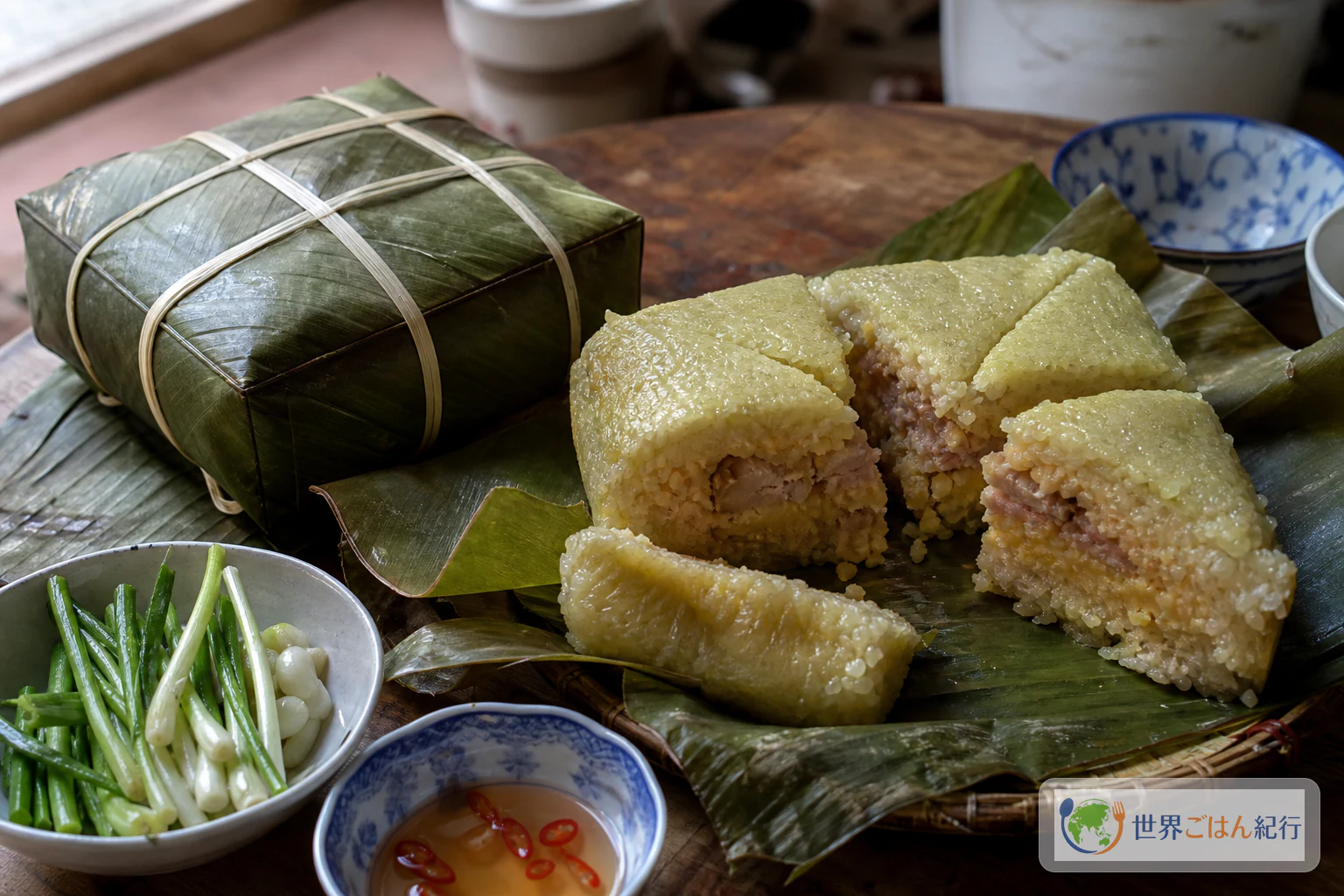
Banh Chung at Tet
Banh chung is closely tied to Tet (Tết), the Vietnamese Lunar New Year. Glutinous rice, mung beans and pork are wrapped in dong leaves (lá dong), tied crosswise with string and boiled for a long time. It is paired with the round banh giay (Bánh giầy), and its square shape stands for the earth. Families gather to wash the leaves and pack the rice, then wait beside the pot for the new year.
In the south, people also eat banh tet (Bánh tét). The ingredients are close to banh chung, but it is wrapped in a cylinder and cut differently. Banh chung is also quite different from com lam, another Vietnamese glutinous rice dish, which has only a light bamboo and leaf fragrance. In banh chung the rice is the star, and the mung bean and pork in the center give it real substance. People eat this rich leaf-wrapped cake for breakfast, at the Tet table, or make it ahead. Once you are comfortable with it, banh beo, which also uses rice flour, and banh bao, a good breakfast dish, show more of the range of Vietnamese flour and rice dishes.
Bánh is a Vietnamese word widely used for cake-like things, flour dishes, and rice dishes. Chưng is the part of the name that is specific to this dish, so the full name is Bánh chưng.
Ingredients (two 4.5 inches (12 cm) square cakes, 8 slices)
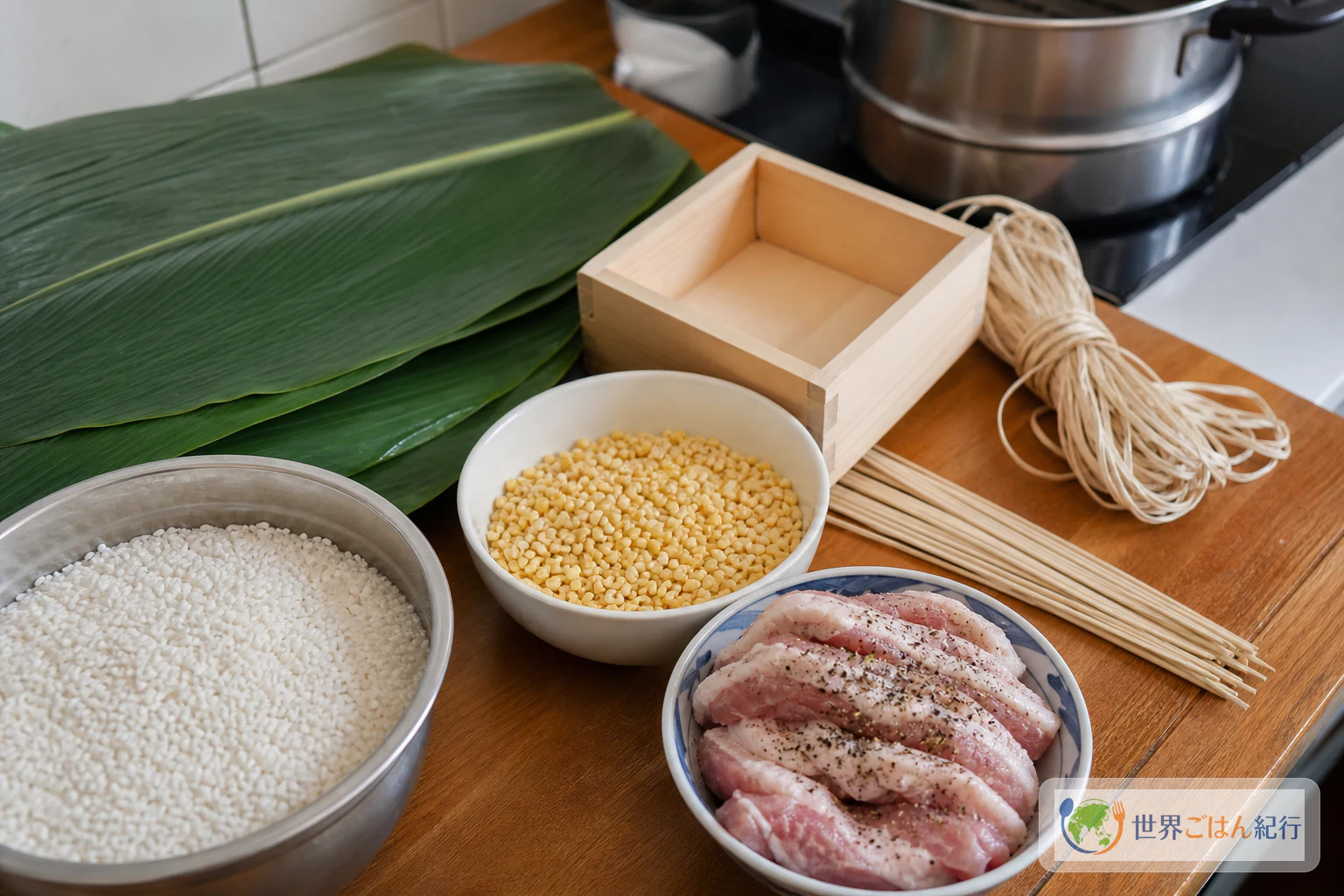
This quantity makes two banh chung, each about 4.5 inches (12 cm) square and 4–5 cm thick. Cutting each into 4 gives 8 slices. As a main dish it serves 4 people; as a breakfast or side dish, 8.
Dong leaves are hard to find, so use frozen banana leaves instead. They are not identical, but they give the rice a green leaf fragrance and hold the wrap together. Parchment paper can give you the shape, but the banh chung aroma will be much weaker, so banana leaves are worth getting.
Main ingredients
Equipment
| Equipment | Amount / size | Substitutes & notes |
|---|---|---|
| 12 cm square mold | 1 | A wooden frame, a square mold with a removable bottom, or a storage container as a temporary mold |
| Kitchen twine or food-safe string | 8 lengths of 55 inches (140 cm) | 4 for each cake, lengthwise and crosswise. Use a material that does not loosen |
| Bamboo skewers | 4 | To keep the cakes under water and to help check doneness |
| Large pot | 10 inches (26 cm) or wider | Deep enough to submerge both cakes |
| Steamer | 1 | For steaming the mung beans. A pot with a steaming rack also works |
| Instant-read thermometer | 1 | To check that the pork is cooked. Open one cake and measure |
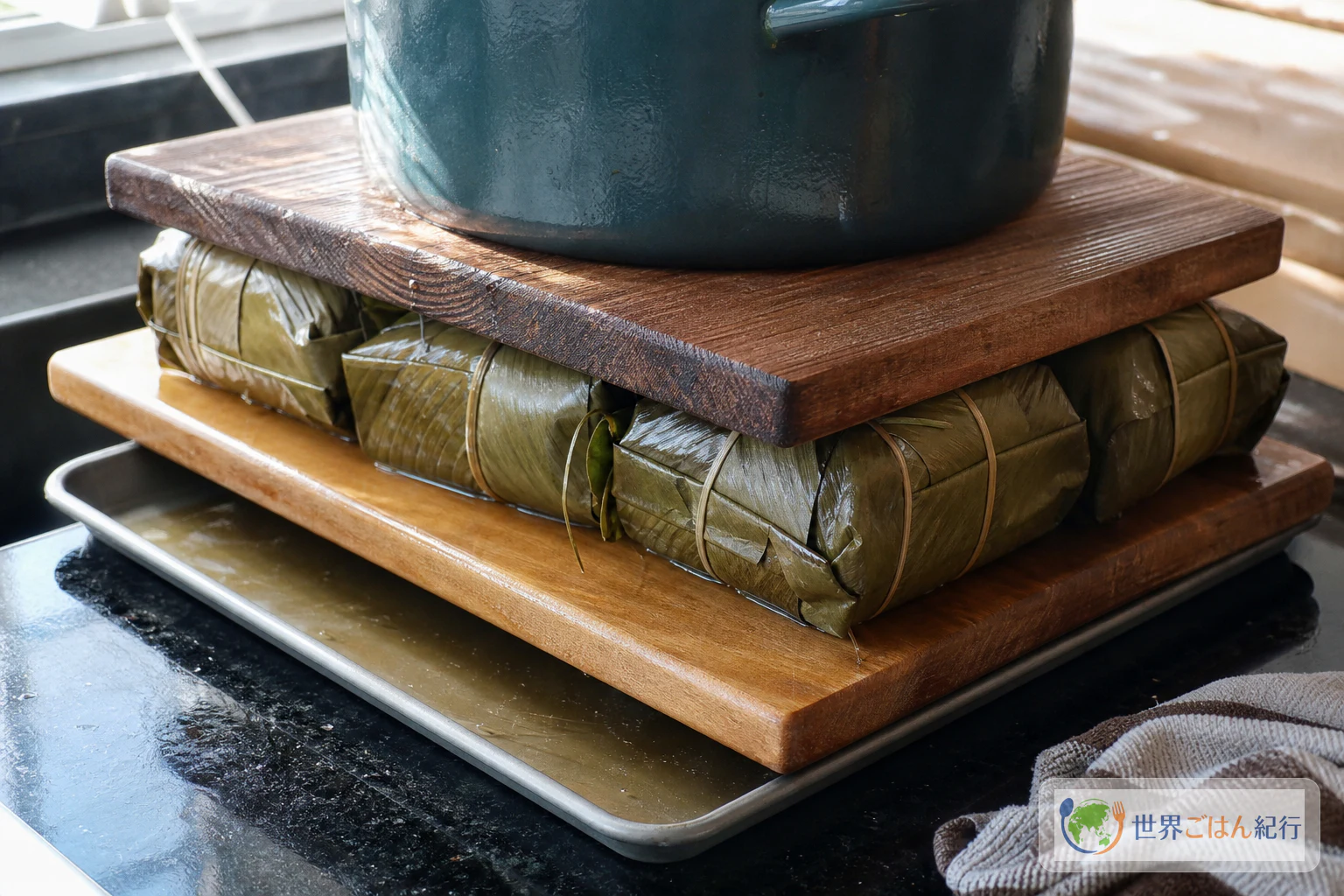
| Cutting boards and a weight | 2 boards, about 4.5 lb (2 kg) | To press and shape after simmering |
This recipe uses pork and fish sauce. Fish sauce comes from fish, so if you have a fish allergy replace it with 1 tbsp soy sauce and a pinch of salt. The pork sits in the center of the wrapped cake, so at the end of simmering open one cake and check that the center has reached 75 degrees C or more. Without a thermometer, check that the pork is grayish-white with no red parts or clear juices, and if not, simmer for 30 minutes more.
Choosing Ingredients and Equipment for Banh Chung
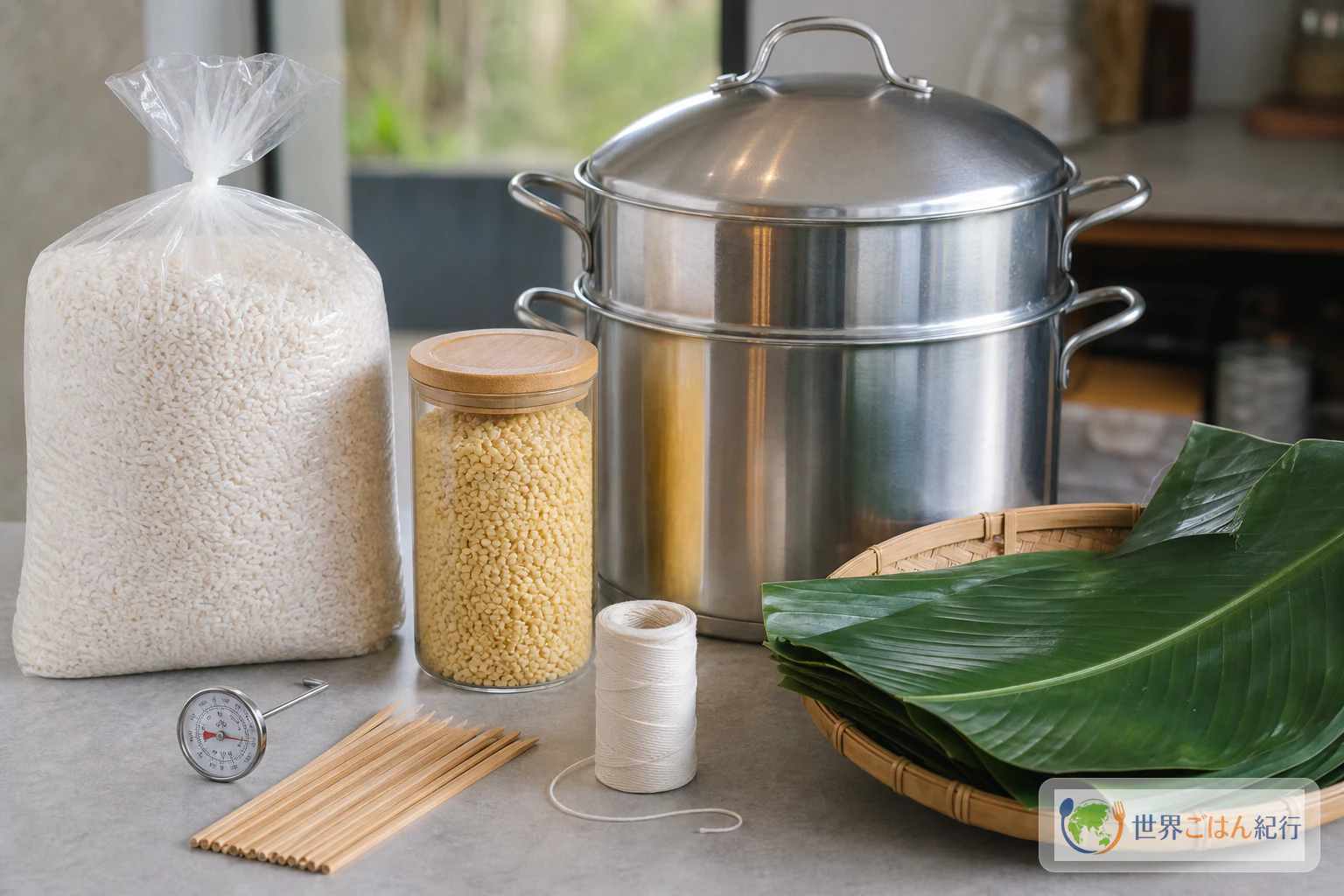
Start with the glutinous rice, because the texture depends on it. If you use only ordinary rice, the layers come apart when you cut the cake, and no amount of simmering gives banh chung its dense texture. Choose rice whose grains soak up water plumply and still hold together when cold. Look for frozen banana leaves at a store that carries frozen imported foods.
At home, the hard parts are the leaves and the pot. In Vietnamese homes, large cakes boil for hours. If you make one that size in a household pot, the rice can take on too much water before the center cooks, and it is hard to tell whether the pork is done. So divide the batch into two smaller cakes about 4.5 inches (12 cm) square. If you have no square wooden frame, line a 4.5 inches (12 cm) square storage container with plastic wrap to use as a mold, then move the rice onto the leaves.
Two tools make the rest easier. The cake itself boils submerged in water, but if you soften the mung beans in a steamer first, the center will not turn chalky even after a long simmer. An instant-read thermometer helps too. The center of the wrap heats up last, and you can't judge doneness by looking, so the thermometer lets you decide calmly whether it needs a little longer.
Method: Simmer Long, Press, and Cut
Most failures with banh chung come from one of these: making it too large, not soaking the rice and beans enough, wrapping so loosely that water gets in, or simmering at too strong a temperature. At home, make it smaller, keep the water gently bubbling, and press at the end to settle moisture and shape.
Banh Chung Problems and Fixes
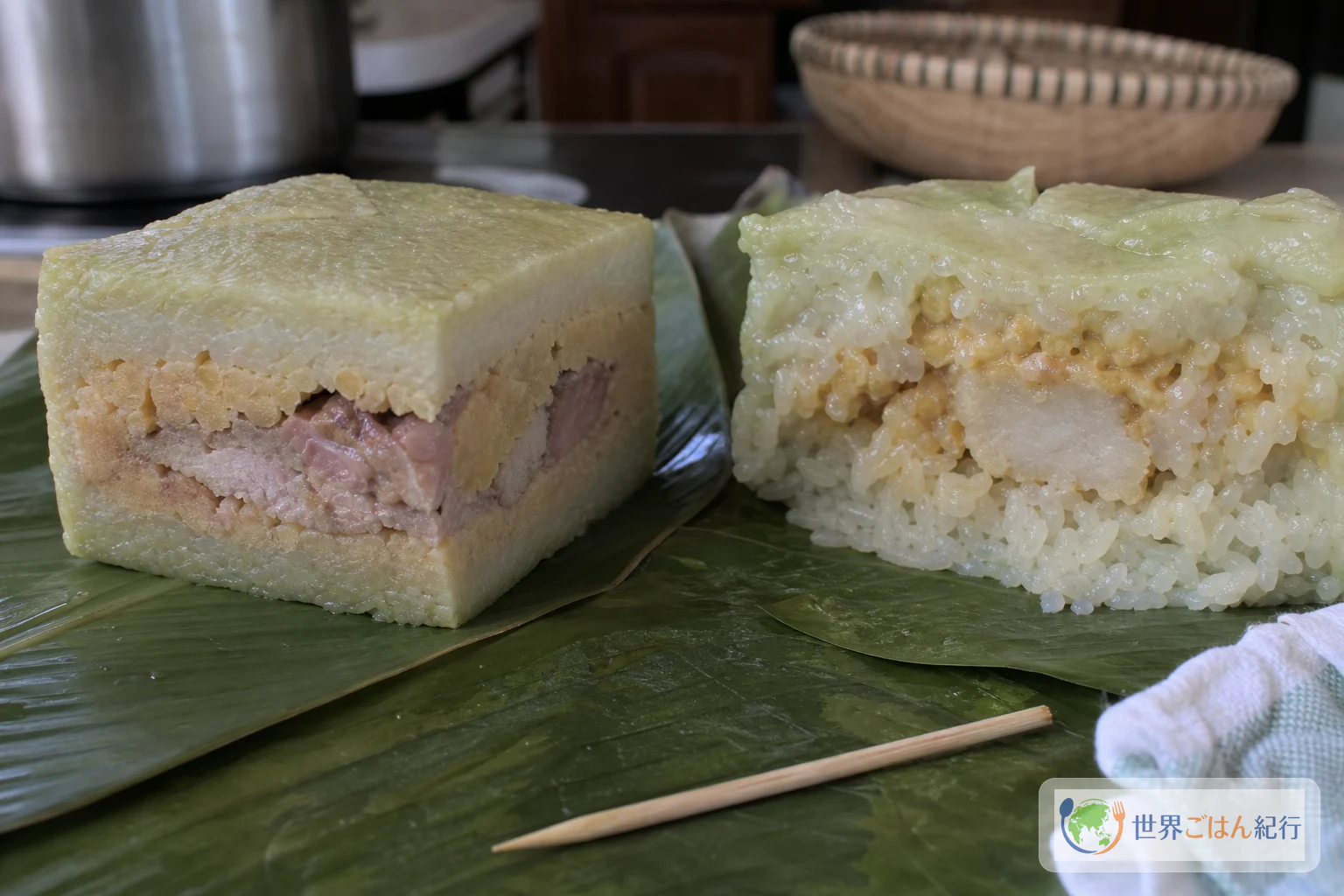
This dish has few ingredients, so small differences in the steps show up in the cross section. A white core means the rice was not soaked or simmered long enough. For this batch, put the cake back in the pot and simmer it 30–60 minutes more over medium-low heat. If you have already cut it, warm it for about 15 minutes in a steamer over medium heat to make it easier to eat. Next time, soak the rice and beans for at least 6 hours.
A watery, collapsing cake means the water boiled too hard, or the string was loose and water got in through gaps in the leaves. It will not fully recover, but you can brown it. Pan-fry slices in a thin layer of rice bran oil over low heat for 4 minutes per side, and turn them only once the surface of the rice has dried. High heat won't work here.
If the pork in the center is still red, do not eat it. Rewrap the cake and put it back in the pot. Keep the water gently bubbling, simmer for 30 minutes more, and check again. Even after hours in the pot, the center of the wrap heats up more slowly than the outside, which is why smaller cakes are the safer choice, especially the first time.
Storage and FAQ
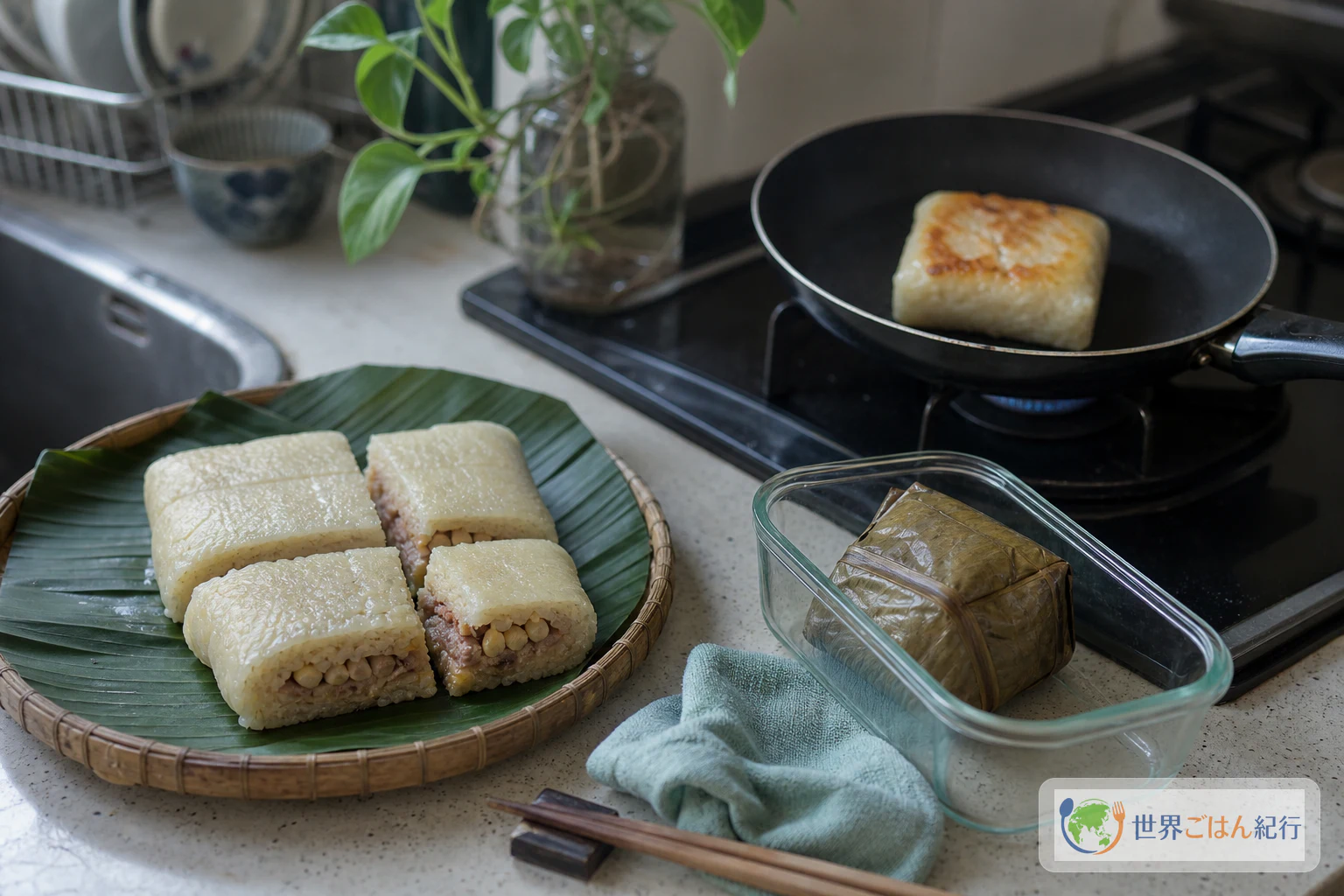
On the day you make it, let the cake cool at room temperature with the leaves still closed. It spoils easily in hot or humid weather, so do not leave it out for more than 2 hours. Once it has cooled, wrap it in plastic wrap, leaves and all, and put it in a storage container. It keeps for about 2 days in the refrigerator or 3 weeks in the freezer. If you freeze it, wrap each slice separately so you can thaw only what you want.
Steaming is the easiest way to reheat it. Steam a refrigerated slice over medium heat for 10–12 minutes. Thaw a frozen slice overnight in the refrigerator, then steam it for 15 minutes over medium heat. To pan-fry, heat a thin layer of rice bran oil over low heat and cook the slice for 4 minutes, turn it, then cook 3 minutes more. Stop when the surface is light golden and the slice is hot to the center. Fried too long, the mung bean layer dries out, so just toast it lightly.
Can I make it without banana leaves?
You can shape it with parchment paper, but you lose the leaf aroma. For a cake that tastes like banh chung, wait until you can get frozen banana leaves. If you find dong leaves, soften them and use them the same way.
Can I make it without pork?
You can, but it becomes a different dish. Leave out the pork, increase the mung beans to 9 oz (260 g), and add 1.5 oz (40 g) dried shiitake, coarsely chopped and seasoned with salt and soy sauce. The center will be less savory, so serve it with fish sauce or pickles.
Can I shorten it with a pressure cooker?
Do not use a pressure cooker for this recipe. If a wrap breaks, the rice and mung beans spill into the pot, and it gets harder to check doneness. Make the cakes smaller instead and simmer them for 4 hours in gently bubbling water, so you can check them easily.
What goes well with it as a menu?
Banh chung is heavy with glutinous rice and pork, so add sourness and fragrance: pickled scallions or onions, cucumber, herbs, fish sauce, and a light soup. For a Vietnamese menu, the clear broth of pho ga or the sweet-and-sour dipping sauce of bun cha is a welcome relief.