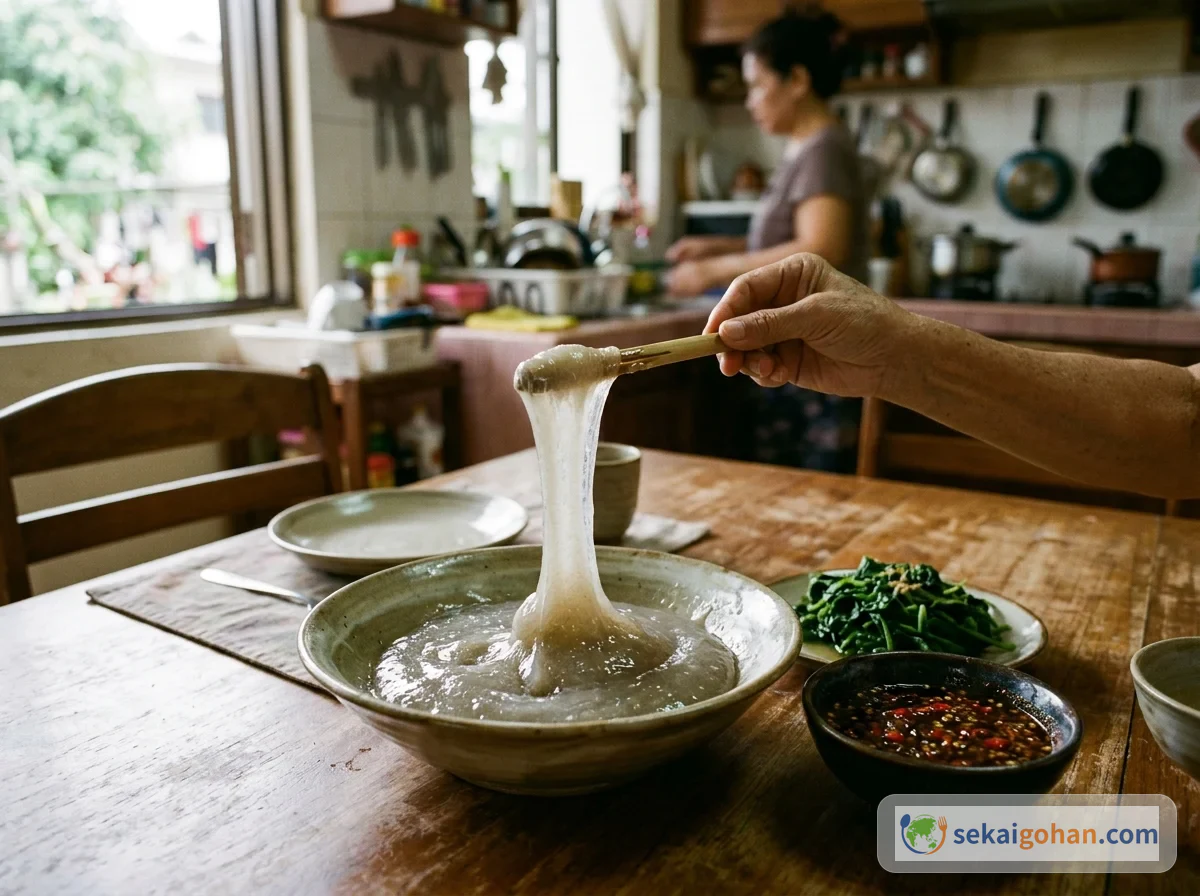
Drag a wooden spoon across the bottom of the pot, and at first the batter flows right back. Partway through, it starts to close slowly behind the spoon. When the sweet coconut smell takes on the edge of brown sugar just short of burning and your arm begins to feel the load, the kalamay is no longer a liquid. This Philippine rice sweet is glutinous rice flour, coconut milk and sugar cooked together, then scattered with latik, toasted coconut curds, once it sets. Bite in and the brown sugar and the richness of the coconut oil open up a moment later. The crux when you make it at home is the heat, not finding ingredients. Rush it over high heat and the bottom scorches; keep the heat too low and the batter stays fluid forever.

Kalamay and Philippine kakanin
Kalamay belongs to the family of Philippine rice sweets known as kakanin. It is a single color, unlike the layered steamed sapin-sapin, and denser than the fluffy steamed puto.
Kakanin turn up at the morning market, as merienda on the way home from church or school, on days when the family gathers, and as souvenirs bought on the way back from a trip. Where rice and coconut are close at hand, sweet rice cakes fill both the table and the road. Whether it comes as a small packet from a shop or a big pan stirred at home, kalamay is meant to be cut and shared.
Kalamay also varies by region. Around Bohol, calamay packed in coconut shells is known as a souvenir. The home version, kalamay hati, is glutinous rice flour, coconut milk and brown sugar or muscovado stirred together and topped with latik. The ingredients are plain, but you'll spend real time at the pot: if the person stirring stops, a burnt line forms on the bottom.

Kalamay is also spelled calamay or kalamay hati. Hati means split or divide, and you see it for the home version cut into squares.
Ingredients: measure everything before you start stirring

This makes one 8-inch (20 cm) square pan, 10 pieces. It firms up when chilled, so aim for a thickness of 2.5 to 3 cm (1 to 1 1/4 in). Pour it thick into a deep pan and the center is slow to cool and sags when you cut it.
This recipe uses coconut. Hot sticky dough burns the skin easily, so avoid tasting while you are stirring. Let it cool completely before storing, and keep the latik in a separate container because it goes soft with moisture; that preserves its aroma.
What can be swapped, and what to keep
| Role | What to keep | Possible substitute | What changes |
|---|---|---|---|
| Stickiness | Glutinous rice flour | Shiratamako | Shiratamako takes extra work to crush the grains |
| Aroma and richness | Coconut milk | Half coconut milk, half water | Lighter, but less moist once cool |
| Brown sugar color | Muscovado, brown sugar | Light cane sugar | Slightly paler color and aroma |
| Fragrance | Banana leaf | Parchment paper | Texture is the same, but less aroma |
Choosing kalamay ingredients and substitutes

Brown sugar, salt and oil are easy to buy anywhere. The things worth seeking out at an Asian grocery or online are glutinous rice flour (shiratamako works too), canned coconut milk, and a deep skillet with a wide base. Banana leaf adds aroma, but on your first batch, skip the hunt: you're more likely to succeed if you concentrate on the heat and on judging when the stirring is done.
Glutinous rice flour and coconut milk are the two things that are hard to replace. With regular rice flour alone, the cake cuts cleaner but loses the stickiness that lingers on the teeth. Dairy milk gives you something like a brown sugar mochi, without the oil and aroma of a Filipino kakanin, so canned coconut milk is the way to go. The latik needs the thick part, so mix the can well before measuring.
The other swaps are easy. Muscovado can be approximated with dark brown sugar or light cane sugar, and since banana leaf is there for aroma and looks, parchment paper does the job in an 8-inch (20 cm) square pan.
As for the pot: kalamay gets heavy while you stir, and a deep, wide-based skillet where the wooden spoon can move freely avoids scorching better than a small saucepan.
Method: stir without scorching, cool, then cut
There are not many steps. But once it is on the heat there is no going back, so put out the pan, spatula, oil and the plate to catch the latik first.
Kalamay problems and fixes

Judge kalamay by the bottom of the pot, the weight of the spatula and how it cuts when cool, rather than by its browning. A cake that's too soft has been under-stirred; more sugar won't fix it. If the whole thing still sags like a thick liquid after you pour it into the pan, put it back in the skillet and keep going over low heat. If it smells scorched, leave the burnt part on the bottom of the pot.
| Problem | Cause | Fix |
|---|---|---|
| Slumps when cut | Under-stirred, under-cooled | Stir over low heat for another 5 minutes. Leave 30 minutes at room temperature and 15 in the refrigerator before cutting |
| Bottom of the pot scorches black | Heat too high, too few passes over the bottom | Keep the heat low and sweep the whole bottom in wide strokes. Leave the scorched bits behind |
| Lumps of flour remain | Shiratamako grains, liquid added all at once | Crush the grains before mixing. Strain the batter before it goes on the heat |
| Greasy surface | Coconut milk oil separated | Blot a little oil after stirring and add the latik just before eating |
| Hard, tough to chew | Over-stirred, over-chilled | Bring back to room temperature for 20 minutes. Next time stop when the spatula line stays 3 seconds |
The deepening scent of brown sugar is different from the smell of a scorched bottom. When a bitter, smoky note shows up beneath the sweet aroma, turn off the heat and check the bottom. If the scorching is still small, you can move only the top part of the batter into another pot and continue.
Serving and storing kalamay

Storage
Kalamay is best on the day it's made and the next day. Rather than leaving it out at room temperature for long, cool it completely, wrap each piece in plastic wrap and keep them in a container in the refrigerator for up to 3 days. Store the latik in a separate small container and add it just before eating; scattered on at the start, it picks up moisture from the surface and loses its toasty aroma.
To reheat, microwave at 600 W for 10 to 15 seconds and stop just as the chill is gone, because any longer and it turns runny. To steam it instead, warm it over medium heat for only 2 minutes and keep condensation from dripping off the lid. Kalamay can be frozen for up to 2 weeks, though the surface dries a little after thawing. Wrap it without the latik, thaw overnight in the refrigerator, then warm briefly.
At the table
Strong coffee, unsweetened tea or warm barley tea balances the sweetness. As a small sweet after a meal, it feels least heavy after the sour sinigang, after adobo with its lingering scent of soy sauce and vinegar, or after coconut dishes like bicol express and laing. For a snack spread, cut sapin-sapin, brown sugar-colored kutsinta and kalamay into small pieces and taste them side by side. Even among rice sweets, the differences in flour blend and texture are clear.
More Filipino dishes to cook alongside
- Sapin-sapin - A celebration kakanin of glutinous rice flour and coconut milk, steamed in layers.
- Puto - A light, fluffy steamed rice cake, faster to make than kalamay.
- Kutsinta - A small steamed sweet with a chewy texture from brown sugar and tapioca starch.
- Bicol express - A spicy coconut milk stew that contrasts with sweet kalamay in a menu.
- Adobo - A main with a strong scent of vinegar and soy sauce, easy to follow with a small sweet rice cake.
Frequently asked questions
Q. Can I make it with shiratamako alone?
Yes. Shiratamako tends to leave grains, so crush them finely with your fingers in the bowl first; large grains turn into white lumps in the smooth batter. Strain the batter after adding the liquid.
Q. Can I reduce the brown sugar?
You can go down to 5.5 oz (150 g). The sugar affects more than sweetness, though: it also keeps the cake moist once cool. Below 4 oz (120 g) the weight of the rice flour comes forward, and it tends to feel hard the next day.
Q. Can I replace the coconut milk with cow's milk?
It will be edible, but less like kalamay. If you use milk, use 1¼ cups (300 ml) milk and 1 cup (220 ml) water, and add 1 tsp rice bran oil to make up for the fat.
Q. What do I do without banana leaf?
Use parchment paper; the leaf mostly adds aroma and looks rather than deciding the texture. If you use frozen banana leaf, thaw it, wipe off the moisture, and pass it briefly over a flame or steam, and it tears less easily.
Q. Is it OK without latik?
You can make it, but it lacks the toasty flavor. On days when there's no time for latik, dry-roast 3 tbsp desiccated coconut in a skillet over low heat for about 3 minutes and scatter a little of the lightly colored coconut on top. It's something different, but the toasty bits keep the surface from being monotonous.
Q. Can I make it the day before?
It's well suited to making ahead. Keep the kalamay in the refrigerator and the latik in a separate container. On the day, take it out 20 minutes before eating, and add the latik once the cut surface has softened a little.