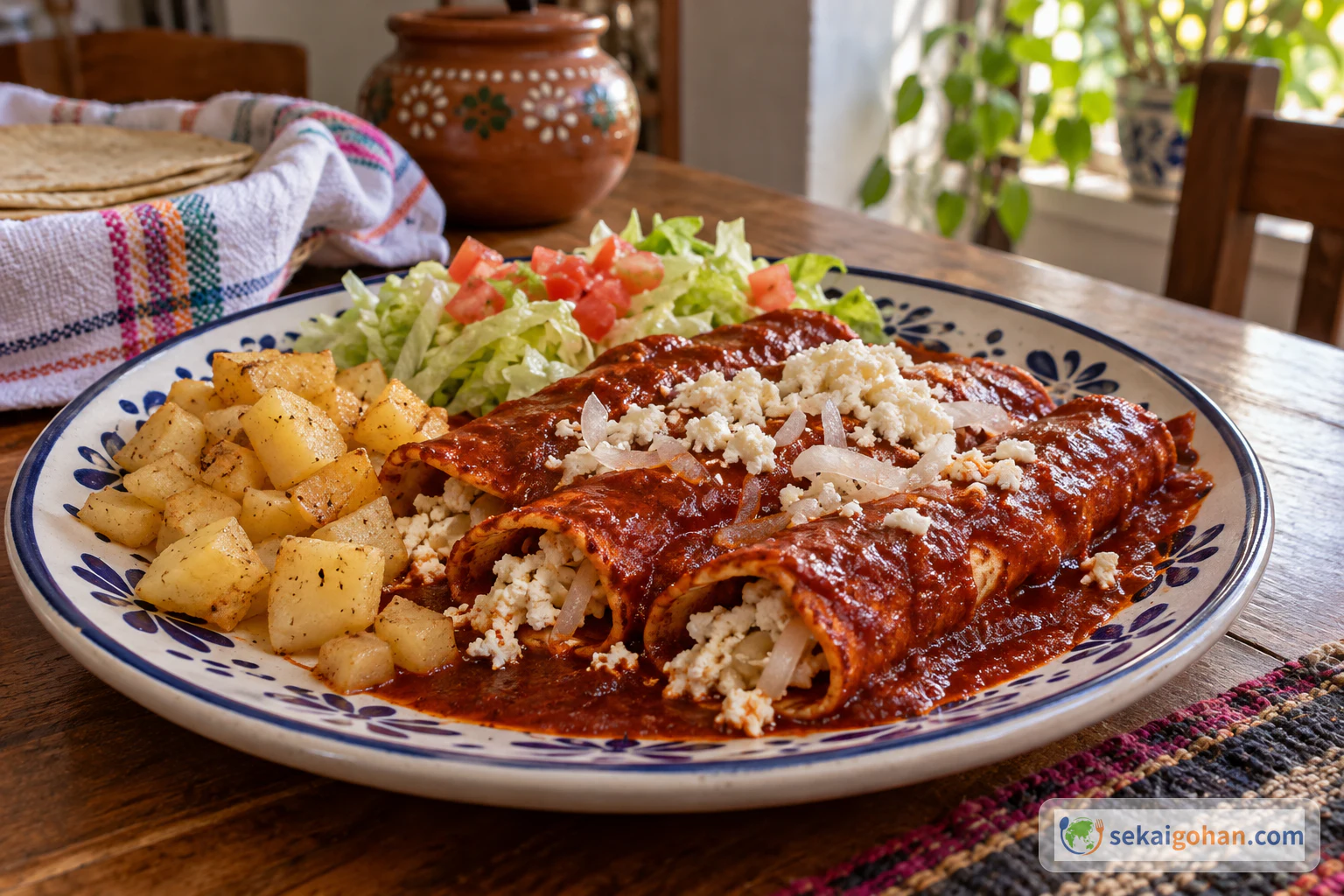
Split open a dried chile and the kitchen fills with a sweet, almost raisin-like smell. It isn't hot; it's deep and red. Blend that with tomato, garlic, vinegar and spices, then braise beef in it slowly, and you get the best moments of birria de res: the red fat floating up when you lift the lid, and steam rising from meat that falls apart at a touch. This Mexican red stew comes from in and around Jalisco, and the beef version is now eaten widely, at home and at street stands. You can sip it from a bowl as a stew, or tuck it into tortillas with cheese, dip them in the red fat and griddle them into quesabirria.

Birria de res and where it comes from
Birria was originally a dish from around Jalisco in western Mexico, where goat and other meats were steam-roasted in an earth oven. Beef birria spread partly thanks to the Tijuana street stalls of around 1950, which swapped pricey, lean goat for beef and made it with more cooking broth (consomé). Quesabirria, griddled with cheese tucked inside, also comes from Tijuana and became popular across North America in the 2010s.
Today the beef is marinated in an adobo of dried chiles and simmered until meltingly tender. Goat can be hard to find, so a mix of beef shank, chuck and short rib is the practical way to make it at home.
Mexico has other red dishes, but each goes its own way. Pozole rojo is a big pot of hominy soup, tinga de pollo is chicken stewed with chipotle, and mole poblano is a rich sauce for celebrations. With birria, you eat the beef's fat together with a red consomé built on dried chiles.
In Spanish it is written birria de res; res means beef. In Japanese the name is spelled several ways. The cheese-filled, griddled taco version is called quesabirria or quesatacos de birria.
Ingredients (serves 4)

This makes 4 servings as a stew, or about 8 small quesabirria tacos. If you're saving some for the next day, store the meat and consomé separately; they're easier to use that way.
This dish contains beef and dairy (cheese). Check the label on store-bought tortillas for wheat. Wash any tools that touched raw meat with detergent and keep them away from cooked meat and tortillas. The beef is cooked until it shreds, but if you taste the cooking liquid partway through, make sure it has come to a full boil first.
Choosing dried chiles and beef for birria

The red of birria comes from the dried chiles, not the tomato. Toasting them lightly, soaking them in hot water and blending them into a smooth adobo carries their aroma through the whole pot. Scorched chiles leave bitterness behind, so stop as soon as the aroma wakes up.
For the meat, a mix of shank, chuck and short rib (or plate) is easiest. Shank alone has strong flavor but little fat, while chuck alone is easy to eat but makes a thinner consomé. A little short rib brings red fat to the surface and makes the tortillas toasty on the griddle. If you prefer it leaner, skim after cooking and keep only 2 tablespoons of fat.
| Core element | Role in Mexico | Practical option | Notes on substituting |
|---|---|---|---|
| Guajillo | Red color, light acidity, fruitiness | Latin American grocers, online | Without it, increase the paprika, but the aroma will be weaker |
| Ancho | Dried-fruit sweetness and depth | Latin American grocers, online | If you leave it out, add a few raisins for sweetness |
| Chile de árbol | Sharp heat | A little ground red chile | Too much makes the whole stew painfully hot |
| Mexican oregano | Herbal aroma close to citrus | Mediterranean oregano works too | Thyme or basil takes it in a different direction |
| Beef shank and chuck | Meat that shreds after a long braise | Combine shank, chuck and short rib | Thinly sliced beef gives a thin consomé and doesn't shred the same way |
| Corn tortillas | Hold the meat and consomé | Store-bought corn tortillas, or flour tortillas | Bread or rice are fine as a home meal, but the dish changes shape |
On days without dried chiles, get close with paprika, a little ground red chile, raisins and vinegar. You won't get the aroma of guajillo or ancho skins, though. Rather than aiming for a perfect replica the first time, using even one kind of dried chile makes it much easier to capture what birria is about.
Method
Spend the first 30 minutes focused on the dried chiles and searing the beef. Once that's done, it's a dish of waiting over low heat. Burnt chiles can't be rescued, but a thin consomé or too much fat can be fixed later.
If you finish the braise the day before, skimming the fat the next day is much easier. Once the fat has set on the surface in the refrigerator, set aside just 3 tablespoons for quesabirria and reduce the rest to taste. On the day you serve it, warm it over low heat for 10 minutes and move the meat into tortillas before it dries out.
Fixing bitter, thin or greasy birria
Most birria problems come down to four things: scorched chiles, boiling too hard, too little salt, and how you handle the fat. Keep an eye on those and you can rescue a lot, even partway through.
| Problem | Why it happens | How to fix it |
|---|---|---|
| Bitter | Chiles scorched, or soaking liquid smells burnt | Don't use scorched chiles. For mild bitterness, add 3.5 oz (100 g) tomato, 1 tsp vinegar and 1/2 tsp sugar and simmer 10 minutes |
| Pale color | Too few chiles, too much tomato and water | Dissolve 2 tsp paprika in a little of the cooking liquid, return it to the pot and simmer 10 minutes |
| Thin consomé | Meat not seared enough, not enough salt | Simmer uncovered over low heat for 15 minutes to reduce, then add salt a little at a time at the end |
| Tough meat | Boiling too hard, braising time too short | Add ½ cup (100 ml) water and simmer 30 more minutes over low heat. Turn the heat back down so large bubbles don't form |
| Greasy | Too much short rib, too much fat left in | Turn off the heat, wait 5 minutes and skim the fat from the surface. Keep only 3 tbsp for quesabirria |
| Tacos tear | Cold tortillas, overstuffed | Warm the tortillas first and use about 2 oz (60 g) meat. Let the cheese glue it together |
| Too spicy | Too much árbol or ground chile | Take out some consomé, add 3.5 oz (100 g) tomato, ½ cup (100 ml) water and a little meat, and simmer 10 minutes |
Longer isn't always better here. Toast the chiles briefly to wake up the red aroma, then loosen the meat with a quiet, gentle braise. Keep those two steps separate and birria becomes very reliable in a home pot.
When the family likes different heat levels, make the braise without árbol and add hot sauce or ground chile at the table. Heat comes forward even more when the pot is reheated the next day, and once the whole batch is hot, there's no taking it back for kids or anyone who avoids spice.
Serving, storing and pairing birria de res
Stew on day one, quesabirria on day two
On the first day, eat it as a stew. Put the meat in a bowl, pour in hot consomé and top with chopped onion, cilantro and lime. Warm the tortillas on a separate plate and wrap the meat a little at a time; dip one into a small bowl of consomé and the red fat and acidity come right back on your tongue.
Day two is for quesabirria. Lift the meat lightly out of the liquid, tuck it into tortillas with cheese and griddle, then dip the tacos in a small bowl of warm consomé.
Storing birria

Birria keeps 3 days in the refrigerator or 3 weeks in the freezer. Separate the meat and consomé, cool them within 30 minutes and transfer them to shallow containers. For freezing, single portions of about 5.5 oz (150 g) meat and ½ cup (120 ml) consomé work well for both tacos and soup.
Reheat in a small pot over low heat for 10 minutes, or in a 600 W microwave for 2 minutes, stir everything, then 1 more minute. Make sure it's hot all the way through.
Leftover consomé and dishes alongside
Leftover consomé makes the next day's soup: add a little rice for something porridge-like, or stir in boiled potatoes or beans. Because birria is rich, the rest of the table goes down easier with acidity, beans and corn. Light beans or a salad suit the red consomé better than a second big pot like pozole rojo, and a corn dough such as arepas helps on days with a run of spicy dishes.
For an all-Mexican spread, try tinga de pollo first to learn the aroma of chipotle, and you'll taste how birria's dried chiles differ. Tacos al pastor, made with red adobo and pineapple, is a good contrast among tortilla meat dishes.
Beef itself goes in very different directions across Latin America. Brazilian churrasco and Peruvian anticuchos bring roasted flavor, and lomo saltado is stir-fried fast over high heat where birria is loosened over low heat. Rotating between a rich braise, a quick stir-fry and a corn dough also makes shopping easier.
Frequently asked questions
I only have one kind of dried chile. Can I still make it?
Yes. Guajillo alone gives red color and lightness but not much depth, so add 1 tablespoon of raisins. Ancho alone gives sweetness but a darker color, so add 1 tablespoon of paprika. Árbol alone makes it far too hot, so keep it as an accent rather than the main chile.
Can I shorten it with a pressure cooker?
Yes. Everything is the same up through searing and combining with the adobo. Cook at high pressure for 35 minutes, let the pressure release naturally for 15 minutes, then open the lid and simmer over low heat for 10 minutes to reduce. A pressure cooker traps aromas, so add 1 teaspoon of vinegar and lime at the table to sharpen the flavor.
Is it lacking if I don't make cheese-filled quesabirria?
As a stew, it's complete without cheese. Cheese holds the meat together when you griddle the tortillas and adds street-stand satisfaction. If you're avoiding dairy, use less meat and griddle it in doubled tortillas so it holds together.
The consomé set solid overnight. Is that OK?
Yes; fat and gelatin naturally set in the refrigerator. Skim the surface fat as you like, and the consomé will loosen again over low heat in a small pot. If the acidity seems weak, add a little lime or vinegar after reheating.