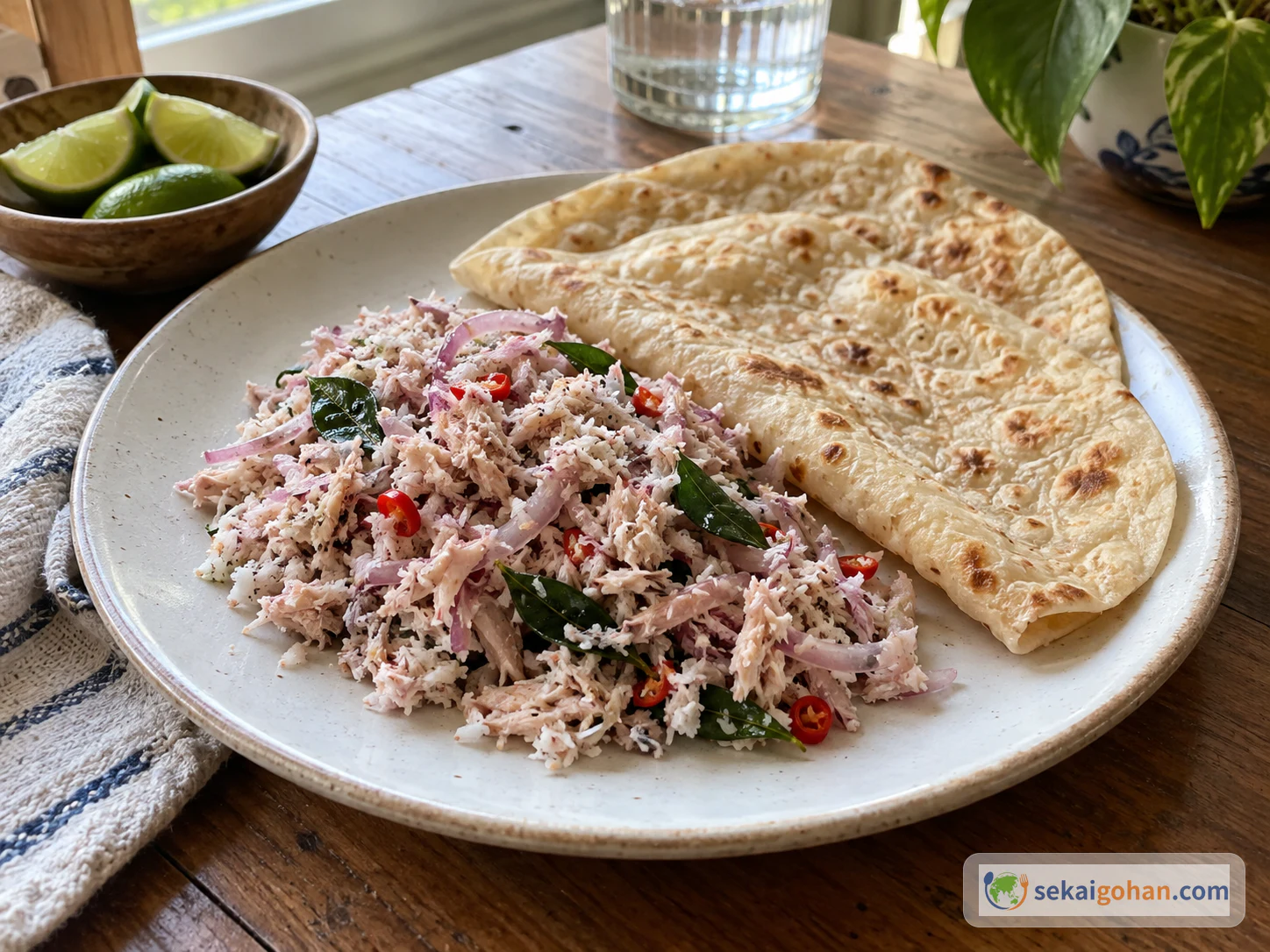
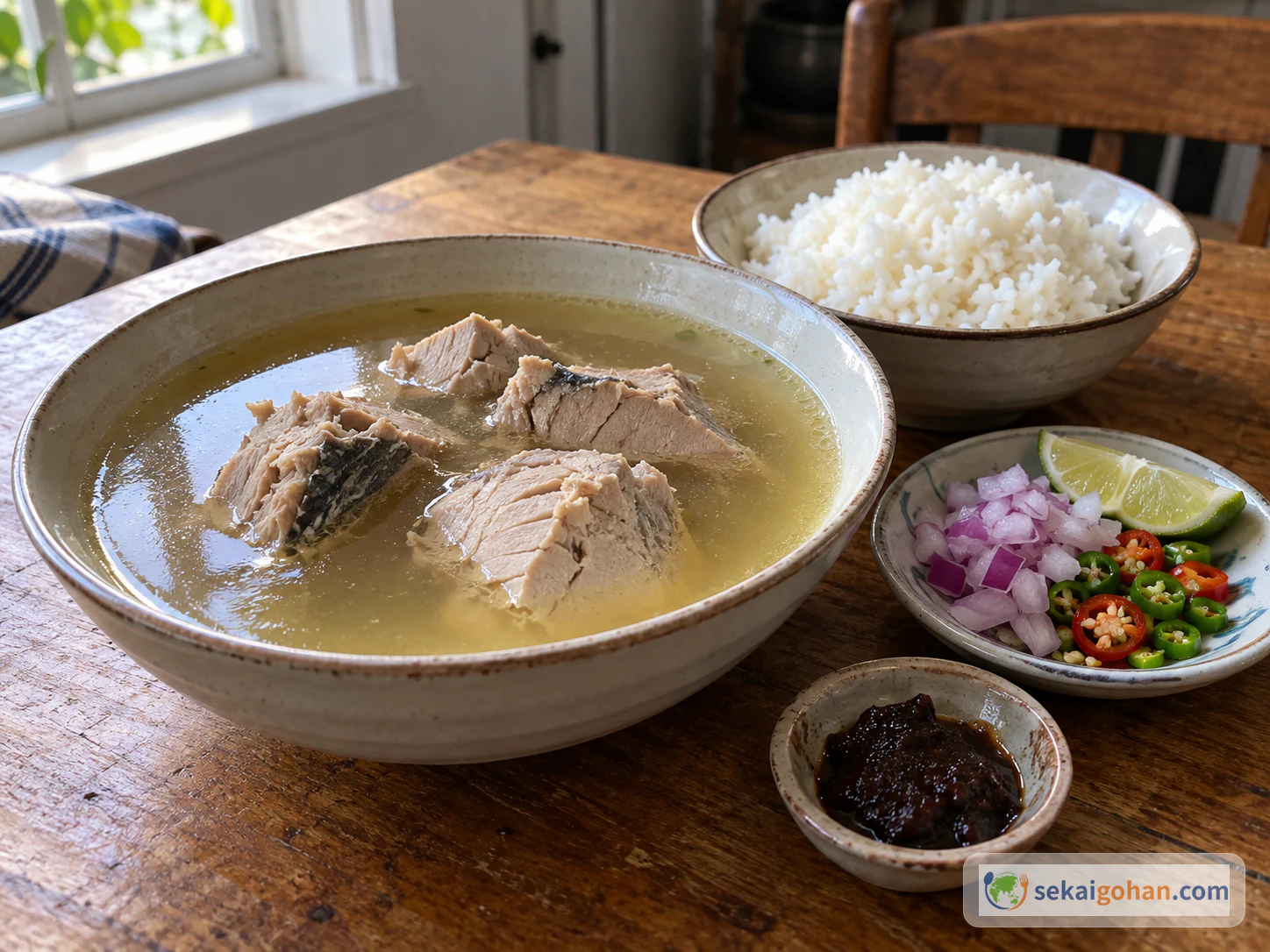
Put rice on low heat in the morning and the pot slowly turns white and cloudy. Tie in a single pandan leaf and a green, sweet fragrance rises, quite unlike rice from a rice cooker. Spoon the hot porridge into a bowl and set a spoonful of coarse tuna-and-coconut relish beside it. With no fuss at all, breakfast suddenly feels like a morning on a Maldivian island. That relish is maskurolhi, a coarse, sambol-like mix of tuna, coconut, onion, chili and lime. It's salty, sour and rich, and it goes with baiypen (bai pen), the gentle white rice porridge of the Maldives.

Maskurolhi and Baiypen at the Maldivian Table
The Maldives is an island nation, so fish and coconut are at the center of the table. Mas huni is a breakfast of tuna, coconut, onion and chili eaten with roshi. Maskurolhi uses similar ingredients but goes with baiypen instead. Don't confuse it with masroshi, a snack of tuna and coconut wrapped in roshi dough and baked. The names are close, but maskurolhi is a loose side dish with nothing wrapped. Before Ramadan, the early-morning table has baiypen with sides of fish and coconut just like this.

Baiypen is a quiet porridge you could eat with salt alone, and the way you eat maskurolhi with it matters more than any showy plating. If you stir tuna into the porridge itself, the fish smell spreads through everything and it ends up feeling like congee for a sick day. So the relish stays on its own plate and gets mixed in a little at a time at the edge of the bowl. Then the sweetness of the white rice, the richness of coconut, the saltiness of fish and the acidity of lime come to you one after another.
It suits breakfast or a late-night bowl. With the heat turned down it's easy to serve to children and older relatives, and anyone who wants more can add chili. Related South Asian dishes include Sri Lanka's kiribath, a celebration dish of rice and coconut, and India's avial, where vegetables are coated in coconut. Maskurolhi is the lightest of these morning dishes.
Ingredients (serves 4)

This amount serves 4 at breakfast or 3 as a late-night meal. If the baiypen is too thin, it can't hold the maskurolhi. If it is too thick, it becomes like rice dumplings. Use 1.25 quarts (1.1 L) water for ¾ cup (180 ml) of rice (1 gō), then adjust the thickness at the end.
This dish uses fish, coconut and chili. Don't serve it to anyone with a fish or coconut allergy. At a table with someone sensitive to heat, halve the chili and serve the maskurolhi on a separate plate so each person can adjust it.
Choosing Ingredients for Maskurolhi

Fish, Coconut and Chili
The hard part at home is finding the smoked and dried fish used locally. Canned tuna combined with bonito flakes gets close, and unsweetened desiccated coconut, rehydrated, takes the place of freshly grated coconut. Rice, canned tuna, onion and lime are easy to buy nearby. Look online or at an import grocery for the coconut, curry leaves and pandan leaf.
Unsweetened desiccated coconut is what gives this dish its grain. The grains soak up the moisture from the tuna and then loosen softly over the porridge. Canned coconut milk can go into the baiypen in small amounts, but if you use it alone in the maskurolhi, the result turns wet and melts over the porridge like tuna mayo. Look for "unsweetened" and "fine" at import grocery stores or baking supply shops.
Curry leaves aren't essential, but a small amount pulls the flavor toward South Asia. Leftovers can go into kukul mas curry or avial. On a day when crushing chili from scratch feels like too much, use just 1 tsp of sambal oelek and let the onion, tuna, coconut and lime round it out. Skip sweet chili sauce; it's a different thing entirely.
Home Substitutes at a Glance
| Question | Closer to local | Practical home option | Direction to avoid |
|---|---|---|---|
| Fish | Smoked or dried tuna-type material | Canned tuna combined with bonito flakes | Turning it into tuna mayo |
| Coconut | Freshly grated coconut | Unsweetened desiccated coconut rehydrated in hot water | Moistening with coconut milk only |
| Rice porridge | Cooked thin as baiypen | Short-grain rice simmered soft on low heat | Briefly warming cooked rice in water |
| Heat | Coarsely crushed fresh chili | Dried chili or a little sambal oelek | Sweet chili sauce |
| How to eat | Porridge and side served separately | Mix a little at a time at the edge of the bowl | Mixing tuna through the whole pot |
Equipment
You won't need a griddle. What helps is a tool that can stop before the onion and coconut get too fine. A knife works, but if you make this often in the morning, a small food processor that chops coarsely is handy.
Method: simmer the baiypen and serve a coarse sambol beside it
Trying to finish the baiypen and maskurolhi at the same time gets hectic. Put the rice on, lower it to low heat, and chop the aromatics while it simmers. The maskurolhi needs no heat, so it is enough to combine it at the end while watching the thickness of the porridge.
Where Maskurolhi and Baiypen Go Wrong

Almost every problem comes down to moisture. Baiypen should be soft, but if it's as thin as soup the maskurolhi sinks. Maskurolhi can be moist, but if liquid pools at the bottom it's too heavy. What you're after is a loose white porridge set against coarse tuna and coconut.
| Symptom | Cause | Fix |
|---|---|---|
| Porridge is watery | Low-heat simmer was too short | Uncover and add 5 minutes on low heat so the grains open |
| Porridge is heavy | Too little water, stirred the bottom too much | Add ½ cup (100 ml) hot water and warm on low heat for 3 minutes |
| Maskurolhi is sticky | The coconut's moisture wasn't squeezed out | Add 2 g bonito flakes or 2 tsp unrehydrated coconut |
| Fishy smell | Too much tuna liquid, not enough lime | Drain again, and add 1 tsp lime and a little black pepper |
| Too hot | Chili seeds were left in | Add 1 tbsp coconut and 1 tbsp tuna |
The other common mistake is over-mixing. Put all the tuna and coconut into the porridge and the white rice loses its place. The dish stays light at breakfast because each person adjusts the salt and acidity in their own bowl.
Storing and Serving Maskurolhi

Once the baiypen has cooled slightly, move it to a shallow container, refrigerate it, and finish it by the next day. Rice porridge firms up when cold, so when reheating, add ¼ cup (80 ml) water per portion and warm on low heat for 4 to 5 minutes. In a microwave, heat at 600 W for 1 minute 30 seconds, stirring once halfway.
Maskurolhi contains fish and onion, so keep it in the refrigerator and eat it the same day. If it has to wait until the next day, put it in a clean small jar and finish it within 24 hours. Don't reheat it. Take it out of the refrigerator, add 1/2 tsp lime juice, break up any tuna that has firmed, and serve it with the porridge.
Leftover maskurolhi is also good on thin toast or rice. Mayonnaise pulls it away from a Maldivian breakfast, though, so finish it with lime, black pepper and a little chili instead.
To keep going with rice and coconut in the morning, try Sri Lanka's kiribath, where the same white rice becomes a celebration dish. If you like coconut grains clinging to vegetables, South India's avial is the next dish. And for another gentle plate of fish and rice, Bangladesh's ilish bhuna shows a different way of building aroma.
FAQ
Can I make just the maskurolhi?
Yes. It's salty and sour on its own, though, so it's best with a plain base such as white rice porridge, white rice or thin roshi. If you're eating it by itself, cut the salt to 1/4 tsp and start with 1 tbsp lime.
What if I don't have desiccated coconut?
Freshly grated coconut is ideal, and unsweetened desiccated coconut is the practical choice. If you have neither, toss the tuna with 2 tbsp coconut milk and 2 g bonito flakes. It won't have the grain, so it tastes less like maskurolhi. Next time, pick up an unsweetened product at a baking supply or import grocery store.
Should the canned tuna be in water or oil?
Water-packed is lighter for breakfast, and oil-packed gives richness. With oil-packed tuna, all the oil from the can makes it heavy, so keep just 1 tbsp and drain the rest. With oil-free cans, 1 tsp rice bran oil keeps it from tasting dry.
Can I make it without heat?
Yes. Leave out the chili and increase the black pepper to 1/3 tsp. Without any heat the flavor loses some of its edge, so add 1/4 tsp sambal oelek to the adults' bowls only.
Is pandan leaf required?
No. It only adds fragrance to the baiypen. If you can't find it, make the porridge with rice and salt only. Skip bay leaf or vanilla as stand-ins, since their aroma is quite different.
- Wikipedia, "Maskurolhi": https://en.wikipedia.org/wiki/Maskurolhi
- LonuMedhu, "Haaru: Maldivian Suhoor": https://lonumedhu.com/blog/haaru-maldivian-suhoor
- Visit Maldives, "Maldivian Gastronomy": https://visitmaldives.s3.amazonaws.com/5oBv9OoG/v9inzimo.pdf
- Wikipedia, "Maldivian cuisine": https://en.wikipedia.org/wiki/Maldivian_cuisine