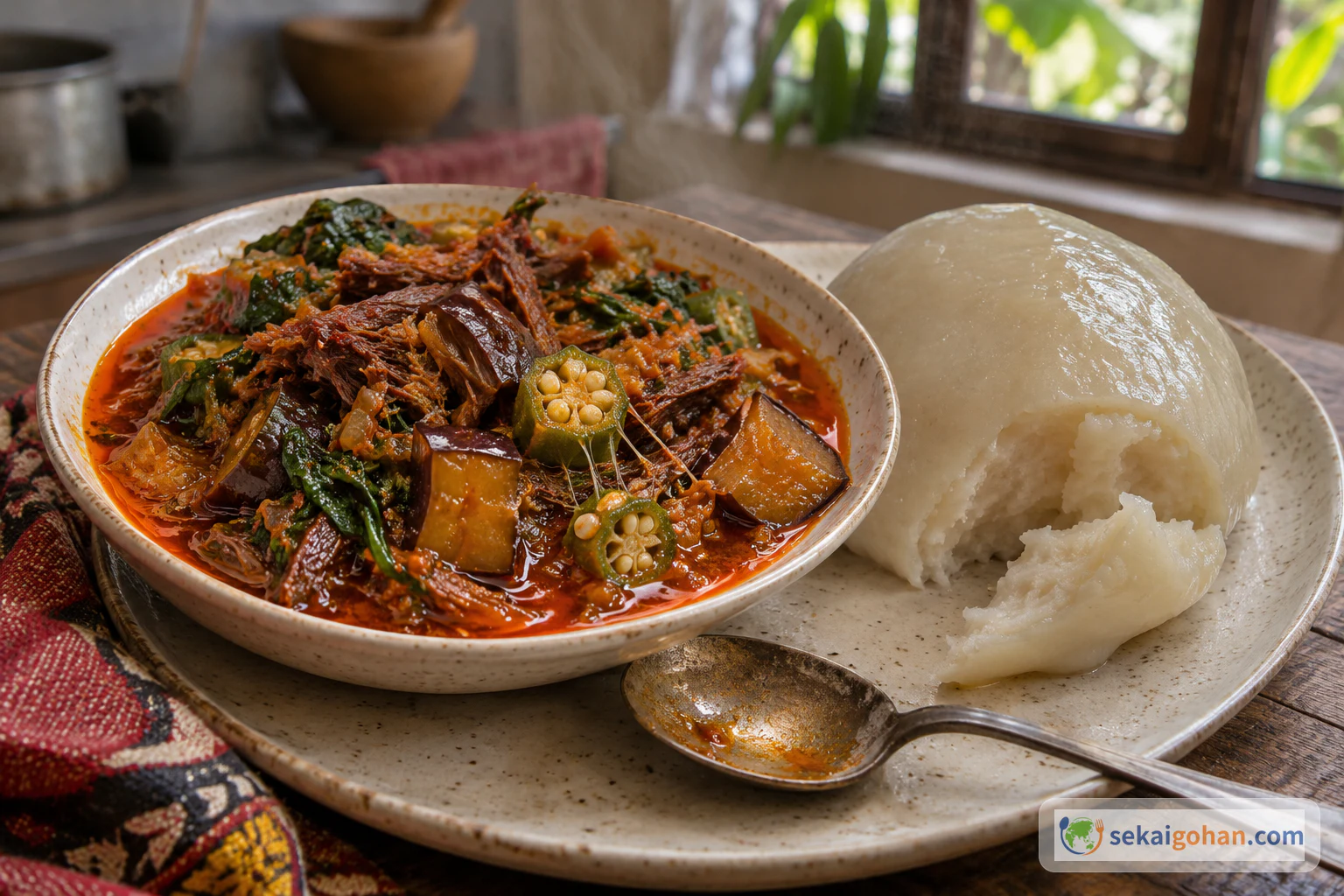
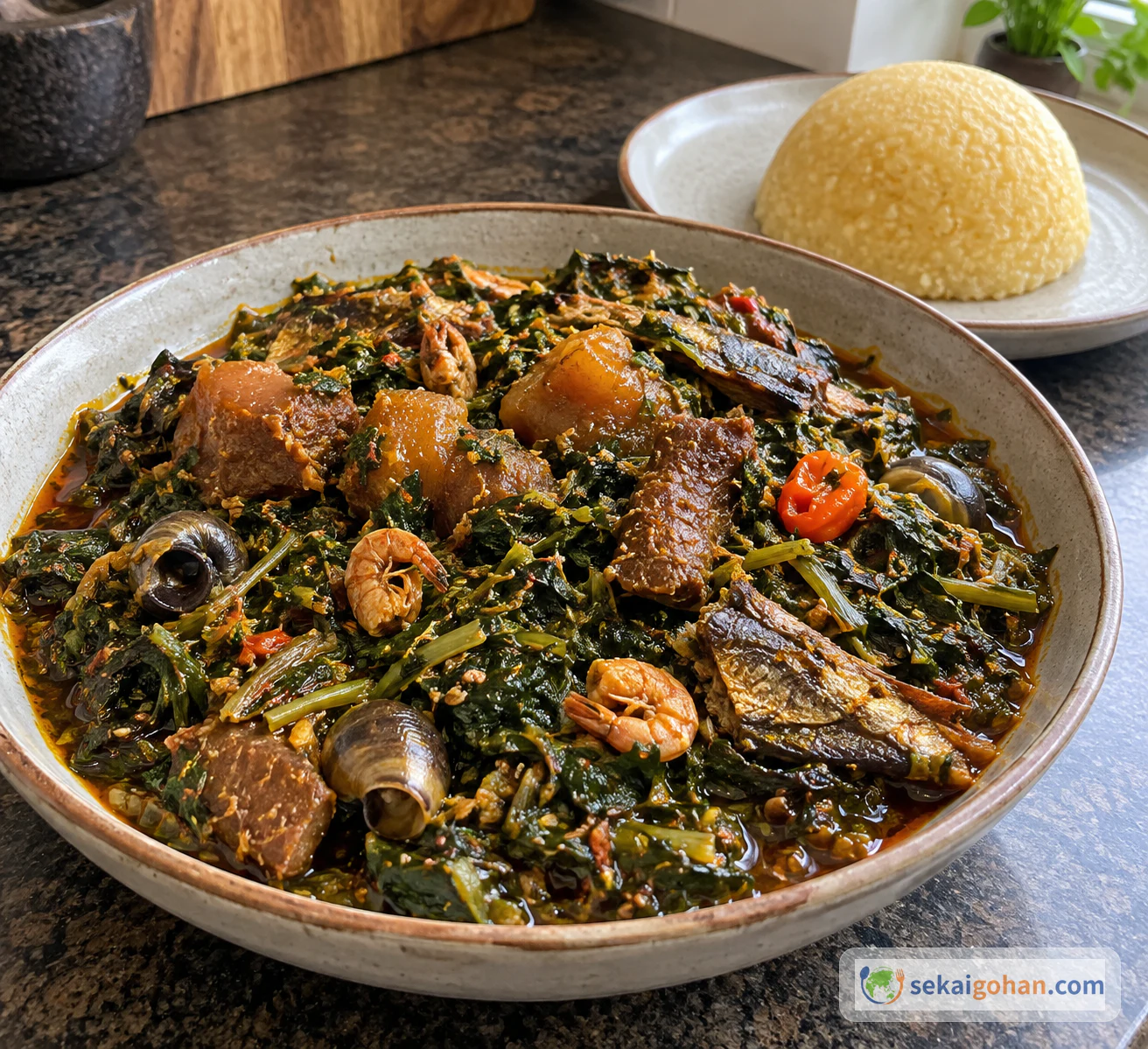
Steam drifts up from a gentle simmer, carrying the deep scent of dried fish. Red palm oil gleams at the edge of the pot, and the sourness of tomato cuts through it. This is calulu de peixe, an Angolan stew of fish, okra and greens. (Peixe is Portuguese for fish.) It's a good way to use the cod fillet you picked up at the fish counter, which can taste a little plain salt-grilled or in a hot pot. With dried fish, okra, greens and red palm oil, it becomes something else entirely. Serve it with funge (funje) or white rice.
Calulu de peixe in Angola
Origin
The origin of calulu de peixe is hard to pin to a single year. It is an old stew that layers dried fish or meat, leafy greens, okra and red palm oil, and it is linked to Brazil's caruru. Today Angolan cooks make it as an everyday dinner, drawing on dried fish that keeps well, fish from the coast, greens from the field and the cassava staple.
Regional differences
In coastal places like Luanda and Benguela, cooks often combine fresh fish and dried fish. Further north and inland, you find river fish, dried meat, cassava leaves, and fermented cassava such as chikwangue on the side. The differences come down to which fish and greens are at hand, not to lavishness. Some households get a deep saltiness from dried fish alone, while others cut fresh white fish large and sink it in at the end.
That flexibility helps when you cook it elsewhere. Build savor from a small amount of dried fish, then add the white fish later and keep it whole. That is closer to the local way of thinking than chasing one particular fish.
Calulu at the table
Calulu is eaten with funge, rice or beans rather than sipped like a soup. Funge is a mild staple that takes a strongly flavored sauce, and you dip it into the rich broth a little at a time. The okra's viscosity, the bitterness of the greens and the saltiness of the dried fish are all strong, so a white staple on the plate settles the taste. The first time you serve it at home, eating by hand is optional. Add white rice or a cassava-flour funge, and put lemon in a small dish.

Calulu and other palm oil stews
Other stews made with red palm oil include muamba de galinha, which stars chicken, and poulet moambé from Congo, where the mix of oil, nut, leaves and staple shifts slightly. Moqueca baiana also uses red palm oil, but coconut milk makes it sweeter and softer. In calulu, the saltiness of the fish, the okra's viscosity and the greens come forward, so go easy on the palm oil and keep the broth from turning cloudy.
Ingredients and shopping
When cooking it elsewhere, a small amount of dried fish is enough. Drawing the salt out of the local dried fish as is would take half a day, so this recipe uses lightly salted cod, dried cod or lightly dried salted fish. Soak it for 30 minutes before it goes into the pot. If you use heavily salted bacalhau, change the water and soak it from the night before.

This recipe uses fish. Dried fish can be very salty, so discard the soaking liquid rather than putting it in the pot. Cook the white fish through to the center, until the middle is white and flakes rather than translucent.
Ingredients used in this dish
Red palm oil is the star of the aroma. With neutral oil it still works as a stew of fish and vegetables, but the red aroma that makes it calulu is weaker. A small bottle is fine the first time. Even just this one ingredient brings out the outline of the taste.
Adding funge makes it easier to take in the saltiness and thickness of the sauce. White rice works too, but a staple made by stirring cassava flour shows how Angolan food is eaten.
For the first time, lightly salted cod is enough. When you want the full saltiness and savor of calulu, add a small amount of dried cod or bacalhau, which gives you the outline of the flavor. Desalting takes time, so buy it a day ahead and start soaking then.
Calulu de peixe ingredients and substitutes
Five things carry calulu: the savor of dried fish, red palm oil, okra, greens and a mild staple. Keep each of those roles covered and the dish works, even without every ingredient exactly as in Angola.

| Local-leaning ingredient | Easy substitute | What to protect |
|---|---|---|
| Dried salted fish | Lightly salted cod, dried cod, lightly dried white fish | Include some, even a small amount. Do not use the soaking liquid |
| Red palm oil | A small bottle of red palm oil | With neutral oil alone it becomes another dish. Even 2 tbsp changes the aroma |
| Jimbua, sweet potato leaves | Komatsuna, spinach, Malabar spinach | Add the greens at the end to keep color and texture |
| Local white fish | Cod, sea bream, sea bass, swordfish | Thin-fleshed fish break easily. Cut large |
| Funge | Cassava flour, white rice, firm polenta | Serve a mild staple to receive the sauce |
Lightly salted cod or dried cod isn't the local fish, but once the salt is drawn out and it goes in sparingly, it brings the savor of dried goods to the bottom of the pot. Komatsuna isn't sweet potato leaves either, yet added at the end it keeps its green color and gives the stew a real presence of leaves.
On a first shopping trip, put red palm oil and some kind of dried fish at the top of the list. Cassava flour changes the feel of the table a lot, but white rice is fine to begin with.
Method: soak the dried fish, and finish without breaking the fish
The harder calulu boils, the more the fish breaks up. Set the saltiness of the dried fish first, build the red base with aromatics, and sink the white fish gently in the second half. Don't stir the fish. Shake the pot slightly to move the sauce around.
Common calulu de peixe mistakes
Three things matter most at home: keep the fish in large pieces, keep the salt in check, and keep the palm oil from scorching. With a fish stew, the more you stir or turn up the heat, the more it breaks, so resist the urge to stir when it tastes thin or to crank the heat when it seems slow. Dried fish, white fish, okra and greens all share one pot, and heat and order make the difference. To move the broth around, gently shake the pot instead.

| Mistake | Cause | Fix |
|---|---|---|
| The fish breaks into small pieces | White fish cut small, boiled hard, stirred with a spatula | Cut into 4 to 5 cm cubes and add the white fish in the second half. Shake the pot instead of stirring |
| Too salty | Not enough desalting of the dried fish, soaking liquid added | Add 2 to 3 tbsp water and take the edge off with 1 tsp lemon juice. Next time change the water at 15 minutes |
| Oily | Too much palm oil, too little broth | Set 3 tbsp as the limit. At the end, skim a little oil from the surface with a spoon |
| Greens turn a dark color | Added too early | Cook only the last 6 to 8 minutes. Residual heat also wilts them |
| Okra is too slimy | Cut too small, cooked too long | Cut 0.5 inches (1 cm) wide and add only for the finish. Add frozen slices still frozen |
Serving and storing calulu de peixe
Serving
Calulu de peixe is easiest to eat with the fish in the center of the plate and funge or white rice beside it. If you've made the pot hot with chili, a squeeze of lemon lightens the aftertaste. The aroma of the oil is strong, so boiled vegetables or a light bean dish work better on the side than a raw salad.

For a weeknight dinner, white rice, calulu, lemon and one boiled egg are enough. The rice soaks up the broth and the egg softens the saltiness of the dried fish a little, which helps if someone is trying it for the first time. For a holiday leaning toward the local style, line up funge, calulu, boiled greens and a cold drink, and the contrast between rich broth and mild staple comes through clearly.
Storage and leftovers
Keep fish stew out of room temperature. Cooled in the pot, the center stays warm for a long time, so move leftovers to a shallow container.

| Storage method | Guide | Reheating |
|---|---|---|
| Refrigerator | 1 to 2 days | Over low heat in a small pot. Add 1 to 2 tbsp water and do not boil hard |
| Freezer | Not recommended | The texture of the white fish and greens falls. If you must freeze, use extra broth and keep it 1 week |
| Funge | Best the same day | When it hardens, sprinkle with a little water, cover and warm over low heat or in a 600 W microwave 1 minute at a time |
The next day, loosen the broth a little and spoon it over warm rice for an easy lunch; even if the fish has broken up a bit, it's easier to eat that way. Leftover funge can be cut small with the warmed sauce poured over it. The fish breaks easily on reheating, so move it around as little as possible. Instead of extra side dishes, set out lemon, chopped onion and thin slices of cucumber in small dishes. When the palm oil feels heavy, that acidity and moisture refresh your mouth.
More stews and staples
For another Angolan red stew, try muamba de galinha; made with chicken instead of fish, the palm oil aroma clings more to the meat. For more staples, try Ghana's fufu and Tanzania's ugali. For fish and rice from West Africa, Senegal's thieboudienne puts layers of fish, vegetables and rice in the lead instead of palm oil, and Nigeria's jollof rice brings a rice dish with more spice aroma.
FAQ
Can I make it without dried fish?
You can, but the saltiness and savor that make it calulu will be weaker. Adding one of 1 anchovy fillet, 1/2 tsp fish sauce or 10 g dried shrimp to the 1.25 lb (600 g) of white fish brings it a little closer. Too much gives a different flavor, so start small.
Can I make it without red palm oil?
Neutral oil still gives you a stew of fish and okra, but the aroma is quite different from calulu. If you really have none, make up the color with 2 tbsp rice bran oil and 1/2 tsp paprika. The aroma can't be replaced, though, so it's worth getting red palm oil next time.
Which greens are closest?
Komatsuna is easy to handle. Spinach is softer, and Malabar spinach gives a bit of sliminess. Leaves with a light green bitterness, added at the end, go better with the saltiness of the fish than sweet greens.
What fish internal temperature should I check?
If you have a household thermometer, aim for 145°F (63°C) at the center. Without one, look for the center to be white rather than translucent, and for the thick part to break into large flakes when pressed with chopsticks. A gentle simmer is enough to get there.
What if I do not want it spicy for children?
Leave out the chili and add chili flakes or chopped chili only to the adults' plates at the end. If the dried fish is too salty for them, reduce it to 2.75 oz (80 g) and increase the white fish to 1.5 lb (650 g) for a gentler result.