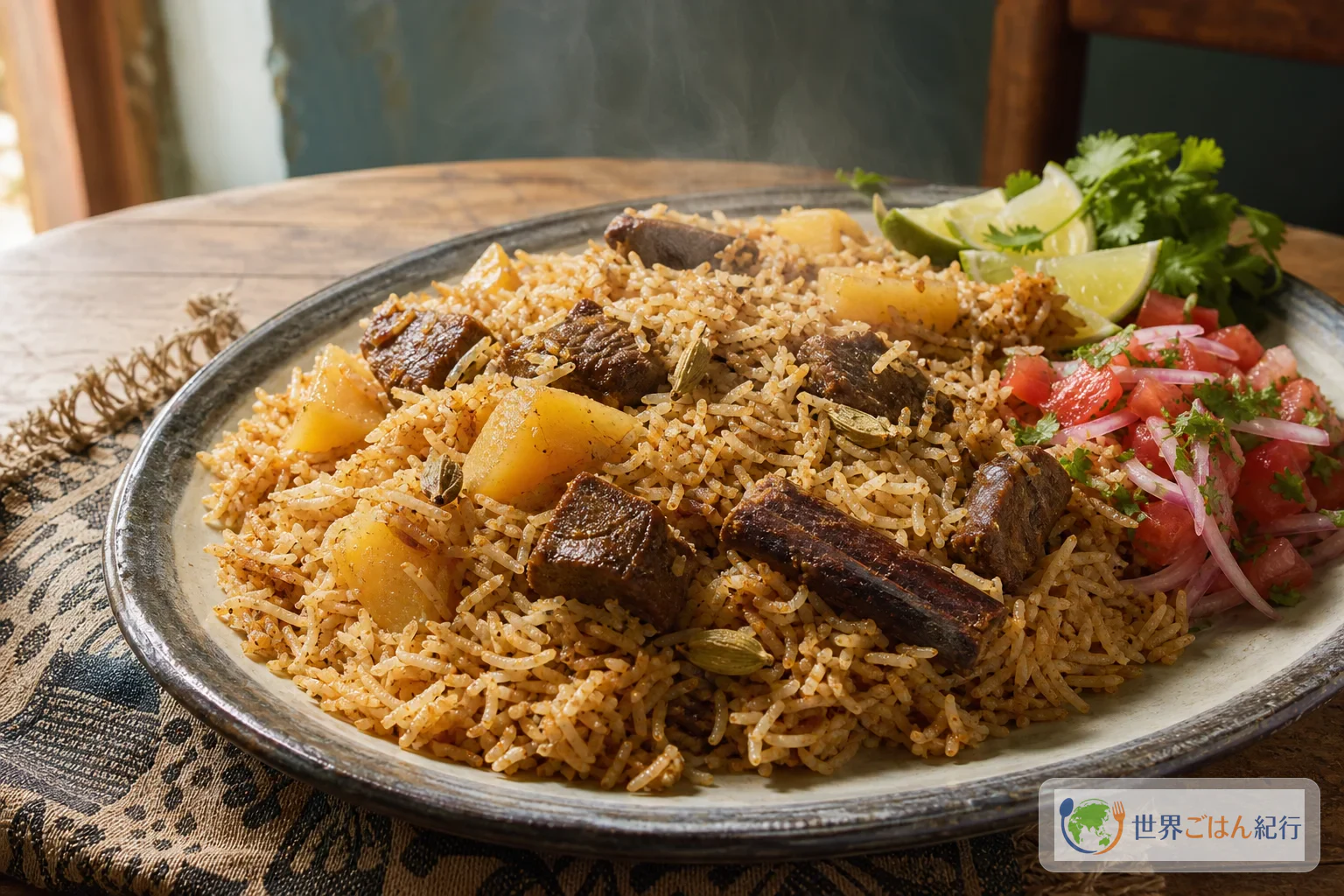
The moment you open the leaf, steam rises smelling of groundnut. Banana leaf held over steam gives off a scent somewhere between green grass and freshly cooked rice, and once it is wrapped around chicken, tomato, onion, mushrooms and groundnut sauce and left to steam slowly, a plate's worth of stew forms inside it. Luwombo (also spelled Oluwombo) comes from Uganda, particularly Buganda. It looks like a stew, but because the packet never sinks into boiling water, the aroma of the leaf and the juices of the ingredients stay sealed inside, rounded out by the groundnut.
About luwombo
Luwombo began as a royal court dish of Buganda, and today Ugandans serve it at home and at celebrations. Meat, fish, mushrooms and vegetables are wrapped in banana leaf and steamed. There is no single fixed recipe. You will find chicken, beef, fish and mushroom luwombo, with sauces that lean toward groundnut, tomato or meat juices. Locally it is eaten with matoke, rice or tubers. This version uses chicken and groundnut sauce, which is easy to reproduce at home and easy to check for doneness.
If matoke is Uganda's everyday staple, luwombo is the feast that sits beside it. Unlike kikomando and rolex from the chapati stalls, it waits patiently in a pot. Make it for a weekend lunch, and opening the leaf becomes a small event at the table.
Other cuisines wrap food in leaves too. New Caledonia's bougna is thick with coconut milk and root vegetables, and the Central African Republic's maboke puts fish and leaf aroma first. Luwombo stands apart for the roundness groundnut brings, and for closing the stew inside the leaf rather than serving it straight onto a plate. A dish wrapped in green leaves looks difficult, but split into steps it is quite practical with a deep pot and a steamer.
Ingredients (serves 4)

This amount is designed to split into two packets so it fits a home two-tier steamer or deep pot. If you have large leaves you can make one packet, but for the first time two packets make it easier to check the internal temperature, and the leaves tear less.
This recipe uses peanuts, chicken and mushrooms. Don't serve it to people with a peanut allergy. Some store-bought peanut pastes contain sugar, dairy or added fats, so check the label for unsweetened and no flavoring.
Ingredients and tools that give you pause when shopping

The things to buy nearby are chicken, tomato, onion, mushrooms, carrot and potatoes. Worth looking for online are unsweetened peanut paste, a deep steamer and an instant-read thermometer. Banana leaf is the pillar of the aroma; look for it in the frozen section of Asian, Filipino, Thai or Vietnamese grocery stores.
If you make it with sweet peanut butter it tilts toward a sweet sauce rather than a chicken stew. For cooking, an unsweetened paste with little graininess thins more easily with water and is less likely to separate inside the leaf.
The key to luwombo is not to submerge the packet in water. With only a low steaming stand, the bottom of the packet absorbs water and the stew inside the leaf turns thin. A two-tier steamer or a tall rack makes it easier to cook with steam alone over a long time.
With bone-in chicken, you can't judge by browning inside the leaf. With a thermometer you can decide without hesitating whether to keep heating or let it rest.
Choosing ingredients for luwombo
Frozen banana leaf works well. Soften it over steam, and double it wherever it tears. For a first attempt, bone-in chicken and mushrooms make doneness easy to see. Mushroom versions of luwombo exist and go well with groundnut sauce, but they are not essential. If you use shiitake, its aroma is strong, so keep it to 4 oz (120 g) or less to balance the chicken.
For the sauce, thin unsweetened peanut paste with water and keep some thickness. Unsweetened peanut butter that isn't too salty can stand in. Sweetened peanut butter tends to taste too sweet for a chicken stew; if that's all you have, increase the tomato by 1 and add 1 tsp more lemon juice to cut the sweetness.
Method: let the groundnut sauce simmer into the leaf
Its flavor does not come from browning. First soften the leaf, adjust the thickness of the sauce, and steam the packet without submerging it in water. For the sauce, steam the onion and tomato in a little water, then add the groundnut instead of frying in oil, which blends better inside the leaf.
Because the steaming time is long, the water drops partway. If the steam suddenly weakens, the sound at the bottom of the pot goes dry or there is a burnt smell, add hot water at once. Adding cold water lowers the temperature in the pot and delays the center reaching temperature.
Luwombo problems and fixes

Luwombo problems show up in the structure more than the seasoning: the leaf tears, the sauce turns watery, or you can't tell whether the chicken is done. Turning up the heat fixes none of these, so look at each cause separately.
| Problem | Main cause | How to fix it |
|---|---|---|
| The leaf tears | Folded while cold, thick rib | Soften with steam and double any torn part |
| The sauce leaks | Thin packet bottom, runny sauce | Lay leaves crosswise; make the sauce thick enough to leave a wooden-spoon trail |
| Watery | Packet sat in water, too much water added | Raise the steaming stand; keep the water below the packet |
| The chicken is tough | Heat too high, steam too rough | Keep steam over medium-low heat and judge doneness with a thermometer |
| The groundnut feels heavy | Not enough sourness, all the sauce poured on | Add 2 tsp lemon juice and eat it separated with the staple |
| The flavor is blurry | Paste thinned with too much water | Reduce at a simmer over low heat and adjust salt last, 1/4 tsp at a time |
Banana leaf is a cooking tool that makes aroma and humidity, so treat it with care. Folded cold it cracks, and softened until scorched it turns bitter. Hold it briefly over steam and stop as soon as it bends easily.
Leave the groundnut sauce a little thicker in the skillet than you want it on the plate. Inside the packet, the chicken juices, tomato, onion and leaf aroma blend in and loosen it. On the plate, it should flow slowly.
Serving and storing luwombo
How to eat luwombo
Luwombo is complete when eaten with a staple. Pick only the chicken from a large platter and the richness of the groundnut sauce takes over. Put matoke, white rice, steamed potatoes or greens beside it, and the leaf aroma and the round sauce settle into balance.
For a Ugandan meal, take matoke as the staple and add tomato and red onion as a light side. Make rolex or kikomando on another day, and you'll see how differently the leaf-wrapped feast and the chapati snack work within the same country. To explore leaf-wrapped dishes further, try bougna, maboke and Nicaragua's vaho, in which a large pot passes on the scent of the leaves.
| Occasion | Pairing | Reason |
|---|---|---|
| Weekend lunch | Luwombo, white rice, a small dish of tomato | Easy to gather the ingredients even the first time |
| Leaning Ugandan | Luwombo, matoke, stir-fried greens | Clear roles for staple, leaf-wrapped dish and vegetable |
| Eating with children | No chili, lemon served separately | Keeps the groundnut sweetness; everyone adds their own sourness |
| A make-ahead day | Store only the chicken and sauce, spoon over rice the next day | Leaf aroma the first day, a stew the next |
Storage and reheating

The leaf aroma is strongest when the dish is freshly made. To store it, move the chicken and sauce to a shallow container, let the first heat go, then refrigerate. Leave the leaf out: by now its aroma has transferred, and sealing it in traps moisture and can bring on a strong green smell by the next day.
Leftovers can last 3 to 4 days, but with chicken and groundnut sauce it's better to eat it within 2 days in the refrigerator. To freeze, divide it into single portions with the sauce and eat within 2 weeks.
A small pot is the most reliable way to reheat. Add 2 tbsp water and warm over low heat for 7 to 8 minutes, stirring, until it simmers. In a microwave, put it in a heatproof container, cover loosely with plastic wrap, heat at 600 W for 2 minutes, stir, and give it 1 minute more. Make sure it is hot through to the center, adding 30 seconds at a time if cold spots remain.
The next day, simply spoon it over white rice. If you can't manage matoke, boiled potatoes or steamed kabocha squash also catch the groundnut sauce nicely. In a sandwich the sauce can feel heavy, so add something sour such as tomato or lemon.
Frequently asked questions
Can I make it without banana leaf?
You can, though it loses much of its character. Line the inside with parchment, support the outside with aluminum foil, and steam it the same way. The green leaf aroma won't come through, so use the substitute to learn the heat first, then look for frozen banana leaf if you like the dish.
Can I make it with fish or beef?
Yes. For white fish, use 1.25 lb (600 g): steam only the root vegetables for 30 minutes first, then add the fish and steam another 30 to 35 minutes. For beef, use stewing cubes rather than thin slices, and pre-boil them for about 30 minutes in a separate pot before wrapping. Chicken is still the easier first try, since its internal temperature is simple to check.
The sauce separated.
This happens when the paste is thinned all at once or boiled too hard. Move it to a small pot, add 2 tbsp water and stir over low heat. Even if it doesn't fully come back, it is fine to eat. Next time, add lukewarm water a little at a time and keep the skillet at a low simmer.
What do I add to make it hot?
Put 1/2 a green chili or 1/4 tsp cayenne pepper in the sauce. Strong heat can make groundnut sauce feel heavy, though, so the first time it's easier to leave it out and add a little chili sauce at the table.