Look through the window of a lahmacun shop in Istanbul or Adana and you can watch the artisan roll out the dough, and from ordering to baked it takes under 5 minutes. What comes out is wheat dough rolled as thin as paper, spread with a meat paste of lamb mixed with spices and herbs, and baked quickly at high heat. You squeeze lemon over it, roll it up and eat it by hand. The flavor is bold and strongly spiced, and the city most closely tied to it is Gaziantep in southeastern Turkey. Here is how to make the traditional southeastern Turkish version in a home oven.
Lahmacun in Turkey
Not a "Turkish pizza"
Lahmacun looks like Italian pizza, so it often gets called "Turkish pizza," and that is the biggest misunderstanding about it. It has no cheese, the dough is thinner, the spices are different, and the baked flatbread is rolled up and eaten by hand rather than cut with a knife. That label has long been a point of friction in Turkey. For many, it is a question of the identity of Turkish food culture and an objection to pressing Middle Eastern dishes into Western categories. For background, see the introduction to Middle Eastern cuisine overall (in Japanese).
Gaziantep and the regional rivalry
Gaziantep (formerly Aintab) became the first Turkish city to be designated a UNESCO Creative City of Gastronomy in 2015. It is known for kebabs, baklava and above all lahmacun, and it is often called the heart of Turkish food. The fertile land of Anatolia, its history as a Silk Road trading route and its position where Arab, Kurdish, Turkish and Armenian food cultures meet all shaped its cooking. Lahmacun makers here are called "lahmacuncu." Gaziantep is the center, but Şanlıurfa, Adana and Mersin each take pride in their own lahmacun, and the rivalry between regions is part of the food culture.
Where the name and the dish come from
The name comes from the Arabic "laḥm bi-ʿajīn" (meat with dough), pronounced "lahmacun" in Turkish. It is called "lahmajo" in Armenian and "lahm bi'ajin" in Arabic, and is eaten widely from the Middle East to the Caucasus. The origin has long been disputed: the Arabic name leads some to argue for an Arab origin, while Armenians stress its history as "lahmajo" in the cuisine of the Armenian diaspora. Most likely it was a dish developed at the same time by several civilizations within the trading and cultural spheres of the Silk Road and the Ottoman Empire. Like Lebanese mujaddara (in Japanese), shared across the Arab world, lahmacun belongs to several peoples.
Street food and family meals
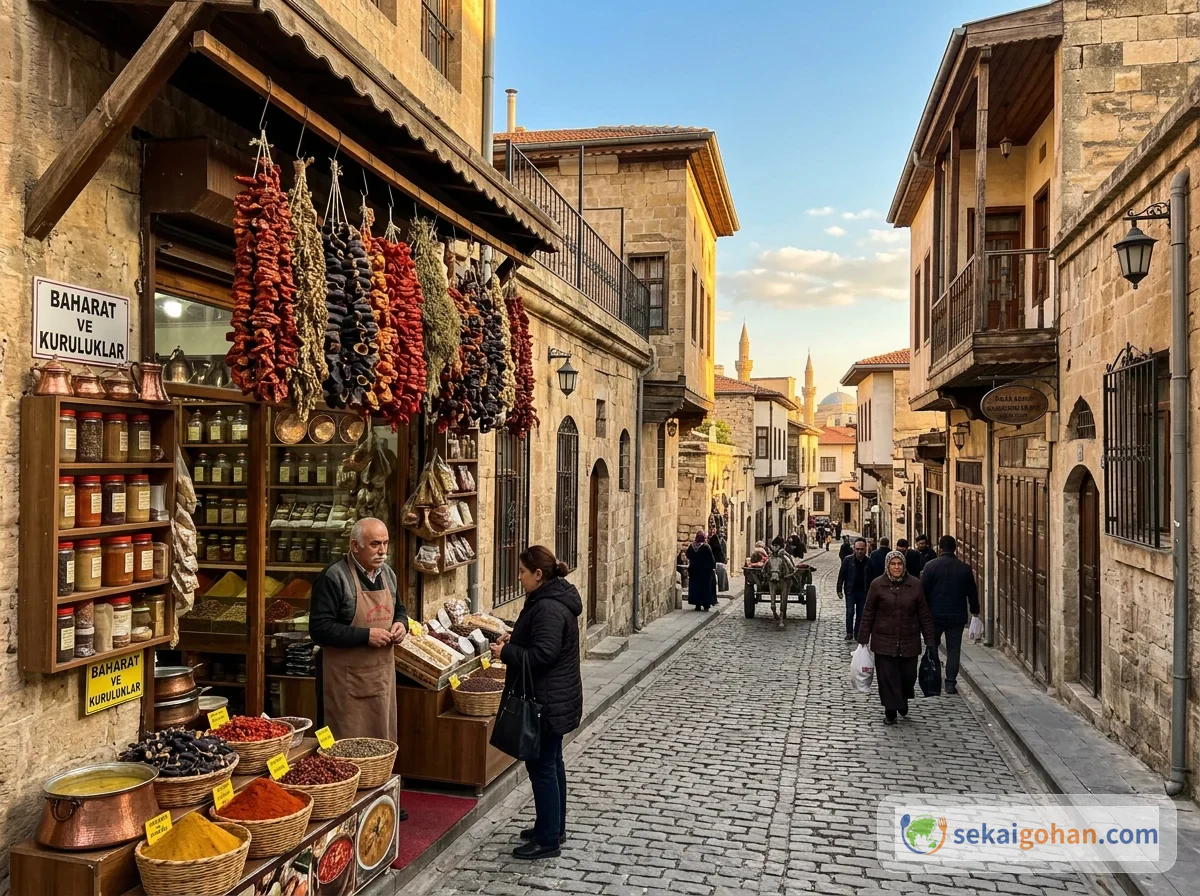
Turkey's street food is among the most diverse in the world, and alongside kebab, simit (sesame bread), balık ekmek (mackerel sandwich) and dondurma (stretchy ice cream), lahmacun plays a central role in Turkish street food culture. Lahmacun shops are everywhere, from the back streets of Istanbul to the bazaars of Ankara and the shopping streets of Adana. It is quick and easy to roll up and eat while walking, which is why it settled in as an everyday food.

That everyday quality sets it apart. Jordanian mansaf (in Japanese) is served at special celebrations, and every region of the Middle East has its own "national dish," like Armenian harissa or Bahraini machboos, but few have become as everyday as lahmacun.
At home, lahmacun is "a dish you make together." The family naturally divides the roles: one rolls the dough, one spreads the meat paste, one moves trays in and out of the oven. During Ramadan it often appears at iftar (the meal that breaks the fast after sunset), and a family around a long table eating lahmacun as fast as it comes out of the oven is a familiar scene in Turkey.
Ingredients (8 pieces, serves 4)
Use a fine flour close to "00," or blend bread flour and cake flour at 3 to 1 for the closest texture. With 100% bread flour it is hard to roll, and with 100% cake flour it loses its chew. Dust with potato starch so the dough does not stick and rolls more easily.
Ground beef (15–20% fat) makes a good substitute. For more of a lamb feel, add another 1/2 tsp cumin to the beef. Cumin gives the beef a lamb-like character.
For the flavor of southeastern Turkish lahmacun, use isot biber (Urfa biber), a dried chile from Şanlıurfa. It has a fruity aroma and gentle heat. Korean coarse chili flakes (gochugaru) are the closest substitute. Avoid Japanese ichimi chili powder, which is too hot. Look for "Urfa biber" or "Aleppo pepper" at online shops or Middle Eastern groceries.

Choosing Spices for Lahmacun
One of the spices that defines the flavor of lahmacun is isot biber (Urfa biber / isot pepper) from Şanlıurfa in southeastern Turkey. After harvest the chile is sun-dried and also wrapped in cloth at night to "sweat." This softens the heat and gives it a fruity flavor reminiscent of raisins and chocolate. If you can't find it, Korean coarse chili flakes (gochugaru) are the closest substitute.
The other key spice is sumac, a powder made from the dried red berries of a plant of the sumac family. It has a lemony acidity and is used throughout Middle Eastern cooking. Sprinkled over lahmacun at the end, it cuts the fattiness of the meat and leaves a fresh aftertaste.
Lahmacun Tips and Common Mistakes
The rule for good lahmacun is thinness: dough thin enough to see through, and meat paste spread thin with the back of a spoon. If you find yourself wondering whether it's really fine this thin, it's just right.
Lahmacun needs a short time at high heat, so always preheat the oven to its maximum temperature. Without enough preheating, the dough turns soggy while the meat paste dries out, the worst of both. A pizza stone needs 30 minutes or more.
Tomatoes vary a lot in water content, so the stiffness of the meat paste varies too. Aim for something spreadable with the back of a spoon but not runny, like thick peanut butter. If it is too watery, drain it in a sieve for 5 minutes; if it is too stiff, add tomato juice 1 tablespoon at a time.
Serving, Storage and Variations
How to serve lahmacun
For a Turkish person, not squeezing lemon over lahmacun is unthinkable. The acidity offsets the fattiness of the lamb and brings out the aroma of the spices, much as olive oil does for Lebanese hummus (in Japanese). Rolling it up with plenty of raw vegetables such as lettuce and tomato adds fiber and vitamins.
For the rest of the table, try dolma (in Japanese), Turkey's rice wrapped in grape leaves; köfte, Turkish meatballs made with the same spices as lahmacun; or kebab with kebab sauce. Tabbouleh, the Lebanese parsley salad, is an ideal accompaniment. Further afield, shakshuka shares the Middle Eastern pairing of tomato and spice, and tahchin (in Japanese) is an Iranian saffron rice cake.
Nutrition (per piece of 8)
Lahmacun is a surprisingly light street food. With no cheese, it has much less fat, and it gets protein from the lamb and vitamin C from the bell pepper and tomato.
| Nutrient | Amount |
|---|---|
| Calories | 320 kcal |
| Protein | 18 g |
| Fat | 12 g |
| Carbohydrate | 1.25 oz (38 g) |
| Fiber | 3 g |
| Sodium | 580 mg |
Vegetarian lahmacun
Use 3.5 oz (100 g) chopped walnuts plus 5.5 oz (150 g) lentils (boiled and mashed) instead of the meat, and mix in the onion, tomato and spices in the same proportions as the meat paste. The richness of the walnuts comes surprisingly close to lamb.
Cheese lahmacun
Scatter grated kashar cheese (or mozzarella) over the baked lahmacun and return it to the oven for 30 seconds to melt. The saltiness of the cheese sets off the spices in the meat.
Spicy lahmacun
Double the Aleppo pepper from 1 teaspoon to 2 and add 2 fresh green chiles (finely chopped) to the meat paste. This is the style of Adana in southeastern Turkey, the same city that gave its name to the Adana kebab, and the chile gives it real punch.
Fish flake lahmacun
For a seafood version, use flakes of mackerel or sardine in place of the meat. Flake canned mackerel, toss it with the same spices and vegetables as the meat paste, and bake. A scattering of dill at the end gives it a seaside aroma.
Grill lahmacun
You can also bake lahmacun on a barbecue grill. Roll the dough, spread the meat paste, set it on the direct-heat side of the grill on its aluminum foil, cover and bake 2–3 minutes. The charcoal smoke adds a wild flavor an ordinary oven can't give. In rural Turkey baking in a wood-fired oven is traditional, and the grill comes closest to that atmosphere.

Frequently Asked Questions
Q1. I can't roll the dough thin. Any tips?
Dough that springs back (shrinks) is a sign of tense gluten. Rest it 5 minutes and try again. Dusting with potato starch reduces sticking and makes rolling easier, and rolling the pin radially from the center outward helps too. If you have a pasta machine, passing the dough through at setting 6 (about 0.125 inch / 2 mm) gives an even thinness.
Q2. My oven only goes up to 475°F (250°C). Is that OK?
At 475°F (250°C) it still bakes well. Extend the baking to 5–7 minutes and bake until the edge of the dough is lightly colored. Preheating a pizza stone or an upside-down baking sheet raises the temperature of the underside and gives a crisp finish. Another trick is a two-sided fish grill, which bakes at nearly 575°F (300°C) from above and below.
Q3. Can lahmacun be frozen?
Yes, before baking. With the dough rolled and the meat paste spread, wrap each one in plastic wrap and freeze. It keeps about 1 month. To eat, put it frozen into a preheated oven and bake 7–8 minutes at 475°F (250°C). I don't recommend freezing baked lahmacun, since the dough softens when thawed.
Q4. I don't like the smell of lamb. What can I do?
Make it with 100% ground beef. The cumin and paprika are the stars, so beef still gives a thoroughly lahmacun-like taste.
Q5. What drink goes with lahmacun?
In Turkey ayran (a salted yogurt drink) is the standard of standards. Mix ¾ cup (200 ml) plain yogurt, ½ cup (100 ml) water and a pinch of salt; its mildness neatly offsets the spicy meat paste. For alcohol, Turkey's Efes beer and rakı (an anise-flavored spirit mixed with water) are the traditional pairings. Something lemony, such as a lemon spritz, also goes superbly, and between the acidity and the spice it's easy to eat too many.
Sources
- Eckhardt, R. (2017). Istanbul & Beyond: Exploring the Diverse Cuisines of Turkey. Rux Martin Books. https://www.hmhbooks.com/istanbul-beyond/ (a comprehensive introduction to Turkish cooking including the food culture of the southeast)
- Sercarz, L.L. (2016). The Spice Companion: A Guide to the World of Spices. Clarkson Potter. https://clarksonpotter.com/spice-companion/ (a reference on the spices of the world including isot biber)
- "Gaziantep: UNESCO Creative City of Gastronomy." (2015). UNESCO. https://en.unesco.org/creative-cities/gaziantep (official material on Gaziantep's designation as a UNESCO Creative City of Gastronomy)