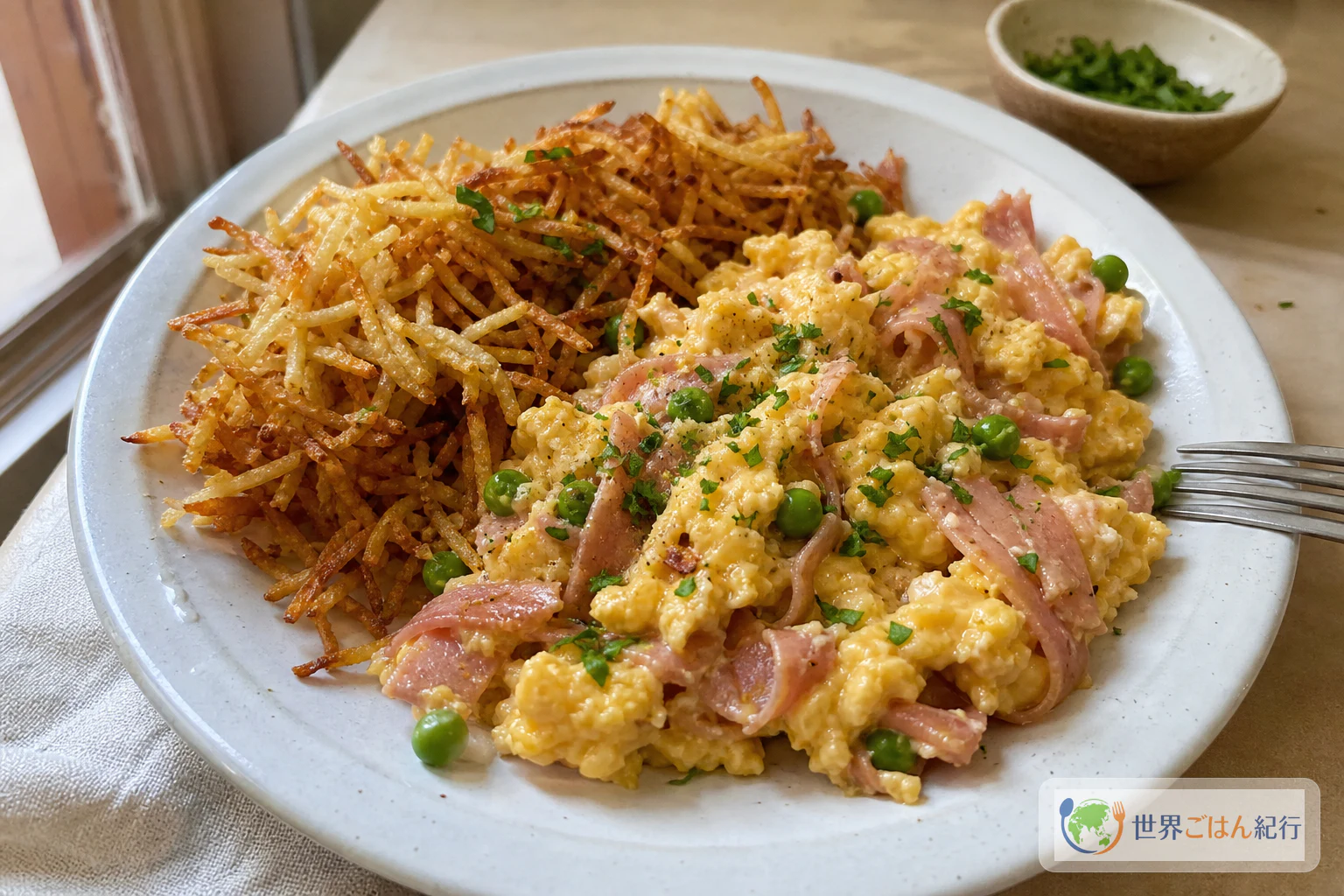
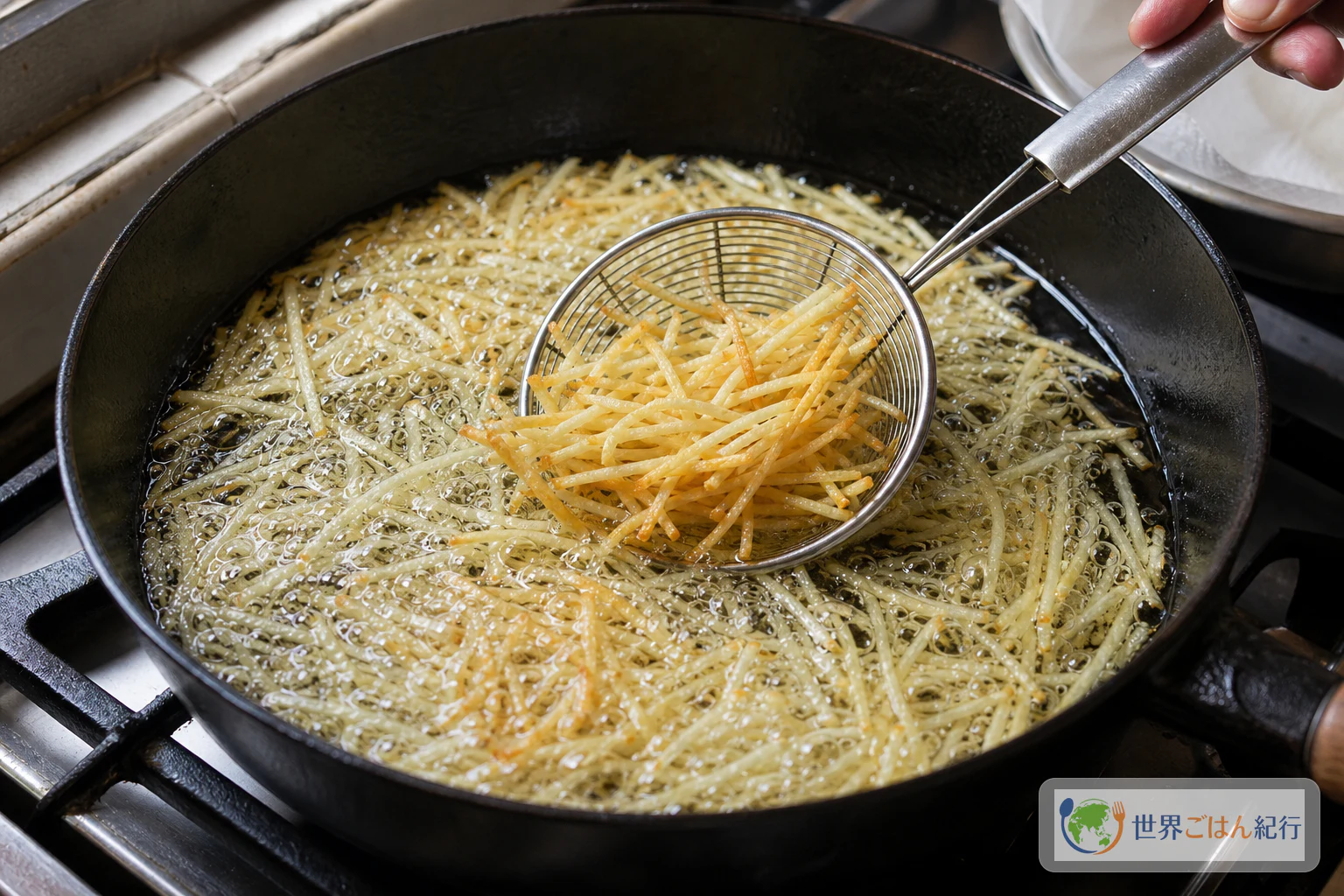
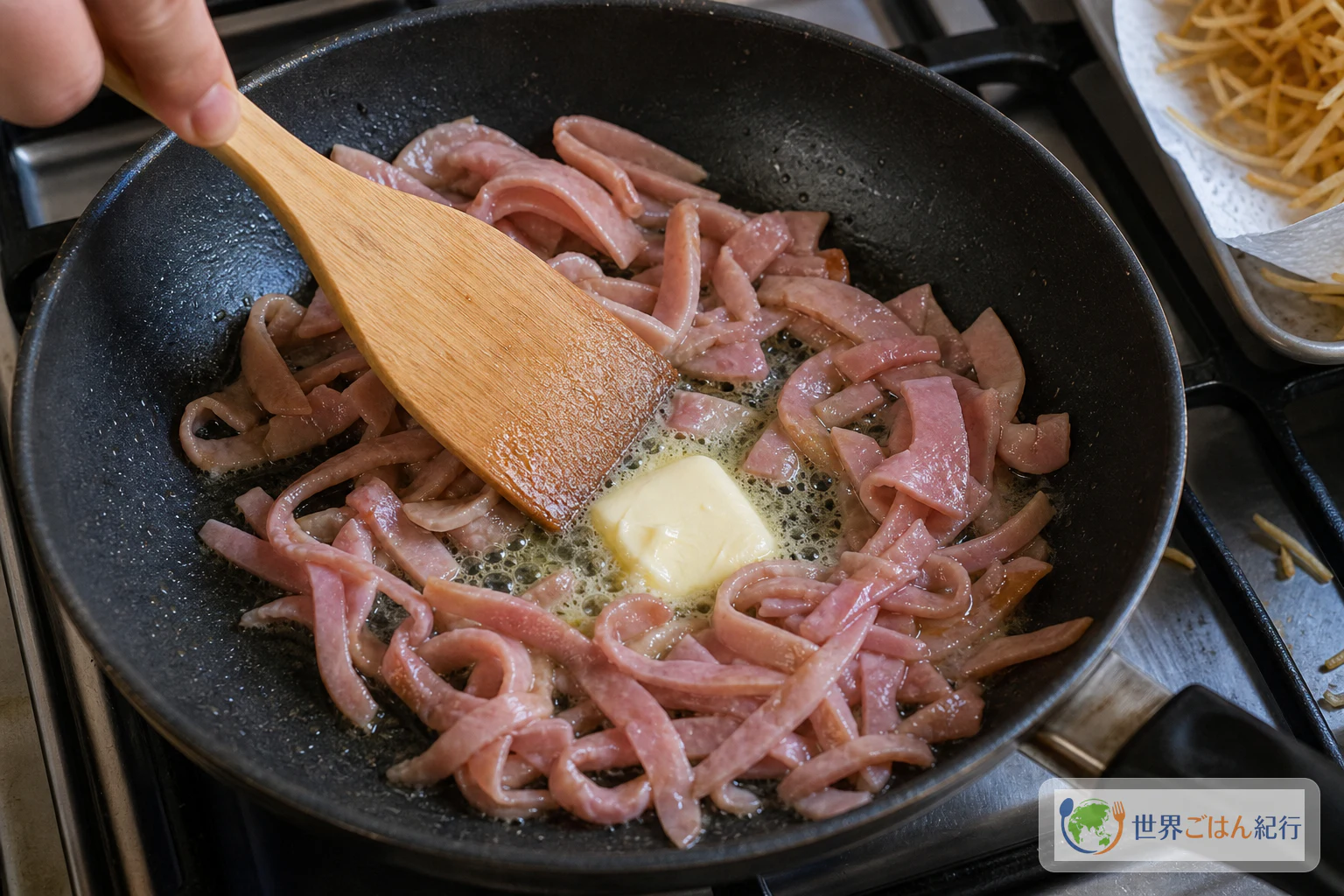
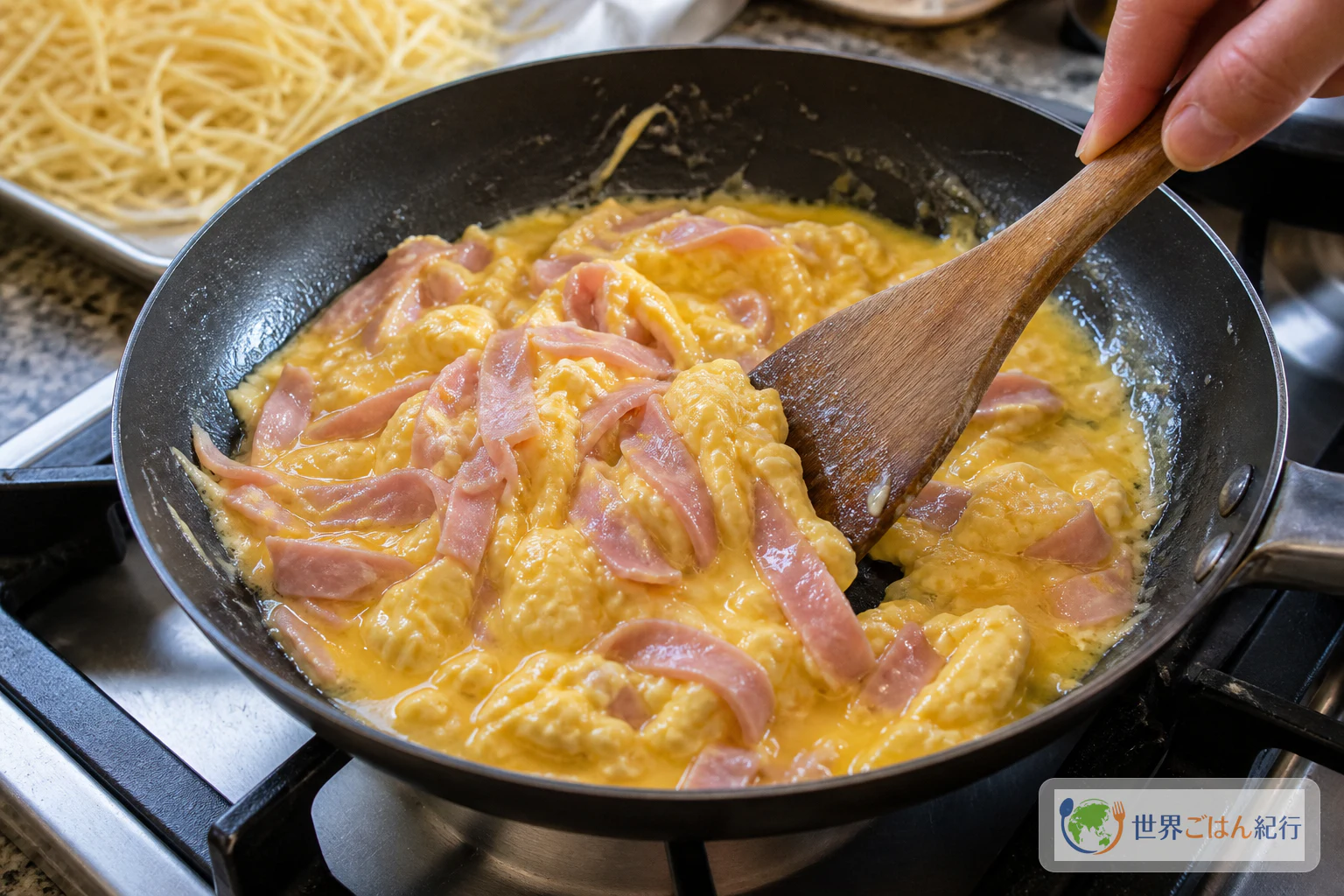
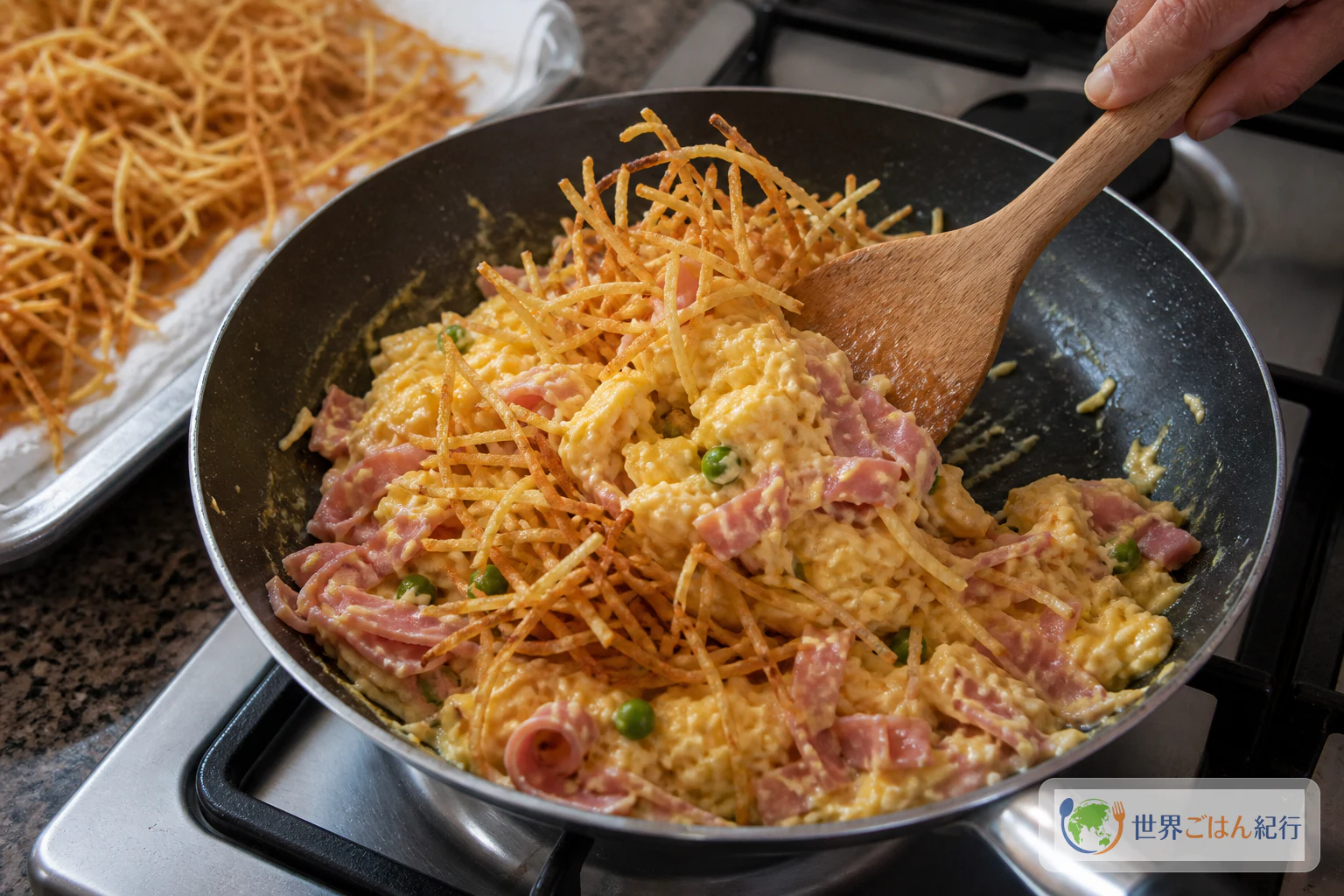
At a late dinner in Buenos Aires, a plate arrives with thin potatoes that still smell of frying oil, loosely tangled with eggs. Lift some with a fork and the potatoes on top are light, while the eggs underneath are just slightly runny. It smells like french fries but eats like soft scrambled eggs, and revuelto gramajo lives somewhere in between. Eggs, ham, and shoestring potatoes come together in a few minutes, and with supermarket eggs and sliced loin ham you can get remarkably close at home.
Revuelto Gramajo in Argentina
In Spanish, revuelto means a dish in which eggs are stirred together with other ingredients. Where gramajo comes from is less clear. One story names the dish for Artemio Gramajo, but the origin is still debated in Buenos Aires, along with what counts as authentic. What local recipes agree on is the form: eggs, ham, and shoestring potatoes brought together quickly.
Revuelto gramajo is both a home dish and a canteen dish. On the plate everything looks like one thing, but each part has its own job: the potatoes bring lightness, the eggs bind, and the ham adds saltiness and a meaty aroma. Stir-fry it all together from the start and the potatoes soak up the egg and turn heavy, drifting toward an oily potato salad. That's why local recipes fry the potatoes separately, keep them warm, and combine them with the eggs and ham at the end.
Versions vary from restaurant to restaurant. Some add green peas, onion, bacon, cream, or mushrooms. One style fries thin potatoes (papas pay), warms the ham in butter, and keeps the eggs soft at the punto babé stage; another includes onion, bacon, and green peas and sets the eggs firmer. There's no single correct version, so make it the way you want to eat it today.
Ingredients (serves 4): Think of the Potatoes, Eggs, and Ham Separately
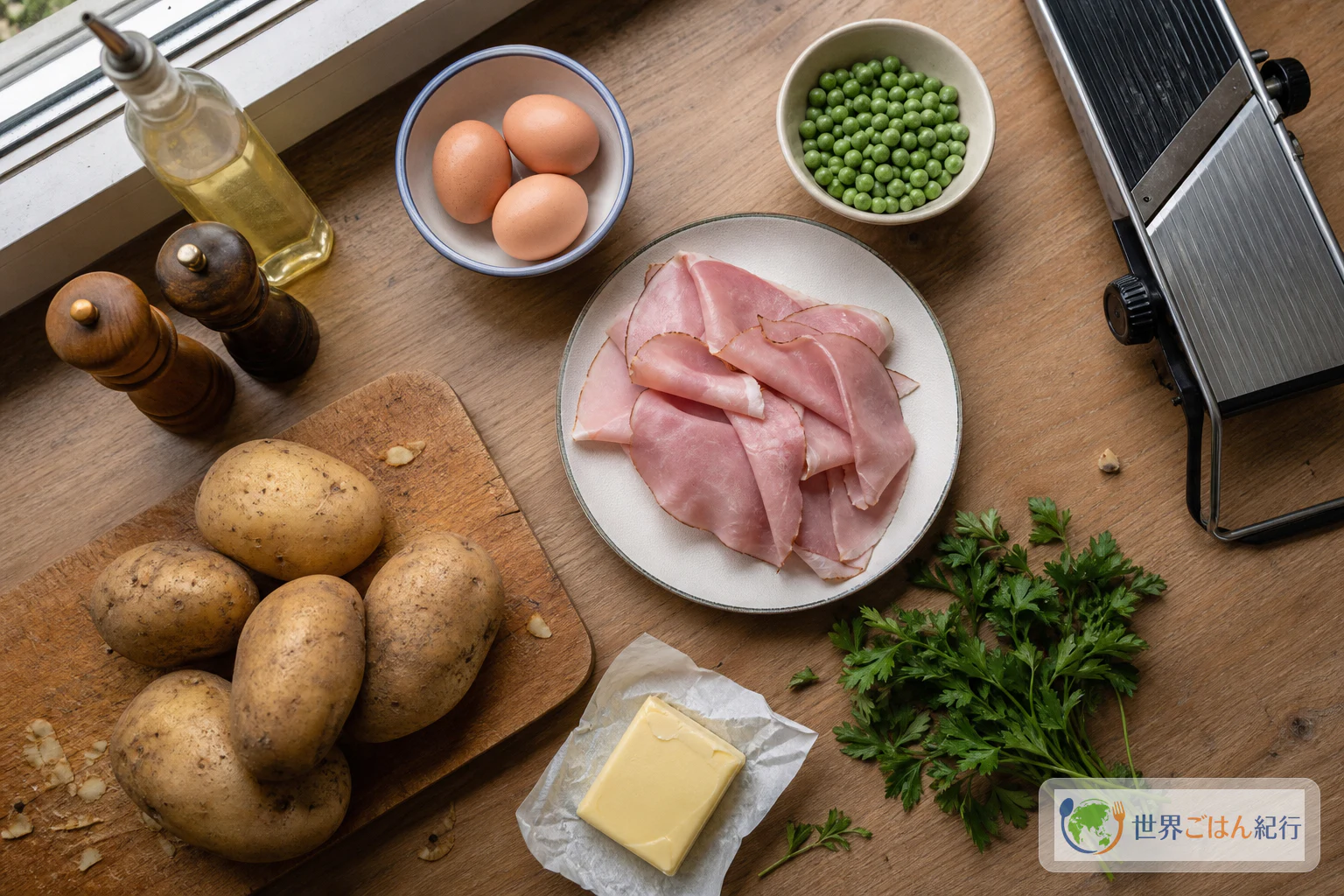
Either waxy potatoes or floury potatoes will work. Waxy potatoes are less likely to break when cut into strips and keep their shape after frying. Floury potatoes bring out aroma but break easily and tend to taste floury once combined with the eggs. The first time, choosing a waxy potato makes it less likely to fail.
For the ham, skip thin slices. Cut slightly thicker loin ham into 0.25 inch (5 mm) widths, which moves it closer to the local jamón cocido. Bacon brings a stronger smoky smell and fat, and turns the dish into something different. If you use it, reduce to 2.75 oz (80 g) and cut the salt to 1/2 tsp.
For the green peas, use frozen rather than canned. Canned peas have a lot of moisture, and their aroma tends to blur when mixed into the eggs. Pour boiling water over them while frozen and drain in a sieve before using.
It uses eggs, milk, and pork. If you have allergies or religious restrictions, don't force substitutions and call it the same dish; reconstruct it as a different dish without egg or without pork.
Choosing Ingredients and Pans for Revuelto Gramajo
Potatoes, ham, and eggs
The ingredients are familiar, which makes it easy to substitute your way into a different dish. Outside Argentina, swap what you need but hold on to three things: cut the potatoes thin, keep the oil temperature from dropping too much, and take the eggs off the heat before they finish. Do that, and even ingredients from your own refrigerator give you the lightness of revuelto gramajo rather than a potato omelet.
| Point of hesitation | Judgment to keep | Judgment you may swap |
|---|---|---|
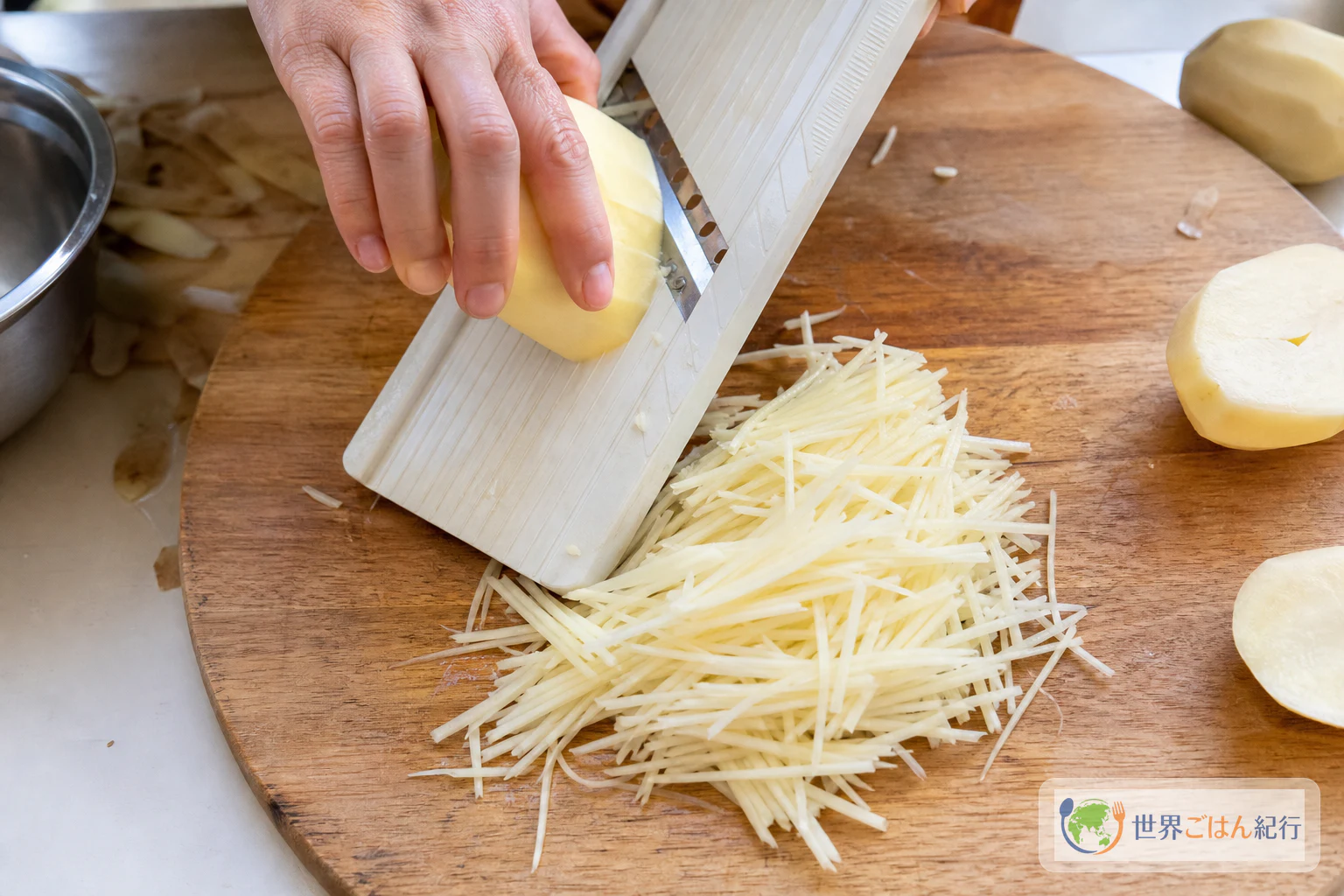
| Potatoes | Cut into strips of 1.5 to 2 mm | Choose among waxy, floury, or frozen shoestring |
| Ham | Cut thick and don't brown strongly | Loin ham, boneless ham. If bacon, up to 2.75 oz (80 g) |
| Eggs | Stop over low heat when about 70% has set | Cream is unnecessary. If added, up to 1 tbsp |
| Green peas | Drain before adding | Can be left out. Don't add watery vegetables |
| Oil | Keep it around 350°F (170°C) | Shallow pan-frying also works, but takes longer |
If you use frozen potatoes, choose only the thin shoestring type. Thick french fries are satisfying, but mixed with eggs their fluffy centers take over and the dish loses its lightness. Fry them a little shorter than the label says to leave room for the eggs' residual heat.
Argentine canteens use jamón cocido, which has a mild saltiness; a thick loin ham is the closest stand-in. Bacon is tasty too, though its smoky aroma comes forward. Either way, warm the ham lightly once the butter's bubbles turn fine, without browning it hard, so it doesn't fight the eggs.
Pans and a thermometer
This dish depends on cutting thin, a steady oil temperature, and a quick finish for the eggs, not on special spices. Potatoes, eggs, and ham are at any supermarket, so the only gear worth buying is what prevents failures. In order of priority: a heavy pot or pan for frying the potatoes, a thermometer for the oil, and a small frying pan of 8 inches (20 cm) for the eggs, though any pan you have can stand in for that last one.
| What you already have | What to add if buying | Reason |
|---|---|---|
| A deep pot | A frying thermometer | You only need to supplement oil-temperature judgment |
| Only thin frying pans | A heavy frying pan of 10 inches (26 cm) | Oil temperature drops less and potatoes overlap less |
| Only a frying pan of 10 inches (26 cm) | A frying pan of 8 inches (20 cm) | The eggs do not spread too far, making it easier to form soft curds |
| You have all of them | Nothing to buy | Concentrate on how you cut and the sequence |
The gear earns its place elsewhere, too. A frying thermometer helps with akara and fricassé, a heavy frying pan handles the high-heat stir-fry of lomo saltado, and a small pan is handy for any egg dish.
Common Revuelto Gramajo Failures and Fixes
| Problem | Cause | Fix |
|---|---|---|
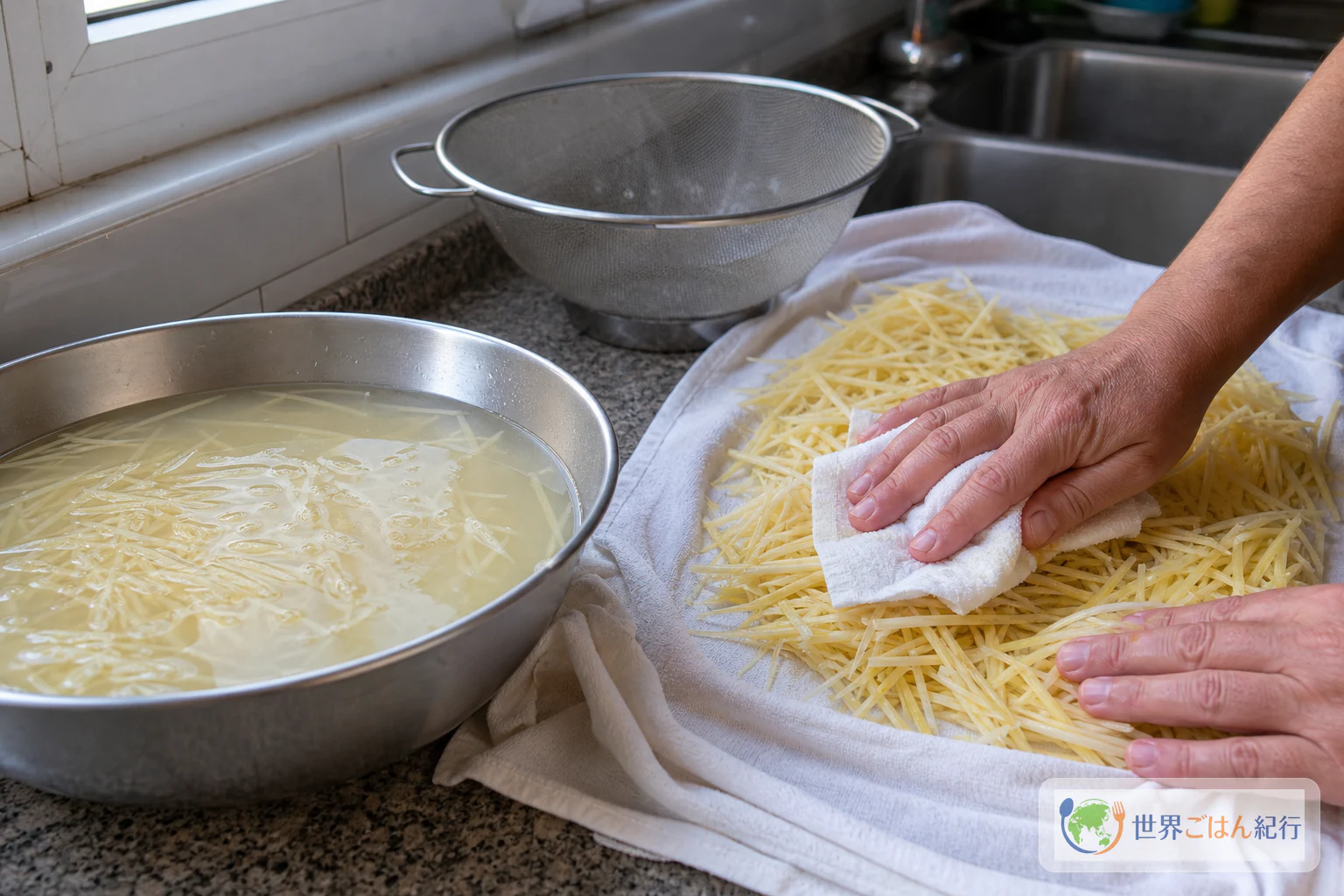
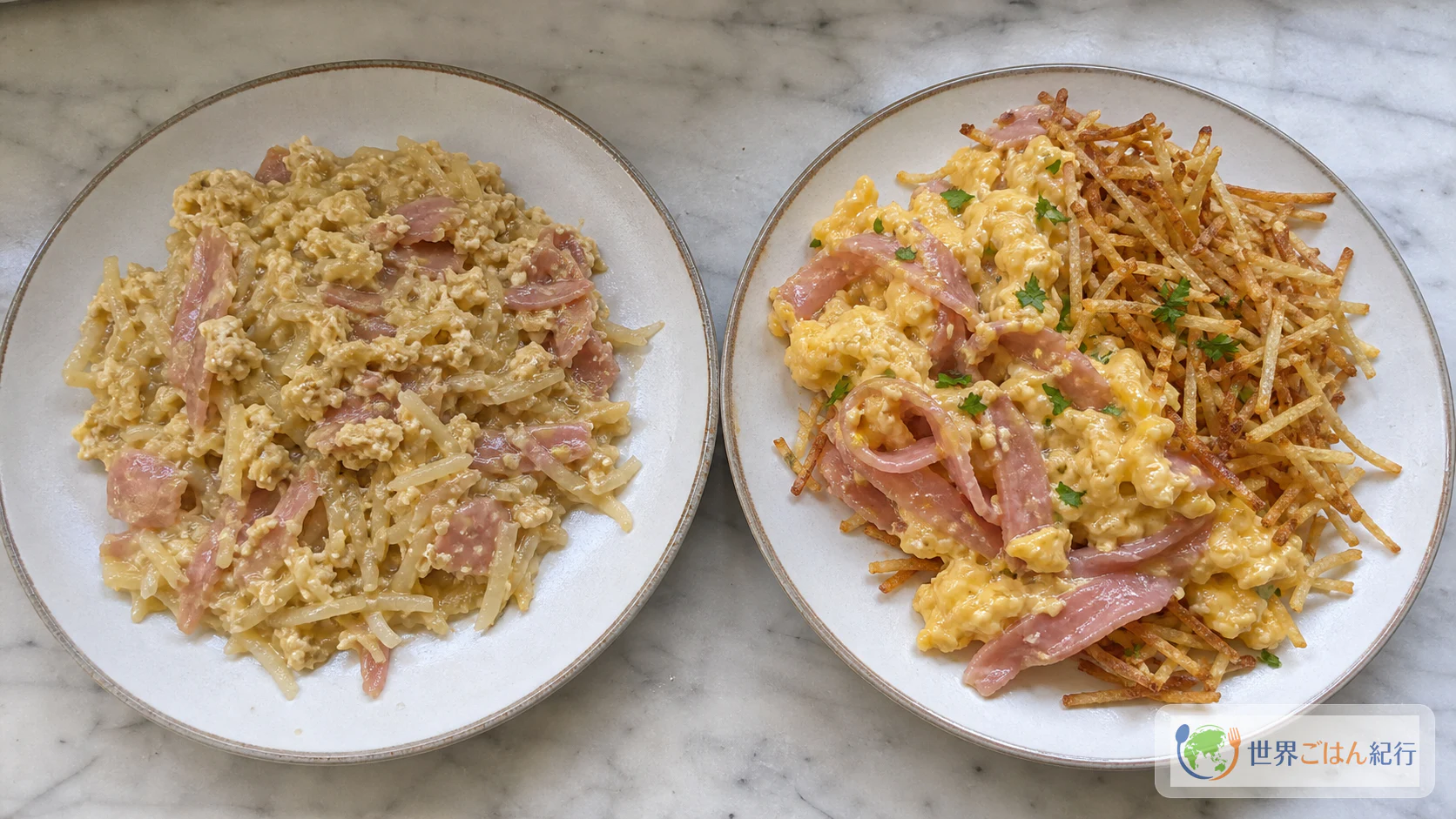
| Potatoes are soggy | Fried with moisture left, or oil below 325°F (160°C) | After soaking, press with a cloth, wait for 350°F (170°C), and fry half at a time |
| Eggs are hard | Added eggs over high heat, or kept heating after mixing in the potatoes | Lower to low heat before adding the eggs, and turn off the heat when 70% has set |
| Whole dish is salty | Ham and salt were both strong | If the ham is salty, reduce the egg salt to 1/4 tsp and add more at the end |
| Oily | Stacked the fried potatoes on paper | Spread on a rack to drain the oil and let steam escape |
| Potatoes burn | Fried the too-thin parts over high heat | Keep the bubbling steady over medium heat and take them out while the color is still light |
The most common mistake is frying the potatoes to the color of french fries. The dish finishes in the eggs' residual heat, so pull the potatoes when only the ends are lightly colored and they'll be just right after mixing.
Order matters as much as any ingredient. Return the potatoes to the pan before the eggs and they soak up egg and turn heavy right away. Set the eggs softly first, then turn off the heat and fold in the potatoes, and their crisp outsides stay crisp.
Salt sneaks up on you. Salt content differs from one Japanese loin ham to another, so taste a bit of the end before cutting. The potatoes are already salted and you can't take salt back out of the eggs, so start the egg mixture on the light side and adjust at the end.
If the eggs come out dry and crumbly, look at the pan size as well as the heat. Five eggs poured into a 10-inch (26 cm) pan spread thin and set at once, while a pan of about 8 inches (20 cm) gives them thickness and time to turn in big strokes. Stuck with a large pan? Try turning off the heat 30 seconds after adding the eggs and finishing them with residual heat.
Serving and Storing Revuelto Gramajo
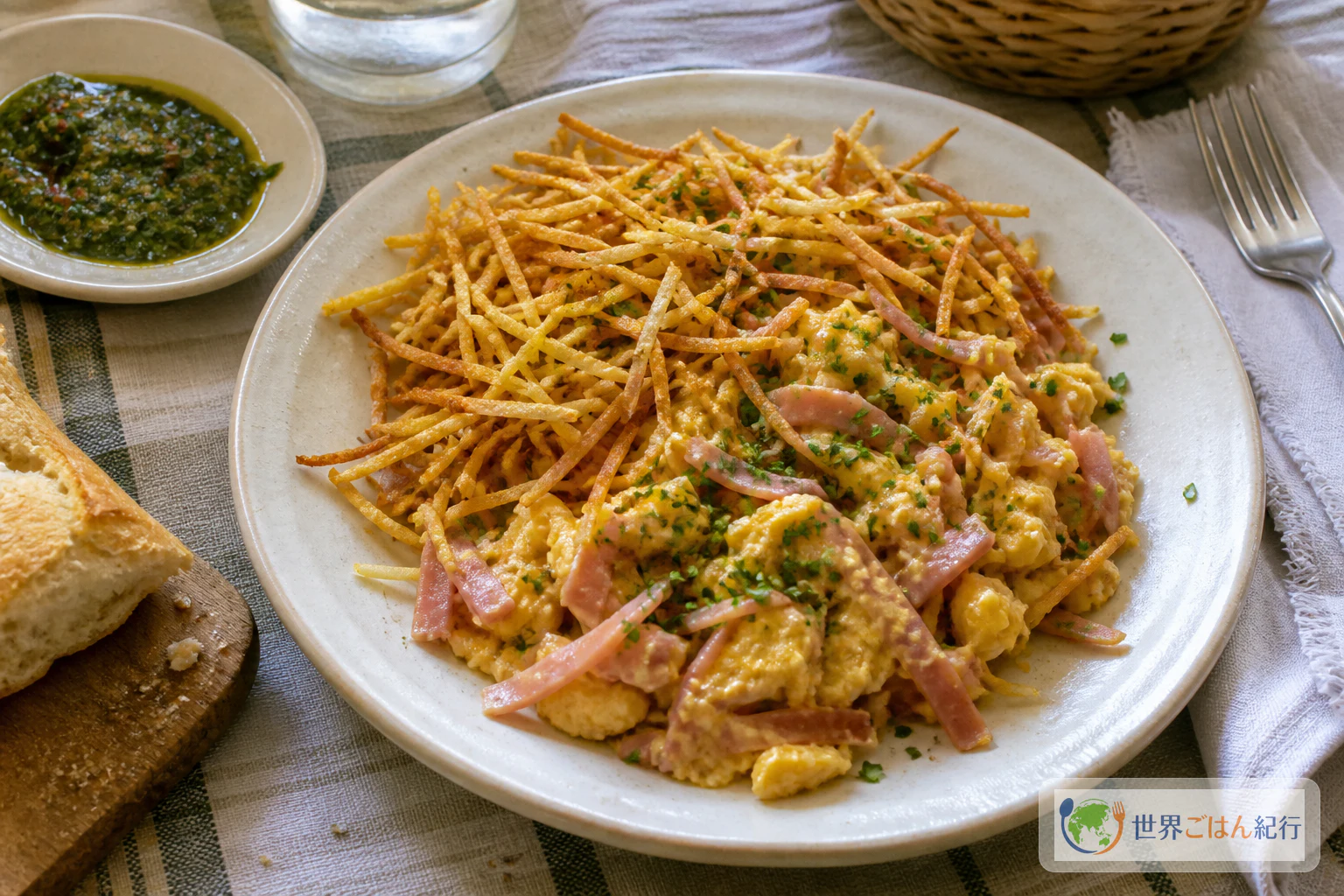
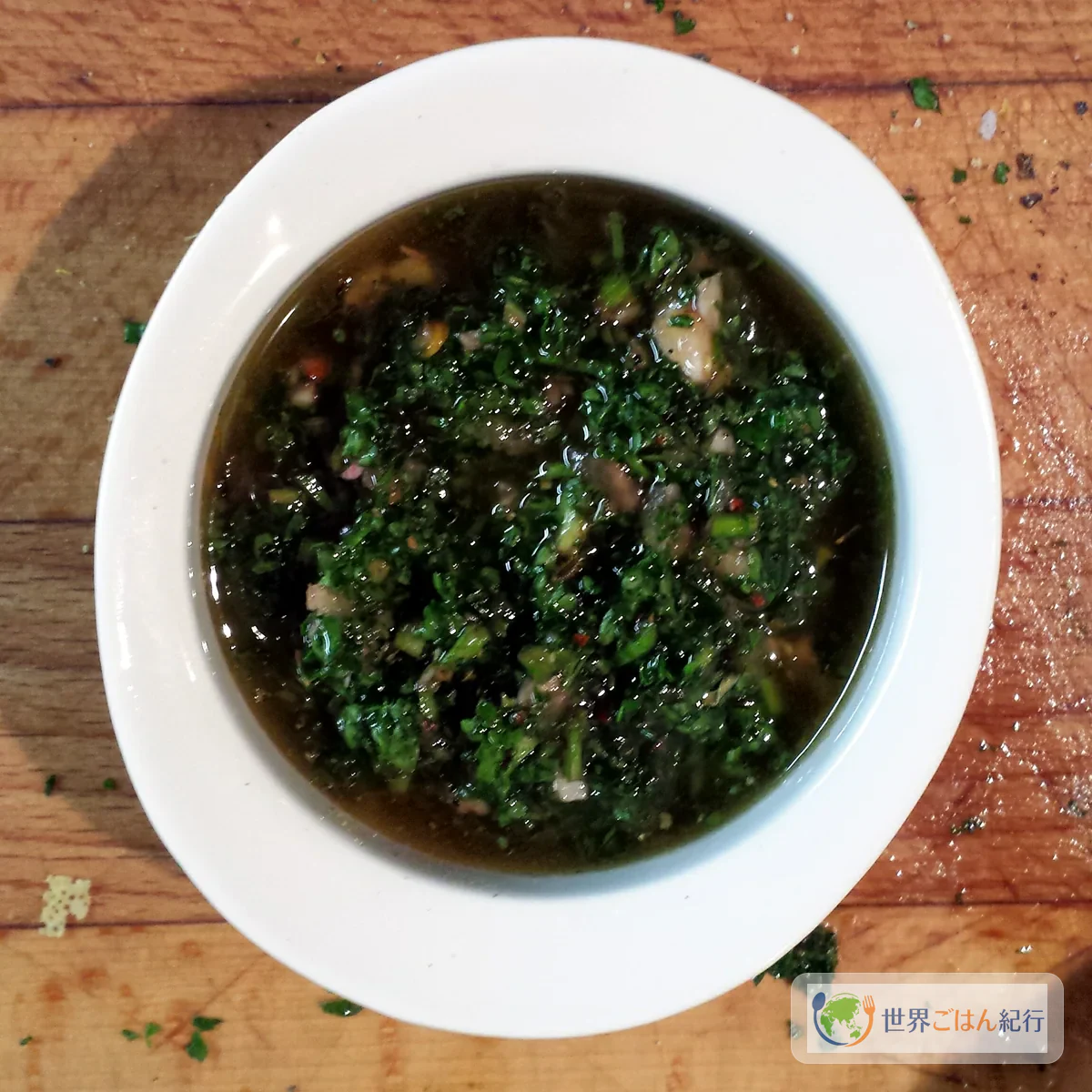
Revuelto gramajo is best as the star of a late-night meal or lunch rather than as a side to a meat main, where you can enjoy the layering of eggs and potatoes. A salad with some acidity, thinly toasted bread, and light red wine or sparkling water all go well, and a little chimichurri cuts the richness of the oil. On a day built around asado, it's better saved for a light meal another day than squeezed in as a small portion on the side.
For a fuller Argentine menu, start with empanadas, make milanesa when you want crisp-fried thin cutlets, and cook locro in the cold season. Set beside Uruguay's hearty sandwich, the chivito, it shows how eggs, meat, and potatoes are used around the Río de la Plata.
This isn't a make-ahead dish: the eggs firm up as they cool and the potatoes absorb humidity. You can get some prep out of the way, but fry the potatoes and combine everything just before eating.
| What can be done ahead | How to store it | What to do right before eating |
|---|---|---|
| Cut the potatoes | Soak in water and refrigerate, up to 2 hours | Wipe thoroughly dry and fry |
| Cut the ham | Seal and refrigerate, same day | Warm briefly in butter |
| Chop the parsley | Wrap in damp paper and refrigerate, same day | Scatter just before plating |
| Fry the potatoes | Not recommended ahead | Fry right before eating |
| Beat the eggs | Not recommended ahead | Mix in salt and cook immediately |
Leftovers should cool slightly, go into an airtight container, and be refrigerated within 2 hours; eat them the next day. Reheat in a frying pan over low heat with 1 tsp of oil spread thinly, for only 1 to 2 minutes. The soft eggs and light potatoes won't come back, though, so it's better to make half the amount than to plan on leftovers.
FAQ
Can I make it with frozen french fries?
Yes, as long as they're the shoestring type; fry them 1 to 2 minutes shorter than the label. Thick frozen potatoes turn heavy when mixed with eggs and won't give the lightness of the local papas paille. Some frozen potatoes are already salted, so start with 1/4 tsp of salt in the eggs.
Do I have to include the green peas?
No. Some local recipes include them and some don't. Add 1.5 oz (40 g) for canteen-style color and sweetness: pour boiling water over frozen peas and drain them in a sieve before using. Avoid watery vegetables as a substitute, since they loosen the eggs.
Can I substitute prosciutto or bacon?
Prosciutto is too salty and hardens when cooked, so skip it. Bacon works if you keep it to 2.75 oz (80 g) and cut the egg salt to 1/4 tsp, but for something closer to jamón cocido, use thick loin ham.
Can I pan-fry instead of deep-frying?
You can pan-fry thin potatoes in extra oil, but since they can't all touch the pan at once, it takes 15 to 18 minutes and crisp and limp pieces tend to mix. To use less oil, put 0.5 inches (1 cm) of oil in an 8-inch (20 cm) frying pan and fry in small batches.
Can I put it in a lunch box?
It doesn't travel well: the eggs and fried potatoes lose their texture as they cool. For a lunch box, cook the eggs through to the center and pack the potatoes separately, and treat it as a different dish.
Can I make the eggs even runnier?
At home, don't finish them too runny. The eggs keep cooking from residual heat after plating, so stop when about 70% has set in the pan. For small children, older adults, or pregnant people, cook the eggs thoroughly all the way to the center.