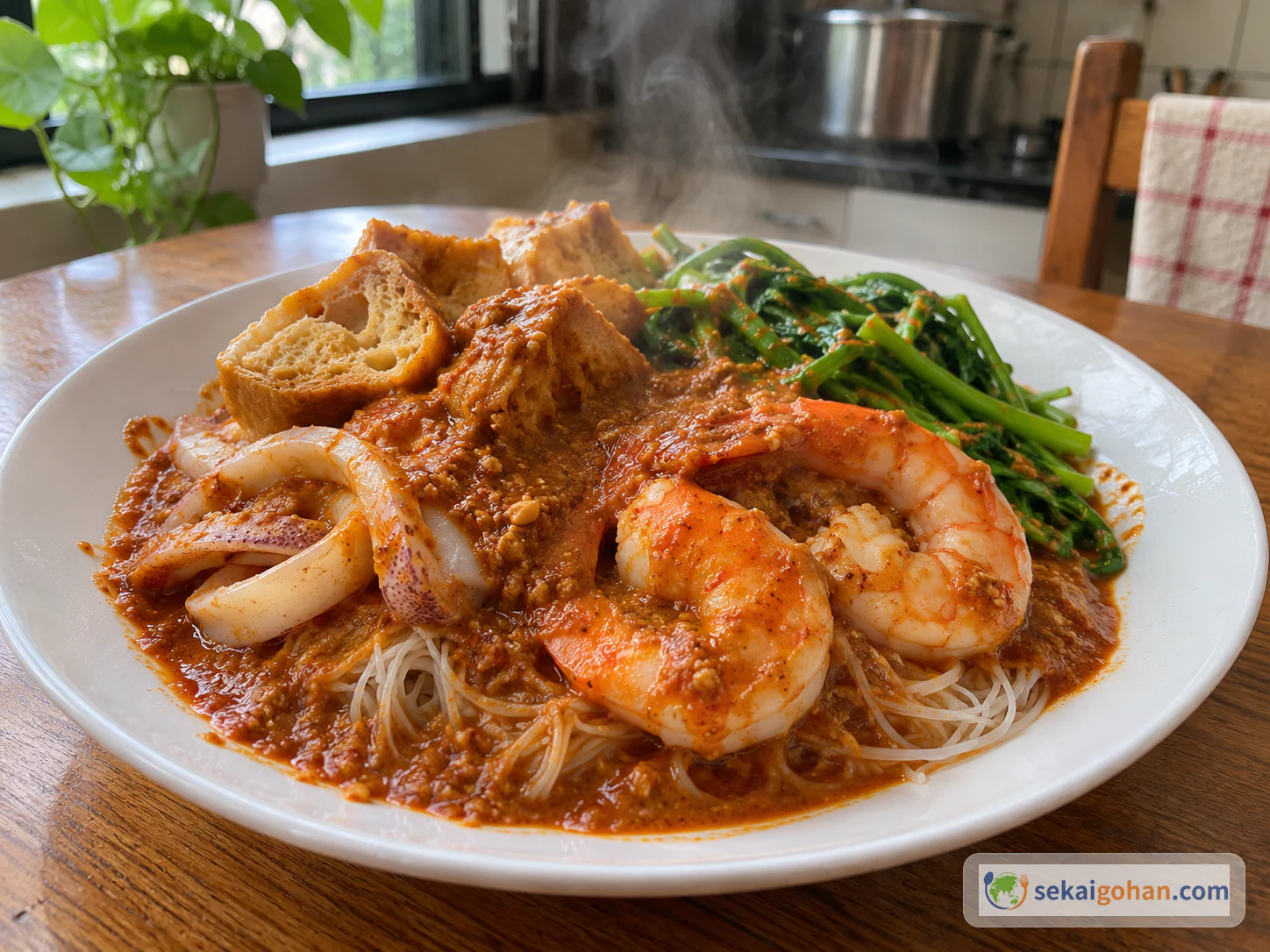
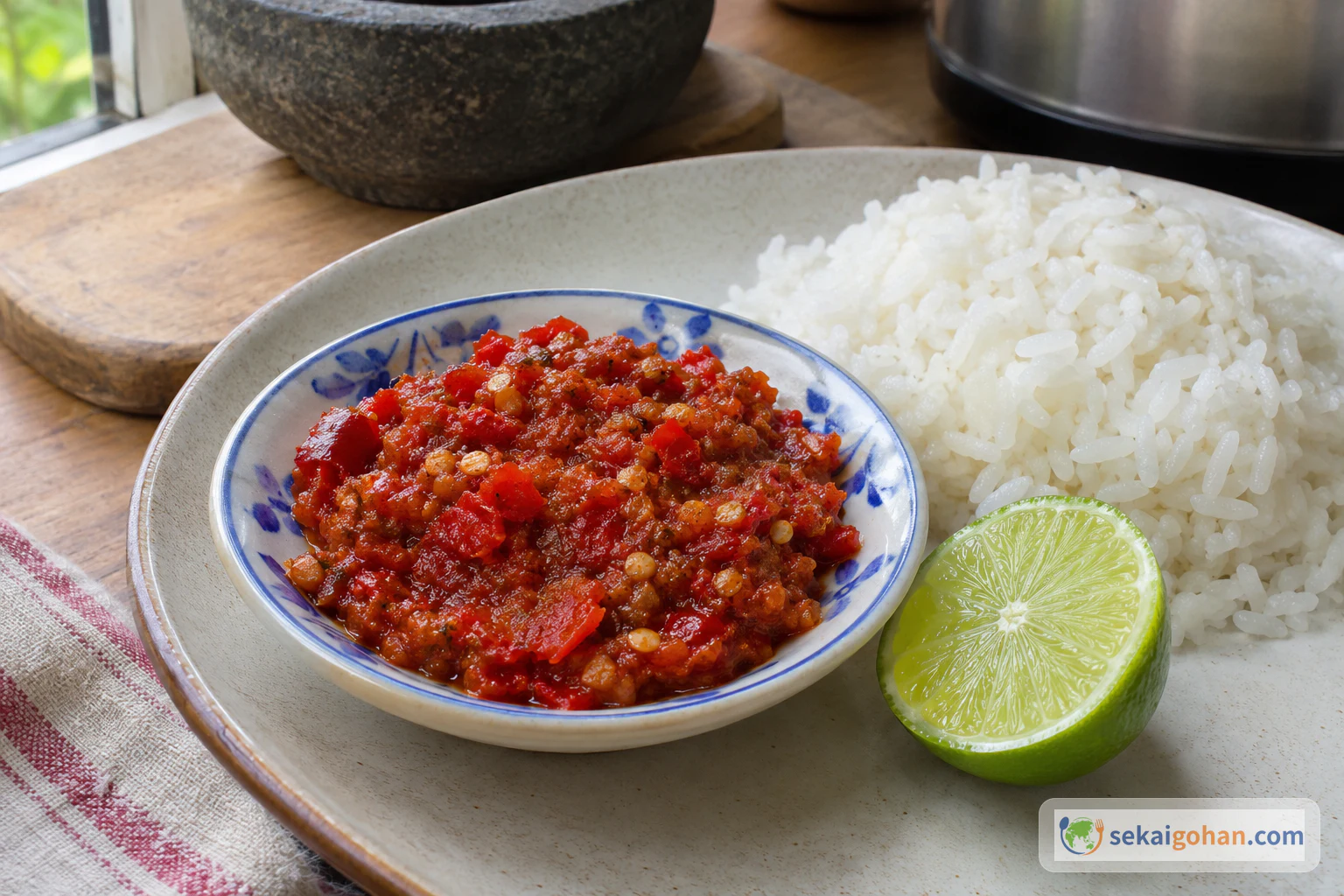
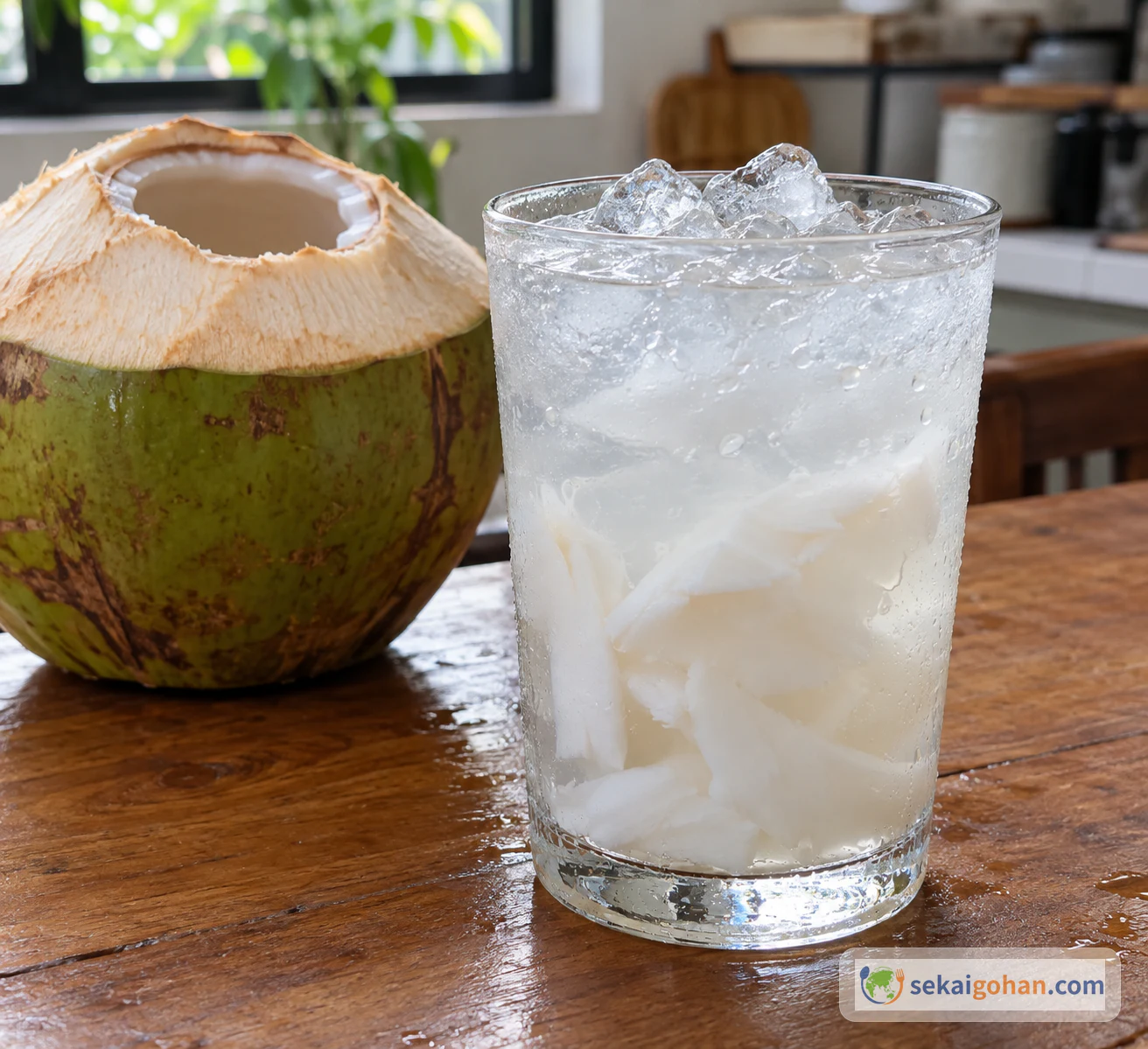
In the kitchen, dried chiles soak in hot water, onion and lemongrass wait on the board, and tamarind is being loosened in a bowl of water. Already the air smells nothing like an ordinary simmered fish: instead of sweet-salty soy sauce, there's red oil, a citrus-like sourness and the stock coming off the fish. Once small bubbles start forming at the edge of the pot, you'll find your hand moving a little faster as it spoons out the white rice.
Asam pedas means "sour, spicy" in Malay, and the name tells you exactly what you get: fish simmered with the sourness of tamarind and the heat of chile. It's eaten across the Malay Peninsula, Sumatra and Borneo, and at the Malay and Peranakan tables of Singapore. Think of it as a sour-spicy fish stew that grew up between port towns and straits. Get three things right and you can come close to the original at home: the sourness, a red aromatic paste, and cooking that keeps the fish whole.
The common Malay spelling is asam pedas. In English it is also written assam pedas.
Asam pedas in Singapore and the Malay world
The heart of asam pedas is the balance between sour and hot. Unlike a curry rounded with coconut milk, it starts with a red aromatic paste fried until a thin film of oil floats on top, then loosened with tamarind liquid, and the fish is simmered only briefly. The soup stays light. Over rice, the sourness keeps each mouthful fresh, while the fat of the fish and the aroma of chile linger.
Names and aromatics shift from region to region, so you'll also meet versions called asam padeh and gerang asam. In Singapore, chile pastes such as sambal and lempah run through Malay, Peranakan and Eurasian cooking, and asam pedas grows out of that tradition. Fish, vegetables and souring agents change from shop to shop and household to household. Minangkabau-style eateries in Singapore have even added sweetness to suit local tastes.
Locally, the sourness comes from tamarind, asam keping or lime, and the heat from dried chiles, fresh chiles or sambal. The fish might be stingray, mackerel types, sea bream, river fish or fish heads, and the pot is scented with lemongrass, turmeric, ginger and fermented shrimp seasoning. Okra, eggplant, tomato and laksa leaf are common additions, and in Peranakan recipes laksa leaf and torch ginger can carry the whole aroma.
If you like eating fish with aromatics, otak-otak, wrapped in leaves and grilled, makes a good next read. Set asam pedas beside the Philippines' sinigang and Thailand's tom yum goong and you'll see how differently each one uses tamarind and sourness. For more casual Singaporean food, there's roti john, and for the aroma of chicken stock and rice, Hainanese chicken rice.
Ingredients — decide the fish, tamarind and aromatic paste first

Serves 4. Use thick fillets of fish. A fish that breaks easily like cod also works, but the first time, ones whose flesh doesn't flake easily when heated, such as Spanish mackerel, swordfish, sea bass or sea bream, are easier to handle. If using frozen fish, thaw it in the refrigerator, wipe the surface dry and then salt it.
This uses fish, shrimp-derived seasoning and fish sauce. If adding shrimp paste, be careful about shellfish allergy. At a table with people who dislike heat, reduce the dried chiles to 6 and remove more of the seeds.
Ingredients that cause hesitation when shopping — fix the sourness and aroma
You don't need to order the fish or okra online. Focus on sourness, aromatics and color, which can be hard to find at a nearby supermarket. If these are vague, the dish turns into just a red fish soup, so settle them first when you shop.
Tamarind is the star of this dish. Lemon or vinegar also bring sourness, but it is different from the round fruity sourness of tamarind. The first time, using paste saves the work of loosening seeds and straining, and makes sourness easier to adjust.
Shrimp paste is an ingredient that adds fermented umami to the red soup in small amounts. You can make it without, but to move toward a Malay-style sour-spicy fish stew, mixing 1/2 tsp into the aromatic paste gives more outline than miso alone. At a table with a shellfish allergy, don't force it; make up for it lightly with miso and fish sauce.
Turmeric is not only for color but the aromatic base that rounds out the smell of fish. If you can't get fresh turmeric, a small amount of powder is enough. Too much turns powdery and bitter, so 1 tsp is the upper limit.
Choosing fish, tamarind and herbs for asam pedas
Every swap pushes the flavor in a new direction, so choose carefully. The first time, hold on to the tamarind, lemongrass and turmeric, and let the fish and herbs lean toward whatever you can buy easily.
| Ingredient in question | Closer to the original | A practical answer at home | Judgment |
|---|---|---|---|
| Fish | Stingray, red fish, fish heads | Spanish mackerel, swordfish, sea bass, sea bream | Choose thick cuts that hold together |
| Sourness | Tamarind pulp, asam keping | Tamarind paste | Lemon juice alone won't do |
| Herbs | Laksa leaf, torch ginger | Shiso, cilantro, a little mint | Add lightly at the finish |
| Fermented umami | Belacan, shrimp paste | 1/2 tsp shrimp paste, or miso and fish sauce | Leave it out if there's an allergy |
| Heat | Dried and fresh chiles | Rehydrated dried chiles, adjusted by number | Chile powder alone flattens the aroma |
The fish is the biggest question. Stingray gives you the local feel, but it's hard to find reliably. Spanish mackerel balances fat and soft flesh well and suits a sour soup, while swordfish holds its shape and has little fishy smell, which makes it a good first choice. Cod is easy to get but fragile, so pick thick fillets, keep the cooking short and leave it alone in the pot. Salmon works too, though its strong fat and aroma take it away from the taste of a local white fish.
Stick with tamarind for the sourness. Vinegar is sharp and pulls the fish's aroma somewhere else entirely. Laksa leaf and torch ginger are hard to gather outside the region, so this recipe builds its aroma on lemongrass, ginger and turmeric, with a little shiso or cilantro added at the end.
Method — fry the paste and cook the fish briefly
What goes wrong in this dish is underfrying the aromatic paste and overcooking the fish. Fry the paste without scorching until the oil seeps out, and add the fish last, cooking it quietly over low heat. Stir around after the fish goes in and the flesh breaks up and the soup clouds.
Reduce the dried chiles to 6 and remove nearly all the seeds. For adults, add a sambal substitute at the table 1 tsp at a time, which lets you adjust without making the whole pot too hot.
Common asam pedas failures and fixes

| State | Cause | How to fix |
|---|---|---|
| Too sour | The tamarind paste is strongly concentrated | Round it with 2 tbsp water, 1/2 tsp sugar and a little salt |
| The fish falls apart | Boiled hard, or stirred too much with a wooden spoon | Low heat once the fish is in. Swirl the pot to move the soup |
| The aroma is weak | The aromatic paste was underfried | Fry 6 to 7 minutes over medium-low heat until the oil seeps out |
| Powdery | Too much turmeric | Up to 1 tsp. If lacking, make up with aromatics, not color |
| Fishy | The fish moisture wasn't wiped, or it wasn't cooked enough | Salt and leave 10 minutes, wipe the moisture and simmer until the center is white |
Add the tamarind gradually. With a strongly concentrated product, putting it all in at the start makes the soup too sharp, so begin with 20 g and add more after tasting in step 3. Sourness mellows a little as it simmers, and if it tastes just slightly strong, it will be right with rice.
You'll see the fish breaking down before you taste it. When the edges of the flesh begin to split and the soup clouds with fine flakes, the heat is too high. Turn it down to low, and slide the vegetables into an open spot in the pot instead of dropping them on the fish.
A weak aroma has to be fixed while frying the paste; chile powder added afterward won't give depth. Cook off the moisture from the onion and let the color of the chile and turmeric move into the oil. This is the step not to rush.
Serving and storing asam pedas
How to serve it

Serving is simple: spoon rice into a deep bowl and pour the fish and red soup over it. Between the stickiness of okra, the softness of eggplant and the sourness of tomato, the pot already has plenty going on, so a light side is enough. Skip heavy fried food and go for sliced cucumber, boiled egg, greens stir-fried with garlic and unsweetened tea.
To build a wider Southeast Asian table, compare it with the sambal of Malaysia's nasi lemak, the sourness of Indonesia's arsik and the herbal quality of Thailand's tom yum goong. Each one makes the character of asam pedas a little clearer.
Storing and reheating

Move leftovers into a wide container so the fish doesn't break. Let it cool slightly, refrigerate it and eat it by the next day at the latest; tamarind or not, this is still a fish dish. Store the fish and rice separately, too, because rice soaks up the sour soup and turns heavy overnight.
To reheat, warm it in a pot over low heat for 5 to 6 minutes until the soup bubbles. In a microwave, give it 1 minute 30 seconds at 600 W, adding 30 seconds at a time if the center of the fish is still cold.
Leftover soup over noodles
Leftover soup makes a good lunch the next day over somen or rice noodles. Take out the fish, bring just the soup to a light boil and pour it over the noodles. A little cilantro, shiso and cucumber keeps the sourness from taking over.
FAQ
Can I make it without tamarind?
You can, but the dish changes a good deal. In a pinch, mix 2 tsp pickled plum (ume) paste, 2 tsp lemon juice and 3 tbsp water for the sourness, though you'll lose the round fruitiness of tamarind. If you want it to taste like asam pedas, use tamarind paste.
Will the taste be weak without shrimp paste?
It will be a little lighter, but it still works. If you have a shrimp allergy, leave it out and use 1/2 tsp miso and 1 tsp fish sauce instead. To avoid fish sauce as well, add another 1/4 tsp salt and fry the aromatic paste thoroughly to bring out depth.
How do I make it less hot?
Cut the dried chiles down to 6, remove more of the seeds and leave out the fresh chiles. Anyone who likes more heat can add sambal or chile flakes at the table. Making the whole pot hot and then diluting it tends to throw off the balance of sourness and salt.
May I add coconut milk?
Adding it turns the dish into a different kind of fish curry, since asam pedas is defined by sourness and heat without coconut. To soften the heat, add a little sugar instead, and let rice and cucumber cool the palate.
What goes with it to make a complete table?
Rice, cucumber and stir-fried greens are all you need. For a Southeast Asian menu, try it alongside the ginger sauce of Hainanese chicken rice, the rich soup of laksa and the sourness of sinigang.