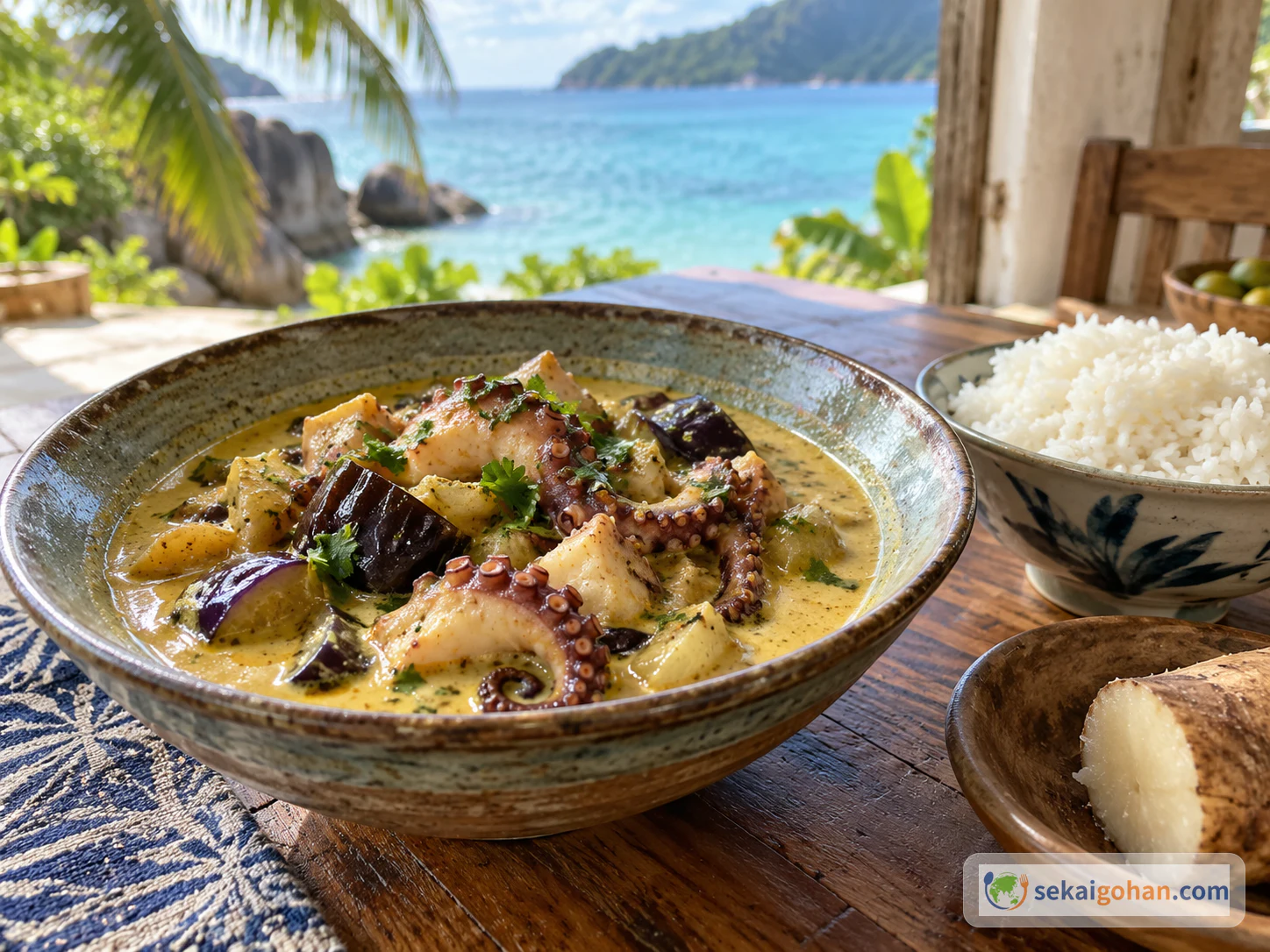
Warm coconut milk in a pot, and before anything sweet you catch the green, fatty scent of a freshly opened can. In go cinnamon, vanilla, and nutmeg, then the plantain and root vegetables. As it bubbles gently, the white liquid slowly turns beige, and a wooden spoon drawn across the bottom leaves a trace that lasts only a moment. That change is the best part of ladob, a coconut simmer from the Seychelles. The sweet version is a warm dessert: soft roots and plantain in spiced, lightly salted coconut milk.
About Seychellois Ladob
The Seychelles lie in the Indian Ocean, east of the African continent. The islands' food layers influences from Africa, France, India, and Southeast Asia, and fish, rice, coconut, spices, and root vegetables turn up again and again. Ladob is less a showy feast than an everyday way of tying together whatever is in the island kitchen with coconut. You'll see it written Ladob or Ladob bannann; bannann points to banana and plantain-type ingredients.
Sweet and Savory Ladob
Sweet ladob simmers plantain, cassava, sweet potato, breadfruit, and similar ingredients in coconut milk with sugar, cinnamon, vanilla, and nutmeg. It's eaten at the end of a meal or as a snack, warm or slightly cooled. The savory version uses salted fish with breadfruit, cassava, and the like, and leans toward a staple, a sign of how the islands lean on starches and preserved foods. Fish and coconut are a natural pairing on the Seychellois table.
The savory version asks a lot at once: soaking the salted fish, managing its smell, and finding a stand-in for breadfruit. Start with the sweet one and learn the feel of coconut milk that never boils and roots that simmer without breaking. For fish and coconut from another direction, Jamaica's rundown is an easy entry.
Ladob and Other Coconut Simmers
Think of ladob as a cousin of other island coconut dishes. Jamaica's rundown is fish and coconut, Sri Lanka's bibikkan is a coconut and spice sweet, and Madagascar's koba is a sweet snack of rice flour and leaves. Ladob sits between them, with staple roots and dessert sweetness in one pot.
Ingredients (serves 4)
This amount serves 4 as a sweet dish after a meal, or 2–3 if eaten generously as breakfast or a snack. Ladob is not a soup with a lot of liquid left. Aim for a finish in which the coconut sauce coats the roots and a little sauce pools at the bottom of the bowl.

Don't prepare raw cassava at home. Use only frozen or pre-cooked cassava sold for eating, and remove any hard core in the center before simmering.
Ingredients That Cause Hesitation When Shopping
Sweet potato, sugar, and salt are easy to find at any grocery store. What defines ladob is unsweetened coconut milk, plantain, frozen cassava, and cinnamon sticks. Look for plantain at import grocers and large supermarkets. When you can't find it, use firm bananas and extra sweet potato.
Check canned coconut milk, cinnamon sticks, and allspice first. Allspice can stand in on days you run out of nutmeg. If the coconut milk is thin, the dish drifts toward roots simply boiled sweet. For frozen cassava, look in the freezer case of a store or at an import grocer. Confirm the ingredient list says cassava itself, because it is easy to confuse with processed items such as croquettes.
Choosing Ingredients and Substitutes for Ladob
Plantain, sweet potato, and frozen cassava are the easiest to find. Breadfruit is hard to come by in many places, so don't go hunting for it. Sweet ladob rests on four things: the fat of the coconut milk, the green notes of plantain, the body of the roots, and the warm aroma of cinnamon and nutmeg. Rather than piling on sugar, add a little salt; it brings out the sweetness of the roots and fruit and keeps the dish tasting of the Seychelles.
Firm bananas can stand in for plantain, but they don't fully replace it. Plantain has starch before sweetness and holds its shape when simmered, while ordinary bananas have a stronger aroma and soften quickly, so the result leans further toward dessert.
| Closer-to-local ingredient | Substitute | Difference in the result |
|---|---|---|
| Plantain | Firm bananas, or 1 banana plus 3.5 oz (100 g) extra sweet potato | Sweet and soft. Breaks down easily |
| Breadfruit | Sweet potato, taro, frozen cassava | No chestnut-like breadfruit aroma |
| Cassava | Waxy potatoes, taro | Less chewy and fibrous |
| Coconut milk | ¾ cup (200 ml) coconut cream and ¾ cup (200 ml) water | Richer. Reduces faster |
The one thing to leave alone is the coconut milk. Made with dairy milk or cream, ladob loses its island character; the coconut fat is the glue that brings roots and fruit together on one plate.
Method: Do Not Boil, and Check the Thickness at the End
Avoid boiling the coconut milk hard, which separates the oil, and adding the plantain too early, which makes it collapse. Add the hard roots first and the plantain in the second half. A heavy pot about 8 inches (20 cm) in diameter is easiest to work with.
Common Ladob Mistakes and Fixes
With so few steps, heat mistakes show up straight in the taste. Boil it hard and the coconut fat separates, the corners of the roots melt away, and the aroma goes flat. Three habits prevent most problems: keep the coconut milk below a hard boil, cut the roots large, and add the plantain last so it doesn't fall apart.
| Condition | Cause | Fix |
|---|---|---|
| The sauce is oily and split | Boiled over high heat | Return to low heat, add 2 tbsp water, and stir gently |
| Roots collapsed and heavy | Cut too small, stirred too much | Cut into 1 inch (3 cm) cubes and turn fewer times after adding the plantain |
| Only the sweetness comes forward | Too much sugar, too little salt | Add 2 g salt and use 1.25 oz (35 g) sugar next time |
| Cassava is hard | Not thawed enough, core left in the center | Warm first in a microwave at 600 W for 2 minutes, remove the core, then simmer |
| Weak aroma | Simmered with only ground spices | Use the cinnamon stick and add a little nutmeg at the end |
Serving, Storing, and Reheating Ladob
How to Eat It
Ladob is better once it has cooled a little and you can notice the aroma, rather than eaten piping hot in a hurry. The sauce tightens slightly as it cools, so set out small spoons and eat it with the sauce coating the roots. Sweet tea, unsweetened iced tea, or strong coffee goes well alongside. With plantain, sweet potato, and cassava in the pot, it's more filling than it looks; after a meal, a small bowl is plenty, and a light drink keeps the coconut richness from lingering.
| Per serving (approx.) | Amount |
|---|---|
| Energy | About 430 kcal |
| Protein | About 4 g |
| Fat | About 18 g |
| Carbohydrate | About 2.5 oz (70 g) |
| Fiber | About 7 g |
| Salt equivalent | About 0.5 g |
If you'd like to keep exploring, try bibikkan for sweet coconut, koba for a leaf-wrapped rice-flour sweet, or fufu for a root-vegetable staple. Mozambique's matapa pairs coconut with greens and peanuts and shares the aroma of the Indian Ocean, while Cape Verde's cachupa, from the Atlantic, layers beans and roots.
Storage
Because ladob is made with coconut milk, don't leave it out for long. Let leftovers cool a little, move them to a shallow container, and refrigerate promptly.

| Storage method | Duration | When eating |
|---|---|---|
| Room temperature | Within 2 hours | Shorter in summer. Do not leave it on the table |
| Refrigerator | 2 days | Move to a pot, add 1–2 tbsp water, and warm over low heat |
| Freezer | 2 weeks | Texture declines. Freeze in single portions, thaw naturally, and warm over low heat |
| Microwave | 1 minute 30 seconds at 600 W | Stir once partway. Overheating makes oil float |
Reheating
Warm it through rather than cooking it again. Chilled, the sauce is firm, so add a little water and bring it back slowly from the bottom of the pot over low heat. High heat makes the coconut fat float and the corners of the roots collapse.
FAQ
Can I make it without plantain?
Yes. Use 2 firm bananas and increase the sweet potato by 3.5 oz (100 g). Ordinary bananas are soft and strongly scented, so the dish leans more toward dessert. Add them in the second half of step 4 and shorten the simmer to about 6 minutes.
Is cassava required?
No, sweet potato alone works. Cassava adds a chewy, weighty root that holds up the liquid, much as yuca gives body to the soup in Ecuador's encebollado.
The coconut milk separated
It was boiled too hard. Turn off the heat, add 2 tbsp water, and stir gently with a wooden spoon. Even if it doesn't fully come back, the flavor isn't badly damaged. Next time, keep to low heat from step 2, with just small bubbles at the edge of the pot.
Can I make it sweeter?
You can, but make it with 1.5 oz (45 g) the first time. Plantain and sweet potato are already sweet, and extra sugar hides their taste. For more sweetness, drizzle just 1 tsp of dark sugar syrup at the table; it's easier to adjust.
Can I eat it chilled?
You can, though straight from the refrigerator the coconut fat is set and the roots are firm. Leave it at room temperature for 10–15 minutes, or warm it in a 600 W microwave for just 30 seconds, and the aroma comes back.
Ladob is a dish that is still often introduced only briefly in Japanese. Yet if you follow its ingredients, plantain, cassava, breadfruit, and coconut milk, you see that the Seychelles is not only a "seaside resort" but a country with a kitchen of island roots and preserved foods. Start by making the sweet version in a small pot, and learn the temperature at which coconut wraps the roots.