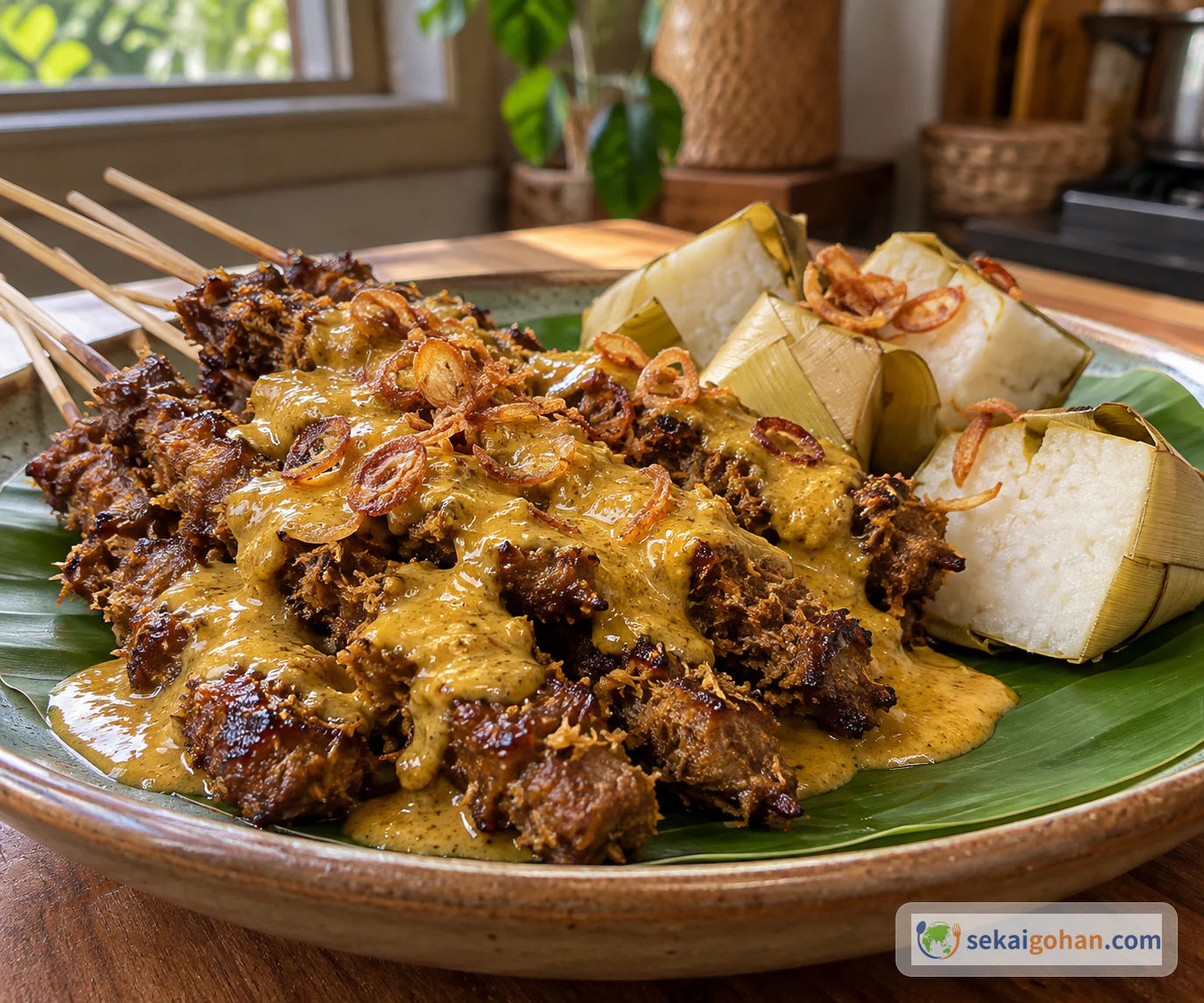
If you picture satay as neat skewers like yakitori, your first plate of sate padang comes as a small surprise. A thick yellow sauce covers it, so much of it that you can't make out the outline of the meat. This is the beef satay of West Sumatra, and unlike the sweet peanut sauce of sate ayam, its sauce leads with turmeric, coriander, cumin, galangal and lemongrass. It is less sweet than you'd expect from a grilled skewer and carries the aroma of a hot soup.
In Indonesian it is sate Padang, and in English it is also written Padang satay. Padang is a city in West Sumatra province, and as a dish name it covers styles from the surrounding region.
Sate padang in West Sumatra
Sate padang is loved across the Minangkabau cultural area of West Sumatra, Indonesia. Beef, beef tongue and offal are simmered until tender in an aromatic broth, threaded on skewers and grilled until fragrant, then dressed with that same cooking liquid thickened with rice flour. Simmering first and grilling after is what sets it apart from other satay. The grill at the end isn't there to cook the meat through, only to add toastiness to its surface.

Indonesian satay varies too much from region to region to sum up under one name: the sweet peanut sauces of Java and Madura, Bali's sate lilit with fish or chicken wrapped around a stick, and sate kambing, goat meat eaten with sweet soy sauce. Among them, sate padang stands out for returning the soup the beef was simmered in to the sauce.
Even within West Sumatra, color and heat shift between Padang, Pariaman and Padang Panjang. Padang leans yellow, Pariaman is strongly red and hotter, and Padang Panjang goes toward a slightly brown, rich style. This recipe follows the yellow Padang style, with the heat toned down a little so you can adjust it with sambal at the table.
| Direction | Impression of the sauce | Heat | If making it at home |
|---|---|---|---|
| Padang | Turmeric yellow, rice-flour thickness | Medium | Good for the first time. The outlines of meat and sauce are easy to follow |
| Pariaman | Red chili color comes forward | Hot | Bring it closer with table sambal afterward |
| Padang Panjang | Brown with a rich spice feel | Medium to hot | Reducing the cooking liquid a little more brings it closer |
Ingredients (serves 4): think of the beef and the yellow sauce separately

This makes about 16 short skewers for 4 people. As a main it serves 4; alongside nasi uduk or vegetable dishes it is a quantity 5–6 people can pick at. Beef feels tough if it has too little fat, so besides shank, include shoulder and chuck rib as candidates.
| Ingredient | Amount | Substitutes & notes |
|---|---|---|
| Beef shank, shoulder or chuck rib in chunks | 1.25 lb (600 g) | Tongue, heart and tripe are for experienced cooks. Thin-sliced meat is unsuitable |
| Water | 1.25 quarts (1.2 L) | Add hot water if it reduces too much |
| Salt | 1 1/2 tsp | Seasons the broth and the meat |
| Raw cane sugar | 1 tsp | Rounds off the edges. Do not make it sweet |
| Neutral vegetable oil | 2 tbsp | To fry the aromatic paste |
| Lemongrass | 2 stalks | Bruise the bottom 4 inches (10 cm). 2 tsp if dried |
| Makrut lime leaves | 3 leaves | Frozen is fine. Leave out if none |
| Bay leaf | 1 leaf | Substitute for daun salam |
| Tamarind paste | 1 tsp | If none, 2 tsp lemon juice at the end |
| Bamboo skewers | 16–20 | About 6 inches (15 cm). Soak in water for 30 minutes |
Aromatic paste
| Ingredient | Amount | Substitutes & notes |
|---|---|---|
| Red onion or onion | 4 oz (120 g) | Substitute for the local shallots |
| Garlic | 4 cloves | About 20 g |
| Ginger | 20 g | Peel thinly |
| Galangal | 20 g | If none, add 10 g more ginger. The aroma changes |
| Red chili | 1–2 | Remove the seeds for less heat |
| Turmeric | 1 1/2 tsp | 20 g if fresh. The core of color and earthy aroma |
| Ground coriander | 1 tbsp | The base of the aroma. Do not omit |
| Cumin seeds | 1 tsp | Lightly crush. 3/4 tsp if ground |
| White pepper | 1/2 tsp | Black pepper also works |
Yellow sauce and plating
| Ingredient | Amount | Substitutes & notes |
|---|---|---|
| Cooking liquid | 3 cups (700 ml) | Add hot water if short |
| Rice flour | 1.5 oz (40 g) | Non-glutinous rice flour is fine. Avoid potato starch alone |
| Water | ½ cup (100 ml) | To dissolve the rice flour |
| Salt | 1/4 tsp or more | Adjust at the end |
| Raw cane sugar | 1/2 tsp | Do not overdo it |
| Firmly cooked rice | 1.25 lb (600 g) | In place of lontong. Cool and cut |
| Cucumber | 1 | Thin diagonal slices |
| Fried onions | 3 tbsp | Substitute for bawang goreng |
| Lime or lemon | 1 | Cut into wedges |
| Sambal | as needed | Add heat at the table |
An easy way to prepare lontong-style rice
Put 1.25 lb (600 g) warm, firmly cooked rice on plastic wrap and press it into a rectangle about 1 inches (2 cm) thick. Once it has cooled enough, chill it in the refrigerator for about 30 minutes, then cut it into 1 inches (2.5 cm) squares. It is not real lontong or ketupat, but it does the job of catching the yellow sauce. Short on time? Serve plain rice on the side instead.
Ingredients that are hard to choose: invest in aroma, not in meat
Beef, onion and rice flour are easy to find at an ordinary supermarket. Seek out the spices that decide the aroma of sate padang. Turmeric, coriander and cumin in particular form the skeleton of the yellow sauce. They also go into rendang and soto ayam, so the jar will not sit unused.
Curry powder gives the yellow color, but it drifts toward a curry flavor. For sate padang, use turmeric on its own to build the earthiness of the rice-flour sauce and the street-food character.
Cumin can be used ground, but lightly crushed whole seeds leave a toasty note deep in the cooking liquid. Unlike Indian cooking, where the seeds are popped in oil, here they are dissolved into the liquid as part of the aromatic paste.
Ground coriander builds depth rather than heat. In the beef broth, it rounds off the sharpness of ginger and galangal, and keeps the rice-flour sauce from being monotonous.
Choosing ingredients for sate padang
The ingredient list can make sate padang look difficult, but sorting things by role makes the decisions easier. Hold firm on three things: simmering the beef, the yellow spices and the rice-flour thickening. The cut, the heat and how you make the lontong are yours to change.
The cut of beef is where most people hesitate. Beef tongue and offal are common in Indonesia, but at home the prep work and the smell are hard to manage. For a first batch, chunks of beef shank, shoulder or chuck rib, simmered until firm enough to skewer, get you quite close to the real plate, and because the meat simmers first, even a fairly tough cut turns tender if you give it time.
Rice flour is what gives the sauce its character. Potato starch alone turns it clear like a Chinese-style glaze, and all-purpose flour makes it heavy, while rice flour turns soft and cloudy and holds the yellow of the spices. Rather than improvising with 2 tsp potato starch and 2 tsp all-purpose flour dissolved in water, it's steadier to buy non-glutinous rice flour. Whatever is left goes into fried-food batter and rice flour pancakes.
Ginger alone doesn't fully replace galangal, which has more citrus and woody aroma and lightens the aftertaste of the cooking liquid. Outside Indonesia, though, adding a little more lemongrass and makrut lime leaf for a first batch is easier than hunting down galangal.
| Where you hesitate | Local-style | Practical answer at home | Verdict |
|---|---|---|---|
| Meat | Beef tongue, offal, beef | Beef shank, shoulder, chuck rib | A chunk of meat is easiest for a first batch |
| Aroma | Shallot, galangal, turmeric leaf | Onion, extra ginger, bay leaf | Make the cooking liquid more aromatic rather than reproduce it fully |
| Color | Fresh turmeric | Ground turmeric | Too much turns bitter, so add by the teaspoon |
| Thickening | Rice flour | Non-glutinous rice flour is fine | Potato starch alone gives a different texture |
| Heat | Simmer plenty of red chili | Less chili, sambal on the side | Easy for a family to split by heat level |
| Rice | Lontong, ketupat | Press firmly cooked rice | Plain rice is fine the first time |
| Grilling | Charcoal | Grill pan, broiler | Return the aroma in a short time |
Method: simmer, skewer, grill, and return the cooking liquid to the sauce
With sate padang, nearly all the flavor is settled before grilling. If the aromatic broth is made thin, the final sauce is also vague. Conversely, boiling the meat hard makes it tough. Open the aroma over medium heat, soften the meat over low heat, and grill only at the end to add toastiness. Proceed in that order.
The meat in sate padang is not grilled to cook it through but to return toastiness to meat that was already simmered. If you scorch it over high heat, the meat turns tough, so make only the browning in a short time.
Sate padang troubleshooting: tough meat, lumpy sauce, weak flavor

| Failure | Main cause | How to fix |
|---|---|---|
| Meat is tough | Boiled hard, not simmered long enough | Add 20 more minutes over low heat. Add hot water to keep the liquid |
| Meat falls apart | Over-simmered, cut while hot | Cut after cooling. Put crumbled meat into the sauce |
| Sauce is lumpy | Rice flour water added all at once | Strain into another pot and mix again over low heat |
| Sauce is thin | Thin cooking liquid, too little rice flour | Reduce over low heat. Add 2 tsp rice flour dissolved in water |
| Tastes like curry | Used a lot of curry powder | Build with turmeric, coriander and cumin |
| Aroma is heavy | No acidity, too much oil | Squeeze lime at the end and serve cucumber |
Lumps form the moment rice flour hits boiling cooking liquid, so always dissolve it well in cold water first and pour it in a thin stream. If a few lumps remain anyway, resist turning up the heat; keep it low and work them out with a whisk. With many large lumps, straining through a sieve and returning the sauce to the pot is faster.
When the flavor is weak, salt alone won't fix it. Reduce the cooking liquid a little first to deepen the aroma. If it still falls flat, add a small amount of coriander and cumin rather than more turmeric, which deepens the color but tends to bring earthiness and bitterness.
Serving and storing sate padang
At the table
Sate padang is meant to be eaten with rice. Lontong-style rice or firm white rice soaking up the yellow sauce is far more satisfying than picking at the skewers alone. Put the rice and skewers in the center, pour plenty of sauce over them, and set cucumber, lime, sambal and a light vegetable alongside. That way everyone adjusts heat with sambal, acidity with lime and lightness with cucumber, and a little palate cleanser at the edge of the plate keeps the rich sauce from getting heavy.
With plain rice, a flat plate suits it better than a bowl. The rice spreads thin, the sauce coats its surface, and you can scoop the meat off the skewers with it. For children or anyone who dislikes heat, pour a little less sauce and keep more in a separate small bowl, which also means fewer leftovers. For adults, a squeeze of lime just before eating and a scattering of fried onions bring back the aroma of a street-stall plate.
Building an Indonesian menu
Although both use beef, the rich rendang is easier to enjoy on a different day. To compare skewers, try the sweet peanut sauce of sate ayam. As a rice dish, the gently coconut-scented nasi uduk fits well, gado-gado makes a good vegetable dish beside the rice, and a sambal substitute handles the heat.
Storage and reheating

Store the skewers, sauce, rice and vegetables separately. Cool the grilled skewers and refrigerate them until the next day; the sauce keeps in a clean container in the refrigerator for about 2 days. Rice-flour sauce firms up when cold, so reheat it in a pot with 2–3 tbsp hot water, stirring over low heat. The microwave only sets the edges.
For freezing, only the simmered meat before grilling works well. Freeze it unskewered in portions and use within 2 weeks, then thaw in the refrigerator, thread onto skewers the same day and grill. Rice-flour sauce tends to separate when frozen, so freeze only the cooking liquid and thicken it with rice flour on the day you eat.
Frequently asked questions
Can I make it with thin-sliced beef?
I don't recommend it. The meat in sate padang is simmered before it goes on the skewer, and thin slices fall apart and lack the chew of skewered meat. If you must use them, season them in an aromatic marinade without simmering and grill briefly, as a different dish.
How do I change it if I use beef tongue or offal?
Beef tongue is easier to handle if you parboil and peel it first. Offal needs careful prep for the smell, so it is best skipped at home; beef shank or shoulder is enough if you put ease of eating ahead of local character.
If I have no rice flour, can I substitute potato starch?
A small amount will thicken the sauce, but it turns clear and jiggly instead of cloudy and yellow. If you use it, keep it to about half the amount of rice flour and don't firm it up as much as a glaze.
Can I make a non-spicy sate padang?
Yes. Use 1 red chili and remove the seeds, then let each person add sambal from a separate dish. Leaving the chili out entirely makes the aroma too round, though, so even for people who dislike heat, a little tightens the flavor.
Is it not authentic without charcoal?
Charcoal aroma is a charm, but at home it isn't essential. The sauce carries most of the weight in sate padang, so browning the surface in a grill pan or under the broiler is enough. Using charcoal indoors is dangerous, so don't try it at home.
If I make it ahead, how far can I go the day before?
You can simmer the beef the day before. Refrigerate the cooked meat and liquid separately, then on the day cut the meat, thread and grill it, and thicken the liquid with rice flour. The finished sauce firms up in the refrigerator, so it's cleaner to make it on the day you eat.